

Sustainability Reporting Best Practices Singapore Companies Need For ESG Growth
Sustainability reporting best practices Singapore companies follow are becoming more important as ESG expectations move from general corporate responsibility into structured business accountability. A strong sustainability report is no longer just a collection of positive initiatives, community activities, or environmental messages. It is a strategic document that explains how a company identifies ESG priorities, manages risks, measures performance, and communicates progress to stakeholders with transparency.
In Singapore, sustainability reporting has a clear governance and market relevance. SGX states that sustainability reports should include primary components such as material ESG factors, climate-related disclosures, policies, practices and performance, targets, reporting framework, and a board statement with governance structure. This creates a practical foundation for esg reporting best practices sg, because companies need to organise disclosures around topics that are material, measurable, and connected to leadership oversight.
Effective sustainability reporting guidelines Singapore should help companies avoid vague claims and weak narratives. Instead of saying the business “cares about sustainability,” a report should explain what the company is doing, why it matters, how progress is measured, and what improvement plans are in place. This makes the report useful for investors, customers, employees, regulators, partners, and suppliers.
A strong corporate sustainability strategy sg also ensures that ESG reporting is not separated from business direction. Sustainability topics should connect to operational efficiency, climate resilience, workforce development, governance quality, responsible procurement, and long-term value creation. When reporting is aligned with strategy, companies can show that ESG is part of decision-making, not a decorative communication exercise.
Professional esg reporting standards Singapore support also helps companies prepare for evolving disclosure expectations. Alivea can support businesses that need ESG reports with clear content structure, credible storytelling, visual clarity, and compliance-aware communication. With the right approach, sustainability reporting becomes more than an annual document. It becomes a tool for trust, improvement, and responsible growth.
Sustainability Reporting Best Practices Singapore For Better ESG Transparency
Sustainability reporting best practices Singapore companies should follow begin with materiality. A sustainability report becomes valuable when it focuses on the ESG issues that truly matter to the company and its stakeholders. These may include emissions, energy consumption, waste, water, employee wellbeing, workplace safety, supplier responsibility, anti-corruption, cybersecurity, diversity, governance oversight, and community impact. The most effective reports do not try to mention every possible ESG topic. They prioritise what is relevant.
Strong esg reporting best practices sg also require clear reporting boundaries. Stakeholders need to know which entities, operations, markets, facilities, or business units are included in the report. If certain information is excluded, the company should explain why. This improves transparency and reduces confusion when readers compare data across reporting periods.
Another important practice is data consistency. Companies should define each ESG metric carefully and use the same methodology where possible from year to year. If a calculation method changes, the report should explain the reason. If data coverage improves, the report should describe what changed. These details make sustainability reporting guidelines Singapore more credible because they show that the company understands how its data is produced.
A professional corporate sustainability strategy sg should also link ESG performance to targets. For example, a company may aim to reduce energy intensity, increase employee training hours, improve supplier screening, strengthen board diversity, or reduce operational emissions. Targets make sustainability reporting more useful because they help stakeholders evaluate progress over time.
Companies also need clear governance. A report should explain how the board, management, and internal teams oversee ESG matters. This may include sustainability committees, department-level data owners, risk management processes, internal controls, and leadership accountability. When these elements are presented clearly, the report becomes more than a communication asset. It becomes evidence of responsible management.
High-quality esg reporting standards Singapore are therefore built on relevance, consistency, transparency, and accountability.

ESG Reporting Best Practices SG For Stronger Governance And Accountability
ESG reporting best practices sg should help companies communicate governance clearly because sustainability is now closely linked to risk, finance, compliance, and reputation. Stakeholders want to know whether ESG matters are being managed at leadership level or handled only as communication tasks. A credible report should explain who is responsible, how decisions are made, how risks are reviewed, and how progress is monitored.
A company following sustainability reporting best practices Singapore should include a clear governance structure. This may describe the board’s oversight role, management responsibilities, ESG working groups, internal reporting lines, and processes for reviewing material sustainability topics. SGX includes a board statement and associated governance structure as one of the primary components of sustainability reporting, reinforcing the importance of leadership accountability.
Governance also affects data quality. ESG information often comes from multiple departments such as finance, human resources, operations, procurement, legal, facilities, and communications. Without governance, data may be incomplete, inconsistent, or difficult to verify. A strong reporting process assigns owners to each metric, sets deadlines, records source evidence, and includes internal review before publication.
Practical sustainability reporting guidelines Singapore should also encourage companies to explain risks and opportunities. Environmental risks may include energy cost exposure, carbon transition pressure, supply chain disruption, and physical climate impacts. Social risks may include workforce safety, talent retention, customer trust, and labour practices. Governance risks may include regulatory breaches, corruption, cybersecurity failures, or weak internal controls.
A strong corporate sustainability strategy sg connects these risks to business priorities. For example, a logistics company may focus on fleet efficiency and safety, while a real estate company may prioritise building energy performance and climate adaptation. A technology company may emphasise data security, responsible innovation, and human capital development.
When companies follow credible esg reporting standards Singapore, they show that sustainability is part of how the business is governed. This strengthens accountability and helps readers understand how ESG performance is managed in practice.

Sustainability Reporting Guidelines Singapore For Clearer Report Structure
Sustainability reporting guidelines Singapore should help companies create reports that are structured, readable, and useful for decision-making. A report may contain strong ESG initiatives, but if the structure is confusing, stakeholders may struggle to understand the company’s priorities. Good structure creates a logical journey from context to strategy, from materiality to performance, and from governance to future commitments.
A practical report structure usually begins with a leadership message, reporting scope, company overview, sustainability strategy, materiality assessment, stakeholder engagement summary, ESG governance explanation, performance sections, targets, framework references, and data tables. This order helps readers understand both the story and the evidence behind the company’s ESG direction.
Companies applying sustainability reporting best practices Singapore should also use clear section headings and concise summaries. Long reports can become difficult to navigate, especially when they include technical climate information, multiple policies, and detailed performance metrics. Executive summaries, key highlights, charts, icons, timelines, and performance dashboards can help readers absorb information faster.
For esg reporting best practices sg, visual presentation should support accuracy. Charts should use clear labels, consistent units, and appropriate comparisons. Tables should be readable and not overloaded with unnecessary detail. Infographics should simplify complex processes without distorting meaning. Good design improves understanding, but it should not exaggerate achievements or hide limitations.
A strong corporate sustainability strategy sg should also appear throughout the report, not only in the introduction. Each ESG topic should connect to why it matters, what the company is doing, how performance is measured, and what the next priorities are. This prevents the report from feeling like a disconnected list of activities.
Recognised esg reporting standards Singapore can help improve structure because they provide a disciplined way to organise disclosures. IFRS S1 requires entities to disclose sustainability-related risks and opportunities that are useful to users of general purpose financial reports, with the standard effective for annual reporting periods beginning on or after 1 January 2024. This global direction reinforces the value of structured, decision-useful reporting.
Corporate Sustainability Strategy SG For Measurable ESG Business Impact
Corporate sustainability strategy sg is the foundation behind a strong ESG report. Without strategy, sustainability reporting can become reactive, fragmented, and overly promotional. A company may have many initiatives, but stakeholders need to understand how those initiatives support business priorities, risk management, and long-term value creation. Strategy turns ESG activities into a coherent direction.
A company following sustainability reporting best practices Singapore should begin by defining its sustainability pillars. These pillars may focus on climate action, responsible operations, people and culture, ethical governance, innovation, customer responsibility, or community impact. The pillars should reflect the company’s sector, business model, stakeholder expectations, and material ESG topics.
Strong esg reporting best practices sg also require measurable objectives. A strategy is stronger when it includes targets, milestones, baselines, and performance indicators. For example, a company may set targets for reducing electricity usage, improving workplace safety, expanding employee training, increasing supplier assessment coverage, or strengthening compliance training. These targets allow the company to report progress with evidence.
Useful sustainability reporting guidelines Singapore should encourage companies to explain how ESG strategy is embedded into operations. This may include procurement policies, employee programmes, risk assessments, climate planning, product innovation, governance reviews, or supplier engagement. ESG should not appear as a side activity managed only for reporting purposes.
A credible corporate sustainability strategy sg also includes challenges. Companies should explain where progress is difficult, what constraints exist, and how they plan to improve. Stakeholders often trust balanced reporting more than perfect-sounding claims. Honest communication demonstrates maturity.
Professional esg reporting standards Singapore alignment helps strategy become clearer. When ESG information is organised around governance, strategy, risk management, metrics, and targets, readers can evaluate whether the company is managing sustainability seriously. Alivea can support companies by helping translate strategy into clear report content, stakeholder-friendly messaging, and premium ESG communication design.

ESG Reporting Standards Singapore For Global Framework Alignment
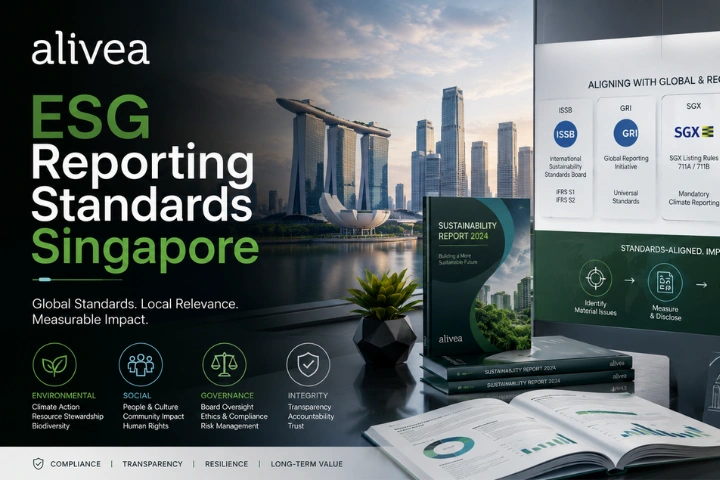
ESG reporting standards Singapore help companies create sustainability reports that are more comparable, structured, and credible. As stakeholder expectations rise, companies need reporting approaches that go beyond internal storytelling. Standards and frameworks help businesses decide what to disclose, how to organise ESG information, and how to explain performance in a way that stakeholders can understand.
Companies applying sustainability reporting best practices Singapore should choose frameworks based on relevance, not popularity alone. A business should consider its industry, stakeholder needs, market exposure, investor expectations, and regulatory environment. The right framework supports clarity. The wrong framework can make the report complicated without improving usefulness.
Strong esg reporting best practices sg also require companies to explain their framework choices. If a company uses a recognised sustainability framework, it should describe why that framework fits its business and how disclosures have been applied. This helps readers understand the basis of the report and reduces uncertainty.
Singapore’s sustainability reporting roadmap has moved toward climate-related disclosure with phased implementation. ACRA notes that all SGX-listed companies need to report, with requirements depending on company tier, while the roadmap follows a climate-first approach starting from FY2025. ACRA has also stated that all listed companies will continue to report Scope 1 and Scope 2 greenhouse gas emissions from financial years commencing on or after 1 January 2025.
Practical sustainability reporting guidelines Singapore should therefore help companies prepare climate data early. Emissions reporting may require information from utilities, fuel consumption, leased assets, fleet operations, purchased services, and suppliers. Strong internal data processes make future reporting more reliable.
A mature corporate sustainability strategy sg uses standards as a tool, not as a box-ticking exercise. The purpose is to communicate material sustainability information clearly and responsibly. When companies align with suitable esg reporting standards Singapore, they improve transparency, strengthen stakeholder confidence, and prepare for future reporting expectations. Read more insights best sustainability report agency singapore for esg design needs.

What Are Sustainability Reporting Best Practices Singapore Firms Need?
Sustainability reporting best practices Singapore firms need include materiality assessment, clear ESG governance, reliable data collection, framework alignment, transparent performance disclosure, and measurable targets. These practices help companies create reports that are useful rather than generic.
For esg reporting best practices sg, the first priority is relevance. Companies should focus on ESG topics that affect their business and stakeholders. The second priority is evidence. Reports should include data, policies, actions, and progress explanations, not only broad statements.
Strong sustainability reporting guidelines Singapore also recommend explaining reporting boundaries, methodologies, assumptions, and limitations. This makes the report more credible. A practical corporate sustainability strategy sg then connects ESG priorities to business objectives, operational improvement, and risk management.
When companies follow recognised esg reporting standards Singapore, stakeholders can better understand how the report is structured and how performance should be evaluated. This strengthens transparency and improves confidence in the company’s ESG communication.
Who Uses ESG Reporting Best Practices SG For Stronger Business Disclosure?
ESG reporting best practices sg are used by listed companies, private enterprises, multinational subsidiaries, SMEs, family-owned businesses, government-linked companies, and organisations preparing for investor or customer sustainability requests. Any company that needs to communicate ESG performance can benefit from structured reporting.
Businesses use sustainability reporting best practices Singapore to improve transparency, reduce reporting confusion, and strengthen stakeholder trust. Listed companies may focus on compliance and investor communication, while non-listed companies may use ESG reporting to support procurement, financing, tenders, brand reputation, or supply chain requirements.
Professional sustainability reporting guidelines Singapore are especially valuable for companies with multiple departments, complex data sources, or limited internal ESG experience. A strong corporate sustainability strategy sg helps teams understand what to report and why it matters.
Companies aligning with esg reporting standards Singapore can produce disclosures that are more consistent, comparable, and credible. This is important in markets where sustainability expectations continue to mature.
Where Sustainability Reporting Guidelines Singapore Improve ESG Visibility
Sustainability reporting guidelines Singapore improve ESG visibility across annual reports, standalone sustainability reports, investor relations pages, corporate websites, ESG microsites, tender documents, and stakeholder presentations. A report should be easy to find, navigate, and understand.
Companies following sustainability reporting best practices Singapore should publish ESG information in formats that serve different stakeholders. Investors may review full data tables and governance details. Customers may prefer concise sustainability highlights. Employees may engage more with visual summaries and internal communication materials.
For esg reporting best practices sg, accessibility is part of transparency. Reports should use clear headings, searchable PDFs, linked contents, readable typography, and consistent design. A strong corporate sustainability strategy sg should also be reflected across digital and corporate channels, not hidden inside one document.
When businesses apply esg reporting standards Singapore effectively, ESG information becomes easier to compare, share, and reuse across stakeholder communication.
When Corporate Sustainability Strategy SG Should Guide Annual Reporting
Corporate sustainability strategy sg should guide annual reporting from the start of the reporting cycle, not only during final writing. Early planning helps companies define material topics, confirm data owners, choose frameworks, set timelines, and identify content gaps before deadlines become urgent.
Companies applying sustainability reporting best practices Singapore should begin collecting ESG data throughout the year. This is especially important for emissions, energy, waste, safety, employee training, supplier screening, and governance metrics. Late data collection can create errors or incomplete disclosures.
Strong esg reporting best practices sg also include early leadership review. Management should understand key ESG messages, risks, and targets before the report is designed. Practical sustainability reporting guidelines Singapore help teams create a repeatable workflow for future reports.
When companies align with esg reporting standards Singapore early, they reduce pressure, improve accuracy, and produce reports that better reflect real performance.
Why ESG Reporting Standards Singapore Build Investor And Market Trust
ESG reporting standards Singapore build trust because they help companies disclose sustainability information in a structured and comparable way. Investors, lenders, customers, and business partners need reliable information to evaluate risk, performance, and long-term resilience.
Companies that follow sustainability reporting best practices Singapore can reduce uncertainty by explaining material topics, governance processes, policies, performance, and targets. Strong esg reporting best practices sg also help prevent vague or unsupported ESG claims.
Practical sustainability reporting guidelines Singapore encourage transparency. When companies disclose methodologies, boundaries, limitations, and year-on-year performance, stakeholders can better understand the quality of the report. A strong corporate sustainability strategy sg also shows that ESG is connected to business direction.
When businesses apply esg reporting standards Singapore thoughtfully, they communicate maturity. This strengthens market confidence because stakeholders can see that sustainability is being managed with discipline, not treated as short-term branding.
How ESG Reporting Best Practices SG Improve Report Quality Clearly
ESG reporting best practices sg improve report quality by making sustainability information more relevant, organised, measurable, and trustworthy. Companies can begin by reviewing previous reports and identifying weaknesses such as unclear materiality, limited data, missing targets, weak governance explanation, or inconsistent design.
Strong sustainability reporting best practices Singapore also require better collaboration between departments. Finance, HR, operations, procurement, legal, and communications teams should work together to collect and verify ESG information.
Useful sustainability reporting guidelines Singapore can improve clarity by using plain language, performance tables, charts, case studies, and concise summaries. A strong corporate sustainability strategy sg then connects ESG data to business goals.
Companies that align with esg reporting standards Singapore can create reports that are easier to review and compare. With expert support from Alivea, businesses can improve content structure, disclosure flow, visual communication, and stakeholder engagement.
Sustainability Reporting Best Practices Singapore Support Better ESG Leadership
Sustainability reporting best practices Singapore support better ESG leadership because they turn sustainability communication into a disciplined business process. A strong report does not simply describe good intentions. It explains material issues, governance responsibilities, policies, performance, targets, and improvement priorities. This gives stakeholders a clearer understanding of how the company manages environmental, social, and governance matters.
For businesses, esg reporting best practices sg also improve internal decision-making. When ESG data is collected consistently, leadership can identify operational inefficiencies, workforce risks, climate exposure, governance weaknesses, and opportunities for innovation. Sustainability reporting then becomes more than external disclosure. It becomes a tool for business learning and performance improvement.
Clear sustainability reporting guidelines Singapore help companies avoid common reporting problems. These include vague claims, disconnected initiatives, unclear data boundaries, inconsistent metrics, and weak explanations of progress. A professional report should be balanced, specific, and evidence-based. It should communicate achievements while also acknowledging challenges and future actions.
A practical corporate sustainability strategy sg ensures that ESG priorities are connected to long-term business growth. Companies that embed sustainability into planning, operations, procurement, workforce development, and governance are better prepared for stakeholder scrutiny and evolving market expectations.
Reliable esg reporting standards Singapore alignment also strengthens credibility. As climate-related disclosure, data quality, and stakeholder expectations continue to develop, companies that build strong reporting systems early will have an advantage. They can respond faster, communicate more clearly, and demonstrate stronger accountability.
Alivea can support organisations that want sustainability reports to be strategic, transparent, visually professional, and aligned with modern ESG communication needs. With the right structure and guidance, sustainability reporting becomes a powerful expression of responsible leadership. It helps Singapore companies strengthen trust, improve transparency, and build a more resilient future.
