

Sustainability Report Production Singapore From Data To Design Excellence
Sustainability report production Singapore is a complete process that turns ESG data, business strategy, stakeholder expectations, and corporate storytelling into a professional sustainability report. It is not only about writing a document or designing attractive pages. A high-quality report requires structured planning, reliable data collection, content development, visual communication, internal review, and final publication across the right corporate channels.
In Singapore, sustainability reporting is becoming more structured because companies face stronger expectations from regulators, investors, customers, employees, lenders, and supply chain partners. SGX states that sustainability reports should include primary components such as material ESG factors, climate-related disclosures, policies, practices and performance, targets, a sustainability reporting framework, and a board statement with governance structure. This makes the sustainability reporting process Singapore companies follow more important than ever, especially for organisations that want ESG communication to be clear, consistent, and credible.
A strong esg report production Singapore workflow begins with understanding the company’s reporting scope. Teams need to identify which entities, operations, departments, markets, and ESG topics will be covered. From there, they must collect data from finance, HR, operations, procurement, facilities, legal, risk, corporate communications, and leadership teams. Without a defined process, ESG information can become fragmented, inconsistent, or difficult to verify.
The next stage is content development. A sustainability report should explain material topics, governance responsibilities, environmental initiatives, social performance, ethical business practices, climate risks, and future targets in a way stakeholders can understand. The report must be informative without becoming overly technical, and professional without becoming promotional.
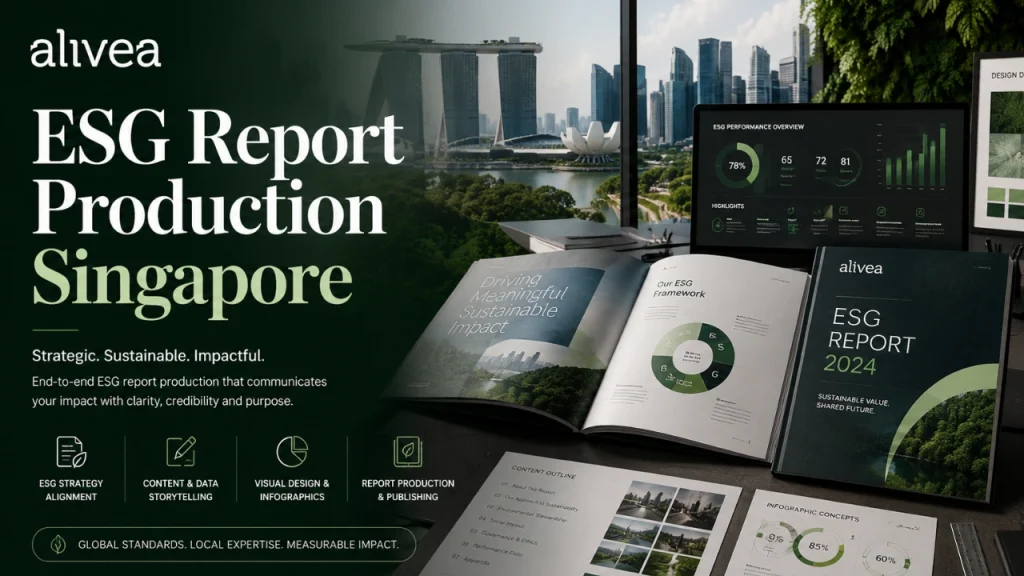
Design is also part of the sustainability report workflow sg companies need. Data tables, infographics, charts, icons, photography, typography, and layout structure help readers absorb complex ESG information. A professional report production Singapore partner such as Alivea can support companies from data organisation to content writing, report design, and final publication. When production is managed properly, the final sustainability report becomes a strategic communication asset that supports transparency, compliance readiness, and long-term business trust.

Sustainability Report Production Singapore For End To End ESG Delivery
Sustainability report production Singapore requires an end-to-end process because ESG reporting involves many moving parts. A report may look like one finished document, but behind it are multiple stages: planning, data gathering, materiality review, framework alignment, content writing, design, internal approval, proofreading, compliance checking, and publication. Each stage affects the quality of the final report.
The first step is project scoping. Companies need to define the reporting period, reporting entities, business units, stakeholder audiences, report format, and expected timeline. This creates clarity before departments begin collecting information. Without a defined scope, teams may collect too much irrelevant data while missing important ESG metrics.
The next step in sustainability reporting process Singapore is identifying material topics. These are the environmental, social, and governance issues that matter most to the company and its stakeholders. They may include greenhouse gas emissions, energy use, waste, water, workplace safety, employee training, diversity, supplier responsibility, cybersecurity, anti-corruption, board oversight, and community engagement. A professional report should focus on relevant topics rather than listing every possible sustainability issue.
During esg report production Singapore, data validation is essential. Numbers should be checked against source documents, calculation methods, and previous reporting periods. If energy use increased, the report should explain the reason. If employee training hours improved, the report should clarify the programme behind the result. This makes ESG data more meaningful.
Content writing should then turn data into a clear narrative. Stakeholders need to understand what the company has done, why it matters, how performance is measured, and what future improvements are planned. The report should not overstate achievements or hide challenges. Balanced communication builds credibility.
A complete sustainability report workflow sg also includes design planning. Designers need to understand the content structure early so they can create page templates, data visualisations, icons, and navigation elements that support readability. Strong report production Singapore ensures that strategy, data, writing, and design work together instead of being handled separately at the last minute.

Sustainability Reporting Process Singapore For Accurate Data And Content
The sustainability reporting process Singapore companies follow should be built around accuracy, consistency, and accountability. Sustainability reports often include information from many departments, and each department may use different systems, definitions, and measurement practices. Without a disciplined process, ESG reports can contain inconsistent figures, unclear boundaries, or unsupported statements.
A reliable sustainability report production Singapore project begins with a data request framework. This framework lists each metric, responsible department, source document, calculation method, reporting period, and approval owner. For example, energy data may come from utility bills, emissions data may come from fuel records and electricity consumption, social data may come from HR systems, and governance data may come from policies, training records, board documents, or compliance registers.
In esg report production Singapore, data quality should be reviewed before writing begins. If teams write content before confirming numbers, revisions can become difficult later. Data should be checked for completeness, accuracy, year-on-year consistency, and relevance to material topics. When gaps are found, the report can explain limitations honestly instead of presenting uncertain figures as final facts.
Content development is the next major stage. ESG writing should avoid vague claims such as “we are committed to sustainability” unless that commitment is supported by actions, policies, data, or targets. Strong writing explains context. It shows what the company is doing, how initiatives are implemented, which teams are involved, and what results have been achieved.
A professional sustainability report workflow sg should also include review rounds. Subject matter experts review technical accuracy, leadership reviews strategic alignment, communications teams review tone, and legal or compliance teams review risk-sensitive statements. This layered review helps ensure that the report is credible and internally approved.
Good report production Singapore also considers readability. Reports should use clear headings, concise paragraphs, summary boxes, performance charts, and visual signposting. When ESG content is accurate and easy to follow, stakeholders can evaluate the company’s performance with more confidence.
ESG Report Production Singapore For Clear Structure And Stakeholder Engagement
ESG report production Singapore should be designed around stakeholder engagement because a sustainability report is meant to be read, reviewed, and used. Different stakeholders approach ESG reports with different priorities. Investors may focus on climate risk, governance, targets, and financial resilience. Customers may care about responsible sourcing, product safety, and environmental practices. Employees may look for workplace culture, diversity, training, and wellbeing. Regulators and partners may check whether disclosures are structured and complete.
A strategic sustainability report production Singapore process builds the report around this reader journey. The opening section should clearly explain the company’s sustainability direction, reporting scope, leadership perspective, and key highlights. The middle sections should explain material topics, governance structure, environmental performance, social impact, and governance practices. The final sections may include data tables, framework references, methodology notes, and future commitments.
Singapore’s sustainability reporting roadmap follows a climate-first approach with phased implementation from FY2025, and ACRA states that requirements depend on company type and market capitalisation. This development makes the sustainability reporting process Singapore companies use more important because reporting teams need to plan climate-related data, governance explanations, and performance disclosures with care.
A strong report structure also helps avoid repetition. ESG reports can easily become repetitive if every section follows the same wording pattern. Professional content planning ensures that each section has a distinct purpose. Environmental sections can focus on resource efficiency, emissions, waste, or climate resilience. Social sections can cover people, safety, community, and stakeholder relationships. Governance sections can explain ethics, risk management, board oversight, and compliance culture.
A successful sustainability report workflow sg should also include visual storytelling. Charts, icons, timelines, process diagrams, and case study pages can make complex ESG information easier to understand. Design should not replace substance, but it can help stakeholders navigate the report more efficiently.
With professional report production Singapore, companies can create sustainability reports that are not only compliant in structure but also engaging, useful, and aligned with corporate communication goals.
Sustainability Report Workflow SG For Smooth Review And Publication
A strong sustainability report workflow sg helps companies move from raw information to final publication without unnecessary confusion. ESG reports often involve many contributors, including leadership, finance, HR, operations, procurement, facilities, legal, risk, sustainability teams, communications teams, designers, and external consultants. Without a clear workflow, the process can become slow, stressful, and inconsistent.
The first part of sustainability report production Singapore is timeline planning. Companies should define milestones for kickoff, data collection, materiality review, content drafting, management review, design development, proofreading, final approval, and publication. Each milestone should have a clear owner and deadline. This prevents last-minute delays and makes the reporting process easier to manage.
During the sustainability reporting process Singapore, version control is also important. ESG reports go through many revisions, and teams need to know which version is current. Content changes should be tracked, data updates should be documented, and approvals should be recorded. This is especially important when reports include sensitive performance information or forward-looking commitments.
A professional esg report production Singapore workflow also separates content approval from design approval. Content should be reviewed for accuracy before final layout begins, while design should be reviewed for readability, brand consistency, and accessibility. If content is constantly changing after design has started, production becomes inefficient and errors may appear.
The design stage should include page templates, hierarchy rules, chart styles, table formats, image direction, icon usage, and navigation elements. These assets help the report feel consistent from beginning to end. For digital publication, the workflow should also consider PDF optimisation, clickable contents, file size, website upload requirements, and downloadable formats.
Effective report production Singapore is not only about producing a polished report. It is about creating a repeatable system that can be improved every year. When the workflow is organised, companies can reduce reporting pressure, improve internal collaboration, and produce ESG reports with stronger quality control.

Report Production Singapore For Final Design, Proofing, And Launch
Report production Singapore reaches its final stage when ESG content, data, design, and approvals come together for publication. This stage is critical because small errors can weaken trust. A sustainability report may contain strong data and thoughtful writing, but inconsistent formatting, broken charts, unclear tables, spelling errors, or outdated figures can reduce professionalism.
The final design stage of sustainability report production Singapore should focus on clarity. Designers should ensure that typography is readable, charts are labelled properly, tables are not overcrowded, images are relevant, and section navigation is intuitive. ESG reports often contain technical content, so design must help readers understand information quickly. Visual appeal matters, but clarity matters more.
In the sustainability reporting process Singapore, proofreading should include both language review and data review. Language proofreading checks grammar, sentence flow, heading consistency, tone, and spelling. Data proofreading checks figures, percentages, units, years, chart labels, source notes, and consistency between narrative sections and performance tables. A number mentioned in one chapter should match the number in the summary table.
For esg report production Singapore, final checks should also include framework references and disclosure completeness. If the report claims alignment with a framework, the corresponding content should be present and easy to find. If material topics are listed early in the report, each topic should be addressed later with enough explanation. If targets are included, readers should understand the baseline, timeline, and intended outcome.
A complete sustainability report workflow sg also includes launch planning. Companies should decide whether the report will be published as a PDF, website page, annual report section, ESG microsite, investor relations update, or internal communication package. Report highlights can be reused for social media, board presentations, employee newsletters, sales decks, and stakeholder briefings.
Alivea can support report production Singapore by helping companies turn ESG information into professionally written, beautifully designed, and publication-ready sustainability reports that communicate transparency with confidence. Check the related page best sustainability report agency singapore for esg design needs.

What Sustainability Report Production Singapore Covers From Start To Finish
Sustainability report production Singapore covers the complete journey from ESG planning to final publication. It includes reporting scope, materiality review, data collection, framework alignment, content writing, design development, internal review, proofreading, approval, and digital release.
A strong sustainability reporting process Singapore begins by identifying what the report must communicate and who the intended readers are. This helps teams decide which ESG topics, metrics, initiatives, and targets should be included. During esg report production Singapore, raw data is transformed into a structured narrative supported by charts, tables, case studies, and visual explanations.
The sustainability report workflow sg also includes review checkpoints to ensure accuracy and consistency. Teams should check whether figures are correct, claims are supported, and disclosures are easy to understand. Professional report production Singapore ensures that the final report is not only visually polished but also useful, credible, and aligned with stakeholder expectations.
Who Manages Sustainability Reporting Process Singapore Within Companies
The sustainability reporting process Singapore is usually managed by a combination of sustainability teams, corporate communications, finance, HR, operations, procurement, risk, legal, and senior leadership. In smaller companies, one department may coordinate the project, while larger organisations may have a dedicated ESG committee or reporting taskforce.
During sustainability report production Singapore, each department contributes different information. Operations may provide energy and waste data. HR may provide employee training, diversity, and wellbeing information. Finance may support reporting controls and business context. Legal and risk teams may review sensitive governance disclosures.
Professional esg report production Singapore often involves external specialists such as writers, designers, ESG consultants, and report production agencies. These partners help organise the sustainability report workflow sg, improve content quality, and prepare the final report for publication. With the right structure, report production Singapore becomes a collaborative process rather than a rushed annual task.
Where ESG Report Production Singapore Should Publish Final Reports Clearly
ESG report production Singapore should publish final reports in places where stakeholders can easily find, download, and review them. Common channels include company websites, investor relations pages, sustainability pages, annual report sections, ESG microsites, SGX-related announcements for listed companies, and internal communication platforms.
A professional sustainability report production Singapore strategy should consider both full reports and shorter summaries. Investors may want detailed data tables and framework references, while employees or customers may prefer concise highlights. The sustainability reporting process Singapore should therefore prepare content that can be adapted for different audiences.
A clear sustainability report workflow sg also includes digital usability. Reports should be searchable, well formatted, properly compressed, and easy to navigate. When report production Singapore is handled well, the final report becomes a practical communication tool that supports transparency across multiple stakeholder channels.
When Sustainability Report Workflow SG Should Start Before Deadlines
The sustainability report workflow sg should start months before the publication deadline because ESG reporting requires data, review, writing, design, and approval from multiple teams. Starting late often leads to incomplete information, rushed design, weak explanations, and stressful approval cycles.
A strong sustainability report production Singapore timeline begins with project scoping and data planning. Companies should identify material topics, confirm reporting boundaries, assign data owners, and agree on review milestones early. This makes the sustainability reporting process Singapore smoother and more accurate.
For esg report production Singapore, early preparation is especially important for emissions data, climate-related information, supplier metrics, safety records, and governance updates. These areas may require evidence from multiple sources. Well-planned report production Singapore reduces errors, improves content quality, and gives leadership enough time to review the final sustainability narrative.
Why Report Production Singapore Improves ESG Communication Quality
Report production Singapore improves ESG communication quality by turning scattered information into a structured, readable, and professional report. Without a clear production process, sustainability content may feel fragmented, repetitive, or difficult to verify. A strong process creates order.
Professional sustainability report production Singapore helps companies explain ESG performance with clarity. It connects data, policies, initiatives, risks, targets, and governance into one cohesive document. This supports trust because stakeholders can understand how the company manages sustainability.
A disciplined sustainability reporting process Singapore also reduces the risk of vague claims. Every statement should be linked to evidence, action, or measurable progress. Strong esg report production Singapore then uses design to make that information easier to navigate.
When companies follow a clear sustainability report workflow sg, they improve consistency across writing, data tables, charts, visuals, and final publication. This makes the report more credible and more useful for decision-making.
How Companies Improve ESG Report Production Singapore Every Year
Companies can improve esg report production Singapore every year by reviewing what worked and what caused delays in the previous reporting cycle. Common improvement areas include data ownership, content planning, internal review speed, design consistency, framework alignment, and publication workflow.
A better sustainability report production Singapore process starts with earlier planning. Teams should collect ESG data throughout the year instead of waiting until reporting season. The sustainability reporting process Singapore also improves when each metric has a clear owner, definition, source document, and approval route.
A stronger sustainability report workflow sg should include templates for data tables, narrative sections, charts, and case studies. This helps teams maintain consistency. Professional report production Singapore support from Alivea can also help companies improve writing quality, visual structure, stakeholder engagement, and final design. With continuous improvement, each report becomes clearer, stronger, and more valuable.
Sustainability Report Production Singapore Creates Better ESG Reporting Outcomes
Sustainability report production Singapore creates better ESG reporting outcomes when companies treat reporting as a strategic process rather than a final document. A sustainability report should not be assembled at the last minute from scattered data, generic descriptions, and rushed design. It should be built through clear planning, strong collaboration, accurate information, thoughtful writing, professional design, and careful publication.
A well-managed sustainability reporting process Singapore helps companies understand their own ESG performance more clearly. When departments collect data consistently and review progress together, leadership can identify risks, gaps, and opportunities. This makes sustainability reporting useful for internal decision-making, not only external communication.
Strong esg report production Singapore also improves stakeholder trust. Investors, customers, employees, regulators, and partners want sustainability information that is transparent, structured, and easy to understand. A professional report shows that the company takes ESG seriously and has the systems needed to communicate performance responsibly.
The sustainability report workflow sg should connect every stage of production. Data should support the narrative. The narrative should support the design. The design should improve readability. The final publication should make the report accessible to stakeholders. When these stages are aligned, the report becomes more than a compliance output. It becomes a brand and governance asset.
Reliable report production Singapore also prepares companies for future expectations. As sustainability disclosure becomes more data-driven and climate-focused, businesses with organised reporting workflows will be better positioned to respond. They can publish reports with greater confidence, reduce errors, and improve year-on-year consistency.
Alivea can support companies that need professional sustainability report production from data to design. With the right process, ESG reporting becomes clearer, more credible, and more engaging. For Singapore businesses, a strong sustainability report is not only a record of past performance. It is a communication tool that supports transparency, accountability, and long-term sustainable growth.
