
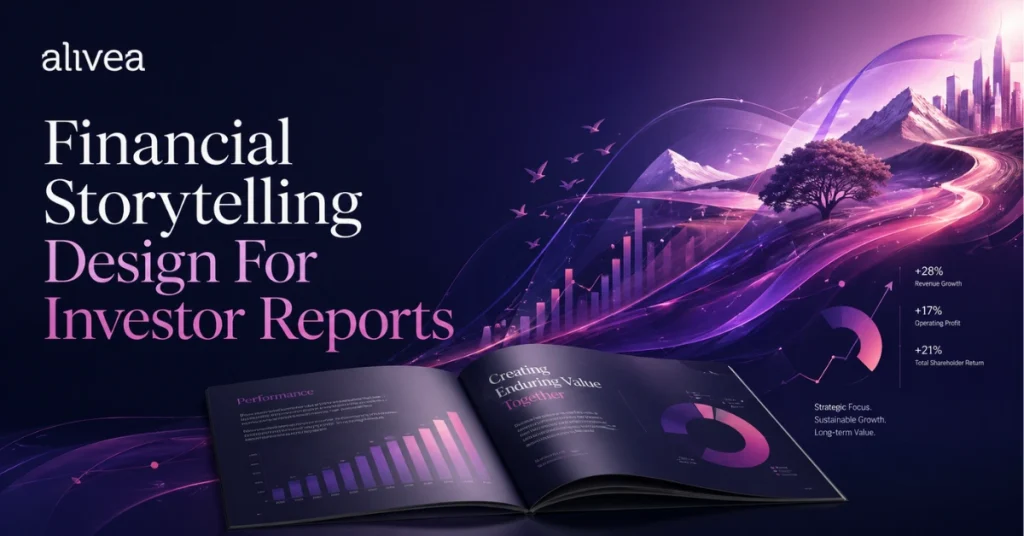
Financial Storytelling Design That Turns Annual Reports Into Investor Confidence
Financial storytelling design is the strategic process of transforming financial results, corporate performance, business decisions, and future priorities into a clear narrative that investors can understand and trust. In annual reports, numbers are essential, but numbers alone rarely explain the complete business journey. Investors want to know what happened, why it happened, how leadership responded, and what the company is preparing to do next. This is where strong storytelling becomes a critical reporting advantage.
A well-designed annual report does not simply place financial statements beside attractive visuals. It builds a meaningful connection between data, strategy, operations, governance, risk, and outlook. When these elements are arranged with purpose, the report becomes easier to read and more valuable for decision-making. Financial storytelling design helps annual reports communicate performance with context rather than presenting results as isolated figures.
For Singapore companies and regional businesses that compete for investor attention, annual report design investor trust depends heavily on clarity. Investors may compare many companies across different sectors, so they need reports that explain business direction quickly and credibly. A confusing report can weaken confidence, even when the company performs well. A clear investor relations report can strengthen perception by showing that management understands its business and communicates responsibly.
Annual report credibility is also shaped by how honestly the story is told. Credible storytelling does not exaggerate growth or hide challenges. It explains achievements, pressures, risks, and strategic responses in a balanced way. Investors trust reports that sound realistic and evidence-based. They are more likely to respect a company that communicates both progress and complexity than one that only highlights positive outcomes.
Investor communication design supports this process by creating structure, visual hierarchy, readable charts, clear page flow, and consistent messaging. It helps stakeholders move from financial highlights to detailed explanations without losing the main narrative.
Brands such as alivea and professional annual report teams can use financial storytelling design to create reports that are not only visually polished, but also informative, persuasive, and trustworthy. When data, narrative, and design work together, annual reporting becomes a powerful platform for investor confidence.

Financial Storytelling Design That Connects Data, Strategy, and Market Meaning
Financial storytelling design begins with one important principle: every number should have a reason, and every reason should connect to the company’s broader strategy. Annual reports are often filled with revenue figures, profit margins, cash flow movements, operating expenses, segment results, and balance sheet details. These figures are necessary, but investors need more than measurement. They need interpretation.
A strong annual report explains the meaning behind performance. If revenue increased, the report should clarify whether the improvement came from higher demand, pricing adjustments, market expansion, new products, stronger customer retention, or acquisition activity. If profit declined, the report should explain whether the cause was rising costs, strategic investment, supply chain pressure, restructuring, foreign exchange movement, or temporary market conditions. This kind of explanation improves annual report credibility because it helps investors see the business logic behind the numbers.
Financial storytelling design also connects strategy with results. A company may have announced priorities such as digital transformation, operational efficiency, sustainability, regional growth, customer experience improvement, or product innovation. The annual report should show how these priorities influenced the year’s performance. Investors want to know whether management actions are producing measurable progress.
This is where investor communication design becomes essential. It helps organize the story into readable sections. A strategy map can explain business priorities. A performance dashboard can highlight key results. A timeline can show progress across the year. Segment pages can demonstrate how each business unit contributed to the overall outcome. Charts and infographics can simplify financial patterns without reducing accuracy.
Annual report design investor trust improves when the report shows a clear connection between promise and proof. If leadership claims that the company is building long-term value, the report should support that claim through data, milestones, and transparent explanations. If management describes the year as challenging, the report should explain what made it challenging and how the company responded.
A compelling investor relations report does not turn financial reporting into marketing language. Instead, it makes corporate performance understandable, structured, and credible. Financial storytelling design gives investors a clearer view of how the business works, how leadership thinks, and how future value may be created.
Annual Report Design Investor Trust Through Evidence-Led Corporate Narratives
Annual report design investor trust is strongest when the corporate narrative is supported by evidence. Investors may appreciate a beautifully designed report, but they trust a report that proves its message. A company can describe resilience, growth, innovation, efficiency, or transformation, but each claim must be connected to credible data and clear explanation.
Evidence-led storytelling gives investors confidence because it reduces uncertainty. Instead of asking readers to accept broad statements, the report helps them verify the company’s performance. For example, if the company discusses stronger operational efficiency, the report can show cost trends, productivity improvements, margin changes, automation progress, or process improvements. If the company discusses market expansion, the report can include geographic revenue movement, customer growth, distribution progress, or strategic partnerships.
Financial storytelling design turns this evidence into a readable investor journey. The story should begin with a clear overview of the year, then move into strategic priorities, performance drivers, risk factors, governance support, and future outlook. This flow helps investors understand how individual details connect to the larger business direction.
Investor communication design is important because evidence can lose its value if it is presented poorly. A table with too much information may overwhelm readers. A chart without proper labels may create confusion. A page filled with dense text may cause important insights to be missed. Good design makes proof accessible. It does not decorate data; it clarifies data.
Annual report credibility also depends on balance. A trustworthy report should not only present positive indicators. It should also discuss pressure points and limitations. Investors understand that businesses face challenges. They want to know whether management can identify those challenges and respond with discipline. A report that explains both progress and difficulty often feels more credible than a report that only celebrates success.
The investor relations report should therefore be designed as a professional communication asset. It should help shareholders, analysts, lenders, and potential investors evaluate the business with confidence. When financial storytelling design is evidence-led, the report becomes more than a corporate publication. It becomes a transparent record of management thinking, strategic execution, and long-term value creation.
Annual Report Credibility Built Through Accurate Context and Clear Disclosure
Annual report credibility is not created by design quality alone. It is built through accurate information, transparent disclosure, consistent messaging, and responsible explanation. Financial storytelling design can strengthen credibility only when it is grounded in truth. A report may look impressive, but if it lacks clarity, omits important context, or presents data selectively, investor confidence can weaken.
Accurate context is one of the most important credibility factors. Financial results should never be shown without explanation. Investors need to understand whether changes in performance are temporary, structural, strategic, or market-driven. For example, a decline in net profit could reflect rising investment in future growth rather than operational weakness. A rise in revenue could be supported by one-time activity rather than sustainable demand. Without context, investors may draw the wrong conclusion.
Financial storytelling design helps provide this context in a disciplined way. It connects financial movement with business events, market conditions, operational decisions, and strategic priorities. This allows the annual report to explain performance honestly while still keeping the reader focused on the bigger picture.
Clear disclosure also supports annual report design investor trust. A credible annual report should make important information easy to find. Governance practices, risk management, related party transactions, sustainability progress, capital allocation, and financial assumptions should not be hidden inside confusing sections. Investor communication design can help by using clear headings, structured layouts, explanatory notes, and navigation cues.
Consistency is another credibility factor. If the report uses different terms for the same metric, changes chart styles without reason, or presents conflicting figures across sections, readers may question the reliability of the document. A consistent investor relations report feels more professional and easier to evaluate.
Annual report credibility also depends on tone. Financial storytelling should be confident but not exaggerated. It should explain improvement without sounding promotional. It should discuss challenges without becoming defensive. It should communicate ambition without making unrealistic promises.
For Singapore companies and global-facing businesses, credibility can influence investor perception, analyst interpretation, and stakeholder confidence. A report that combines accurate context with clear disclosure helps investors understand not only the company’s results, but also the quality of its communication culture. That is why financial storytelling design must always serve transparency, not replace it.
Investor Communication Design That Guides Stakeholders Through Financial Insight
Investor communication design is the framework that helps financial storytelling become clear, logical, and useful. Annual reports often contain many types of information, including financial highlights, operating reviews, board statements, governance disclosures, sustainability data, risk analysis, and audited financial statements. Without strong communication design, these elements may feel disconnected. With the right structure, they become one coherent investor journey.
The main purpose of investor communication design is to guide attention. Investors should be able to identify the most important messages quickly, then explore details when needed. This requires strong hierarchy. Key results should stand out. Supporting explanations should be easy to follow. Technical information should remain accessible without overwhelming the main narrative.
Financial storytelling design relies on this hierarchy. A good report does not simply tell investors that the company performed well or faced challenges. It leads them through the evidence. It may begin with a summary of the year, followed by strategic priorities, business performance, market context, financial review, governance support, and future outlook. This sequence helps investors understand cause, effect, and direction.
Annual report design investor trust improves when the reading experience feels intentional. Clear typography, page spacing, section markers, data visualization, and consistent visual systems help investors move through the report with less effort. When readers can understand the report smoothly, they are more likely to view the company as organized and transparent.
Investor communication design also supports different reading behaviors. Some stakeholders read the entire report. Others scan specific sections such as financial statements, risk management, or business outlook. A strong investor relations report serves both types of readers. It provides quick summaries for scanning and deeper explanations for detailed review.
Annual report credibility is strengthened when visuals are used responsibly. Charts should use fair scales, clear labels, and relevant comparisons. Infographics should simplify complex ideas without distorting meaning. Callout boxes should highlight facts, not replace complete explanations.
In modern annual reporting, communication design is not an optional layer. It is part of the trust-building process. When design helps investors understand financial insight, the report becomes more effective, more credible, and more valuable as a decision-making tool.

Investor Relations Report Strategy for Transparent Long-Term Market Engagement
An investor relations report should be designed as a long-term engagement tool, not only a yearly disclosure document. Investors use annual reports to evaluate performance, but they also use them to understand management discipline, business resilience, governance quality, and future direction. Financial storytelling design can help transform the report into a stronger platform for transparent market engagement.
The first strategy is to understand investor expectations. Different stakeholders look for different types of information. Shareholders may focus on returns, dividends, earnings, and governance. Analysts may study margins, segment performance, growth drivers, and risks. Lenders may review cash flow, debt levels, liquidity, and capital structure. Potential investors may look for business model clarity and future opportunity. A strong investor relations report should serve these needs through clear structure and accessible content.
The second strategy is to create a consistent story across sections. Leadership messages, financial reviews, sustainability updates, governance explanations, and outlook pages should not feel like separate documents. They should support one clear corporate narrative. Financial storytelling design helps connect these sections by aligning themes, evidence, visuals, and language.
Annual report design investor trust grows when investors feel the company is communicating openly. This means the report should explain achievements and challenges with equal seriousness. It should show how the company handled risks, how it allocated resources, how it measured progress, and how it prepared for future conditions.
Investor communication design also improves engagement by making the report easier to use. A digital version should be searchable, easy to navigate, mobile-friendly, and visually consistent. Important sections should be easy to locate. Charts and tables should remain readable across devices. A positive reading experience can strengthen annual report credibility because it shows that the company respects stakeholder time.
A strong investor relations report also supports communication beyond the report itself. The same financial storytelling can guide investor presentations, shareholder meeting materials, website content, press releases, and corporate profiles. When the message is consistent across channels, stakeholders receive a clearer and more reliable view of the company.
Long-term investor confidence is built through repeated clarity. Every annual report contributes to how the market remembers the company. When financial storytelling design remains credible, structured, and transparent year after year, it becomes part of the company’s reputation. Curious to learn more? annual report design that builds trust with investors.
What Makes Financial Storytelling Design Valuable in Annual Reports Today?
Financial storytelling design is valuable because it helps investors understand the meaning behind financial data. Annual reports contain many figures, but figures without context can feel incomplete. Investors want to know what caused performance changes, how management responded, and what the company expects in the future.
The “what” of financial storytelling design includes narrative structure, data visualization, strategic explanation, and investor-focused communication. It connects financial performance with business decisions so readers can see the relationship between strategy and results. This supports annual report design investor trust because the report becomes easier to evaluate.
Annual report credibility improves when the story is honest and supported by evidence. Investor communication design makes the information readable through clear layouts, charts, summaries, and section flow. A strong investor relations report does not only present numbers; it explains why those numbers matter. This makes the annual report more useful for shareholders, analysts, lenders, and potential investors.
Who Uses Annual Report Design Investor Trust to Evaluate Company Quality?
Annual report design investor trust is used by many stakeholders who need to evaluate company quality. Shareholders use annual reports to understand whether management is protecting value and communicating responsibly. Institutional investors review the report to assess strategy, governance, financial strength, and risk. Analysts use it to interpret business performance and compare companies across sectors.
Lenders also depend on annual report credibility when reviewing financial stability, cash flow, debt levels, and business outlook. Board members, employees, regulators, media professionals, and potential partners may also use the investor relations report to understand the company’s direction.
Financial storytelling design helps these groups because it turns complex data into structured insight. Investor communication design supports the process by making key messages easier to find and interpret. When the report is clear, evidence-based, and professionally presented, stakeholders can evaluate the company with stronger confidence.
Where Annual Report Credibility Matters Across Key Investor Touchpoints
Annual report credibility matters across every place where investors interact with company information. This includes printed annual reports, PDF downloads, investor relations websites, stock exchange announcements, shareholder meeting materials, analyst briefings, corporate presentations, and digital report platforms.
Financial storytelling design should remain consistent across these touchpoints. If the annual report communicates one message but the investor presentation tells a different story, stakeholders may become uncertain. Consistent investor communication design helps reinforce the same business narrative across multiple channels.
Annual report design investor trust is especially important on digital platforms because many investors begin their research online. A strong investor relations report should be easy to access, readable on different devices, and supported by clear navigation. Annual report credibility improves when financial data, strategy, governance, and outlook are presented consistently wherever stakeholders encounter them.
For Singapore companies and international-facing businesses, credible reporting touchpoints can influence market perception and long-term stakeholder trust.
When Should Investor Communication Design Shape Annual Reporting Work?
Investor communication design should shape annual reporting work from the earliest planning stage. It should not be treated as a final visual process after all content has been written. When communication design begins early, the company can create a stronger narrative, clearer structure, and more useful report.
Financial storytelling design requires planning because the report must connect data, strategy, governance, and future outlook. Teams should identify the main reporting themes, key investor questions, important performance drivers, and supporting evidence before layout production begins.
Annual report credibility improves when content and design are developed together. Charts, tables, leadership messages, business review pages, and digital navigation can be built around one clear communication goal. Annual report design investor trust becomes stronger when the report feels intentional instead of assembled at the last moment.
The investor relations report should also be reviewed for clarity, consistency, and usefulness before publication. Early communication planning reduces confusion and improves final quality.
Why Financial Storytelling Design Influences Investor Confidence Strongly
Financial storytelling design influences investor confidence because it explains performance in a way that numbers alone cannot. Investors want to understand whether results are sustainable, whether management decisions are effective, and whether the company has a credible future direction.
Annual report credibility becomes stronger when the report connects financial outcomes with business context. If revenue rises, investors need to know why. If costs increase, they need to understand the cause. If the company invests in transformation, they need to see how that investment supports long-term value.
Investor communication design helps present these explanations clearly. It creates readable sections, visual hierarchy, and meaningful charts. Annual report design investor trust grows when stakeholders can follow the logic behind the company’s results.
A strong investor relations report does not hide uncertainty. It explains challenges, risks, and strategic responses with a balanced tone. This honest storytelling helps investors view the company as transparent, disciplined, and worthy of deeper consideration.
How Investor Relations Report Design Builds Trust With Clear Narratives
Investor relations report design builds trust by turning annual reporting into a clear narrative experience. The process begins with identifying the company’s main story for the year. This may involve growth, resilience, transformation, efficiency, innovation, or sustainability. Once the theme is clear, financial storytelling design can connect evidence to that message.
Investor communication design then organizes the report so readers can move through it easily. Financial highlights, leadership statements, business reviews, governance updates, risk discussions, and future outlook sections should support one connected story. This improves annual report credibility because the report feels coherent and professionally managed.
Annual report design investor trust also depends on honest presentation. Charts should be clear. Explanations should be specific. Claims should be supported by data. The investor relations report should show both achievements and challenges.
When companies combine accurate information with strong narrative structure and visual clarity, investors can understand the business more confidently. That confidence is the foundation of trust.
Stronger Financial Storytelling Design Creates Clearer Investor Trust Over Time
Financial storytelling design is one of the most valuable ways to strengthen annual reports and build investor trust. It helps companies move beyond basic disclosure by explaining what financial results mean, how strategy influenced performance, and why management decisions matter for future value. A report that only presents numbers may inform investors, but a report that explains the story behind the numbers can build deeper confidence.
Annual report design investor trust depends on the relationship between data, narrative, and design. Investors need accurate figures, but they also need context. They need evidence, but they also need structure. They need transparency, but they also need a report that is easy to navigate. Financial storytelling design brings these requirements together into one communication system.
Annual report credibility is strengthened when the report is honest, balanced, and supported by clear proof. Credible storytelling does not exaggerate success or ignore difficulty. It explains growth, pressure, risk, investment, and future priorities with maturity. This makes the investor relations report more useful because it gives stakeholders a realistic understanding of the business.
Investor communication design supports the entire process by improving readability and flow. It helps companies present complex financial information through strong hierarchy, visual clarity, consistent formatting, and purposeful layouts. When readers can move through the report easily, they are more likely to understand and trust the message.
For Singapore companies and global-facing businesses, a well-designed annual report can improve stakeholder perception, support investor engagement, and strengthen market reputation. It can also serve as a reference point for presentations, shareholder meetings, website content, analyst discussions, and corporate communication.
Brands such as alivea and professional reporting partners can help companies transform annual reporting from a routine publication into a strategic investor communication asset. The goal is not only to make the report look polished. The deeper goal is to make financial performance understandable, credible, and connected to long-term value.
In conclusion, financial storytelling design helps annual reports become clearer, more persuasive, and more trustworthy. When companies combine accurate data, meaningful narrative, transparent disclosure, and professional investor communication design, they create investor relations reports that support confidence year after year.
