
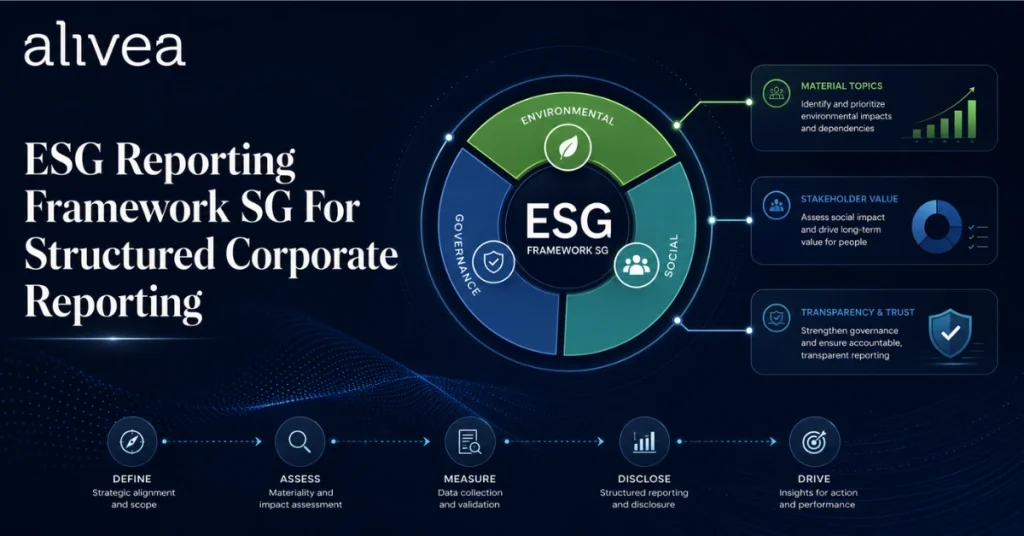
ESG Reporting Framework SG Builds Clear Corporate Sustainability Structure
ESG reporting framework sg helps companies transform sustainability information into a structured corporate report that stakeholders can understand, evaluate, and trust. In Singapore, ESG communication has moved beyond general environmental or social statements. Businesses are increasingly expected to explain material topics, climate-related matters, governance oversight, policies, performance, targets, and reporting methods in a disciplined way. A strong framework gives this process order.
For many companies, sustainability information comes from different departments. Operations may track energy, emissions, water, or waste. Human resources may manage workforce safety, diversity, training, and engagement. Procurement may monitor supplier practices. Legal and compliance teams may oversee ethics, risk, and governance. Without an esg framework sg, these inputs can become scattered and difficult to compare. A structured approach helps every team understand what information is needed, how it should be collected, and where it belongs in the final report.
Singapore’s reporting landscape continues to develop. SGX states that sustainability reports should include primary components such as material ESG factors, climate-related disclosures, policies, practices, performance, targets, a sustainability reporting framework, and a board statement. ACRA also states that listed companies and large non-listed companies need to comply with sustainability reporting and assurance requirements from FY2025 and FY2030 respectively, while listed companies must report Scope 1 and Scope 2 greenhouse gas emissions from financial years starting on or after 1 January 2025.
Because of this, sustainability framework sg planning is important for both compliance readiness and stakeholder communication. A company should not wait until the design stage to decide how ESG information should be structured. The framework should guide the report from the beginning, covering materiality, metrics, governance, narrative flow, evidence, and review.
For brands such as alivea, a strong ESG reporting framework supports more than document production. It helps create consistent disclosures across annual reports, sustainability reports, investor presentations, corporate websites, and stakeholder communications. When supported by the right esg standards sg and practical esg reporting guidelines sg, ESG reporting becomes clearer, more comparable, and more useful for long-term business trust.
ESG Reporting Framework SG Helps Companies Organize Disclosure Clearly
ESG reporting framework SG provides the foundation for organizing disclosure in a way that is logical, consistent, and stakeholder-ready. Many companies begin ESG reporting by collecting whatever information is available, then arranging it into environmental, social, and governance sections. While that approach may produce a report, it does not always produce a strong reporting structure. A better process begins with a clear framework that defines what matters, why it matters, how it is measured, and how the company manages it.
The first role of an esg framework sg is to help identify material sustainability topics. Material topics are the ESG issues that are most relevant to the business and its stakeholders. These may include greenhouse gas emissions, energy efficiency, workplace safety, employee development, board oversight, business ethics, customer privacy, responsible sourcing, community investment, or climate resilience. Not every company needs to give equal attention to every issue. The framework helps prioritize topics based on business relevance and stakeholder importance.
The second role is to organize evidence. A sustainability framework sg should help companies connect each topic with policies, actions, performance indicators, targets, responsibilities, and future plans. For example, if energy efficiency is a material topic, the report should not only state that the company supports energy savings. It should explain what actions were taken, what data was measured, what progress was achieved, and what improvements are planned.
The third role is to improve comparability. ESG reports are more useful when stakeholders can compare data across years. This means companies should use consistent definitions, reporting periods, measurement units, and calculation methods where possible. If a metric changes, the report should explain why. This makes esg standards sg important because standards help improve reliability and consistency.
ESG reporting guidelines sg also support readability. A report should not feel like a technical file that only specialists can understand. It should guide different audiences through the company’s sustainability position. Investors may focus on risk and metrics. Customers may look for responsible practices. Employees may care about culture and safety. A clear ESG reporting framework helps each audience find useful information faster.
ESG Framework SG Aligns Governance, Strategy, Metrics, And Accountability
ESG framework sg is valuable because it aligns sustainability reporting with governance, strategy, metrics, and accountability. A report that lists activities without explaining oversight can feel incomplete. Stakeholders want to know not only what the company has done, but also who is responsible, how ESG decisions are made, and how progress is monitored. This makes governance a central part of structured reporting.
A strong esg reporting framework sg should show how ESG issues are connected to leadership. This may include board oversight, senior management responsibility, sustainability committees, risk management teams, department owners, or internal reporting lines. The exact structure depends on the company’s size and maturity, but the report should make accountability visible. When stakeholders understand who oversees ESG performance, the report becomes more credible.
Strategy is another key part of the framework. Sustainability should not sit apart from business planning. Environmental risks may affect costs, operations, supply chains, and asset resilience. Social issues may influence talent, safety, customer trust, and productivity. Governance issues may affect investor confidence, compliance culture, and business continuity. A sustainability framework sg helps companies explain how ESG priorities support long-term business direction.
Metrics give the framework practical evidence. Without metrics, ESG claims can sound broad or promotional. Useful indicators may include emissions, energy use, water consumption, waste reduction, employee turnover, training hours, safety performance, board composition, supplier assessments, ethics training, or customer satisfaction. These indicators should be selected because they are relevant, not because they are easy to present.
ESG standards sg can help companies strengthen this alignment. The ISSB’s IFRS Sustainability Disclosure Standards, including IFRS S1 and IFRS S2, use core content areas such as governance, strategy, risk management, and metrics and targets. Even when a company is still developing its maturity, understanding these content areas can help teams build more disciplined ESG reporting.
ESG reporting guidelines sg should also help companies avoid disconnected storytelling. A polished case study is useful only when it supports a material topic. A chart is useful only when it helps explain performance. A governance diagram is useful only when it clarifies responsibility. The framework ensures that every part of the report serves a clear reporting purpose.
Sustainability Framework SG Connects Material Topics With Business Outcomes
Sustainability framework SG helps businesses connect material topics with real business outcomes. This connection is important because sustainability reporting should not only describe corporate responsibility. It should also explain how ESG issues affect performance, resilience, reputation, and long-term value. A company that can make this connection clearly is more likely to produce a report that stakeholders find useful.
Material topics become stronger when they are linked to business context. For example, emissions management may relate to energy costs, operational efficiency, regulatory readiness, and customer expectations. Workforce safety may relate to productivity, employee morale, insurance risk, and operational continuity. Governance ethics may relate to investor confidence, legal compliance, and brand reputation. A strong esg reporting framework sg helps companies explain these relationships instead of presenting ESG issues as isolated themes.
A practical esg framework sg should also define how each topic is managed. This may include policies, procedures, responsibilities, internal controls, training, monitoring, or improvement programs. Stakeholders need to understand whether ESG issues are actively managed or only described. The more clearly management approaches are explained, the more credible the report becomes.
Metrics are then used to show progress. A sustainability framework sg should help companies choose indicators that reflect the topic accurately. For employee development, training hours may be useful, but the company may also need to discuss leadership programs, skills development, career pathways, or engagement outcomes. For climate-related reporting, emissions data may be central, but the report may also need to discuss risk assessment, energy strategy, mitigation actions, and future targets.
ESG standards sg support this process by encouraging structured thinking. They help companies move from broad intentions to decision-useful disclosure. This is especially relevant in Singapore as climate-related reporting and emissions disclosure continue to become more important for listed companies and larger businesses. ACRA’s current timeline identifies phased requirements for listed companies, including Scope 1 and 2 emissions from FY2025 and Scope 3 emissions for STI constituents from FY2026.
ESG reporting guidelines sg also help teams maintain consistency. If the company reports the same material topics each year, stakeholders can track progress more easily. If priorities change, the report should explain the reason. This transparency helps the sustainability framework become a practical business communication tool, not just a reporting template.
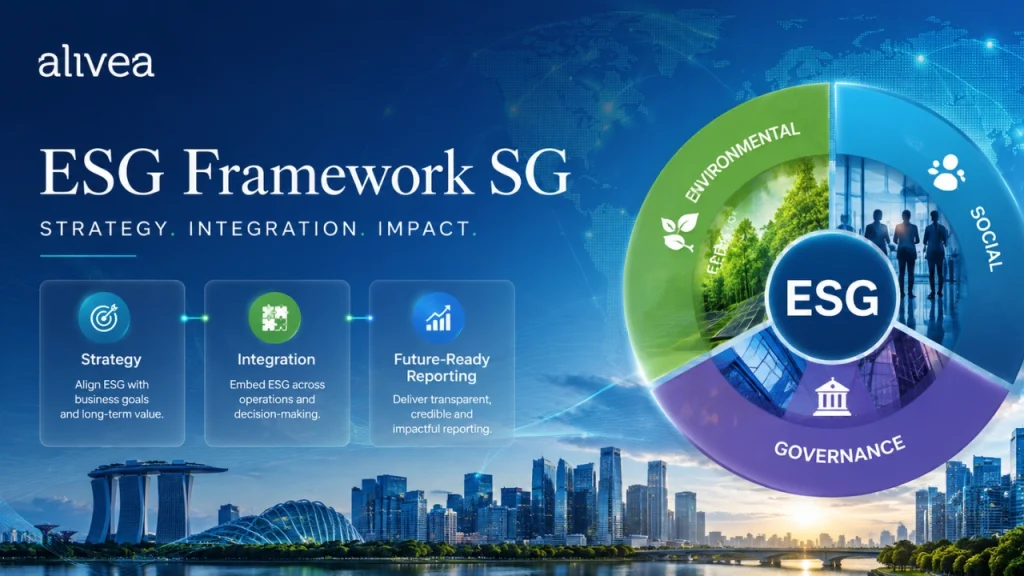
ESG Standards SG Help Companies Improve Consistency And Comparability
ESG standards SG help companies improve the consistency, reliability, and comparability of sustainability reporting. Without standards, every company may define topics, metrics, boundaries, and targets differently. This makes it harder for stakeholders to evaluate performance. Standards do not remove all judgment from ESG reporting, but they provide a clearer foundation for deciding what to disclose and how to explain it.
A strong esg reporting framework sg should use standards as guidance, not as empty labels. It is not enough to mention a framework on the final page of the report. The selected framework should influence the structure of the content, the metrics used, the governance explanation, and the way risks and opportunities are discussed. When standards are applied thoughtfully, the report becomes more useful for investors, customers, employees, partners, and regulators.
ESG framework sg development should also consider industry relevance. A manufacturing company may need stronger environmental and safety metrics. A real estate company may focus on energy efficiency, green buildings, tenant well-being, and climate resilience. A technology company may prioritize data privacy, digital ethics, talent development, and governance controls. A professional services firm may emphasize people, ethics, diversity, and client responsibility. The selected sustainability framework sg should fit the business model.
Global standards can also support local reporting needs. The ISSB explains that IFRS S1 is designed to require disclosure of sustainability-related risks and opportunities useful to users of general purpose financial reports, while IFRS S2 focuses on climate-related risks and opportunities and is designed to be applied with IFRS S1. This reinforces the importance of structured disclosure across governance, strategy, risk management, metrics, and targets.
ESG reporting guidelines sg should help companies apply standards without making the report too technical. The report should still be readable. Stakeholders need clear explanations, not only framework references. Charts, tables, summaries, and narrative sections should work together to present the information in a practical way.
For corporate reporting teams, the value of esg standards sg is discipline. Standards encourage companies to define boundaries, explain methods, organize data, and disclose relevant information consistently. This helps ESG reporting become more credible over time.
ESG Reporting Guidelines SG Support Better Planning And Review Workflows
ESG reporting guidelines SG help companies create better planning, drafting, review, and approval workflows. A strong ESG report is rarely produced successfully at the last minute. It requires coordination across departments, data owners, leadership teams, writers, designers, sustainability specialists, and reviewers. Guidelines make this process more predictable by defining what needs to happen at each stage.
At the planning stage, esg reporting framework sg guidelines help companies clarify reporting scope, key audiences, material topics, data needs, framework alignment, and publication format. This prevents confusion later. If the company knows early which topics must be reported, each department can prepare relevant evidence before the deadline becomes urgent.
At the data collection stage, esg framework sg guidelines help teams use consistent templates. Each metric should have a clear owner, source, reporting period, unit of measurement, and supporting explanation. This reduces the risk of mismatched numbers or unclear assumptions. It also makes future reporting easier because the company can improve from the previous year’s structure.
At the content stage, sustainability framework sg guidelines help writers and ESG teams shape the narrative. Each material topic should explain why the issue matters, how it is managed, what progress was achieved, and what the company plans to do next. This creates a consistent rhythm across the report. Readers can compare topics more easily when every section follows a logical pattern.
At the review stage, esg standards sg guidelines help internal teams check whether disclosures are complete, balanced, and supported by evidence. Finance may review quantitative data. HR may validate workforce information. Legal may review sensitive claims. Leadership may approve strategic messages. Designers may refine visual clarity. This workflow supports stronger ESG reporting compliance.
SGX’s guidance notes that issuers should select sustainability reporting framework or frameworks that are appropriate for their industry and business model, and should disclose the chosen framework and reasons for selection. This makes reporting guidelines especially useful because they help companies document decisions and explain their approach clearly.
For brands such as alivea, strong ESG reporting guidelines can turn reporting into a smoother annual discipline. Instead of reinventing the process every year, the company can build a repeatable workflow that improves accuracy, consistency, and stakeholder confidence. Top pick best esg report sg solutions for corporate reporting and design.

What Is ESG Reporting Framework SG For Modern Corporate Reporting Needs?
ESG reporting framework SG is a structured approach that helps companies organize sustainability information for clear corporate reporting. It guides how environmental, social, and governance topics are selected, measured, reviewed, and disclosed. A good framework helps companies explain material topics, policies, actions, performance indicators, targets, governance responsibilities, and reporting methods.
For modern corporate reporting, an esg framework sg is important because stakeholders expect more than general sustainability statements. They want evidence that the company understands ESG risks and opportunities. A sustainability framework sg helps connect this evidence with business strategy.
ESG standards sg provide discipline by improving consistency and comparability. ESG reporting guidelines sg then help teams manage the practical workflow, from data collection to final publication. Together, these elements create a report that is easier to read, more reliable, and more useful for investors, customers, employees, partners, and regulators.
Who Should Use ESG Framework SG To Strengthen Sustainability Disclosures?
ESG framework SG should be used by listed companies, large private businesses, growing SMEs, regional brands, and organizations preparing for stronger sustainability expectations. Any company that needs to explain ESG performance to investors, customers, regulators, employees, procurement teams, or business partners can benefit from a structured framework.
An esg reporting framework sg is especially useful when ESG information comes from multiple departments. Operations, HR, finance, procurement, legal, risk, and communications teams may all contribute data. Without a common structure, the final report can become inconsistent.
A sustainability framework sg helps these teams work toward the same reporting direction. ESG standards sg support quality and comparability, while esg reporting guidelines sg make the process easier to manage. This is useful for companies that want to improve transparency, reduce reporting pressure, and build stronger stakeholder confidence over time.
Where Can Sustainability Framework SG Improve Corporate Reporting Quality?
Sustainability framework SG can improve reporting quality across annual reports, standalone ESG reports, sustainability reports, investor relations pages, corporate websites, board presentations, tender documents, and supplier questionnaires. ESG information is often reused across many business channels, so consistency matters.
An esg reporting framework sg helps ensure that sustainability messages remain aligned wherever stakeholders encounter them. If the annual report says one thing, the website says another, and procurement documents use different metrics, credibility can weaken. A clear esg framework sg reduces this risk.
ESG standards sg also improve quality by encouraging consistent definitions, methods, and disclosures. ESG reporting guidelines sg help teams maintain the same structure across different formats. This makes the company’s ESG communication more professional, easier to verify, and more useful for stakeholder decision-making.
When Should ESG Standards SG Guide Sustainability Reporting Preparation?
ESG standards SG should guide sustainability reporting preparation from the beginning of the reporting cycle, not only after content has been written. Early framework selection helps companies understand what data is needed, which material topics should be covered, and how disclosures should be structured.
An esg reporting framework sg works best when it informs the full process. This includes planning, data collection, content drafting, design, review, and approval. If standards are considered too late, the company may discover missing information or unclear reporting boundaries close to publication.
A sustainability framework sg should also support year-round data management. ESG reporting guidelines sg help companies assign responsibilities and prepare evidence early. This makes reporting more accurate, reduces stress, and improves the final report’s reliability. Early use of standards creates a stronger foundation for transparent corporate sustainability disclosure.
Why ESG Reporting Guidelines SG Matter For Long-Term Stakeholder Trust?
ESG reporting guidelines SG matter because stakeholder trust depends on clarity, consistency, and evidence. A company can have meaningful sustainability initiatives, but if the report is vague or poorly organized, stakeholders may struggle to understand the value. Guidelines help turn internal action into credible disclosure.
An esg reporting framework sg supports trust by explaining what the company reports and why. An esg framework sg connects governance, strategy, risk, metrics, and targets. A sustainability framework sg helps stakeholders see how ESG topics relate to business performance and long-term value.
ESG standards sg also reduce confusion by encouraging consistent reporting practices. When companies follow clear guidelines, they are less likely to publish unsupported claims or scattered information. This makes the ESG report more useful for investors, customers, employees, partners, and leadership teams that rely on accurate sustainability communication.
How Can Companies Apply ESG Reporting Framework SG More Effectively?
Companies can apply ESG reporting framework SG more effectively by starting with material topic identification, stakeholder needs, and business context. The framework should not be treated as a document template. It should guide what the company reports, how data is collected, and how sustainability performance is explained.
The next step is to assign clear ownership. Each esg framework sg topic should have responsible teams, data sources, review steps, and supporting evidence. A sustainability framework sg becomes stronger when internal teams understand their role before the reporting deadline arrives.
Companies should then align disclosures with suitable esg standards sg and practical esg reporting guidelines sg. Each section should explain why the topic matters, how it is managed, what progress was achieved, and what comes next. This creates a report that is structured, transparent, and useful for decision-making.
ESG Reporting Framework SG Creates Stronger Structure For Sustainable Growth
ESG reporting framework SG helps companies create stronger, clearer, and more reliable sustainability reports. In today’s corporate environment, ESG reporting cannot depend on scattered information or broad sustainability claims. Businesses need a structure that connects material topics, governance, strategy, metrics, standards, and stakeholder communication. A framework provides that structure and helps reporting teams produce disclosures that are easier to read, review, and trust.
The value of an esg framework sg begins with organization. It helps companies identify which ESG topics matter most, decide what information should be collected, and explain how each topic is managed. This prevents the report from becoming a random list of activities. Instead, the company can present sustainability performance as part of business responsibility and long-term value creation.
A sustainability framework sg also supports consistency. When the same structure is used across reporting cycles, stakeholders can compare progress more easily. If metrics, boundaries, or topics change, the company can explain those changes transparently. This makes ESG reporting more credible and useful over time.
ESG standards sg strengthen this process by encouraging disciplined disclosure. Standards help companies think about governance, strategy, risk management, metrics, targets, and decision-useful information. ESG reporting guidelines sg then turn these principles into practical workflows for data collection, content planning, review, design, and publication.
For Singapore businesses, a clear ESG reporting framework is especially important as sustainability reporting expectations continue to mature. Companies that prepare early can improve data quality, reduce reporting pressure, and communicate more confidently with investors, customers, employees, regulators, and partners. For brands such as alivea, the right framework can also support stronger corporate storytelling by ensuring sustainability messages remain accurate, consistent, and useful.
The best ESG report is not only attractive. It is structured, evidence-based, readable, and aligned with stakeholder needs. When companies apply the right reporting framework, ESG disclosure becomes more than a compliance task. It becomes a strategic communication asset that supports transparency, accountability, and sustainable business growth.
