

ESG Audit Best Practices Singapore For Transparent Corporate Compliance Success
ESG audit best practices singapore help companies build sustainability disclosures that are accurate, evidence-based, and suitable for corporate compliance review. As ESG reporting becomes more connected to governance, climate accountability, investor confidence, and stakeholder trust, businesses need more than well-written sustainability claims. They need a disciplined review process that can prove where ESG data comes from, how it was calculated, who reviewed it, and whether the final disclosure fairly reflects actual performance.
A practical esg audit singapore approach should begin with clear scope, material topics, assigned data owners, reporting boundaries, source evidence, calculation methods, and approval workflows. Without these foundations, ESG reports may look professional but still contain inconsistent figures, missing records, vague statements, or unsupported claims. Strong audit practices reduce these risks by connecting sustainability performance with reliable documentation and internal controls.
Singapore’s reporting landscape makes audit discipline especially important. SGX states that annual sustainability reports should include primary components such as material ESG factors, climate-related disclosures, policies, practices and performance, targets, a sustainability reporting framework, and a board statement with the associated governance structure. SGX Rulebooks also state that an issuer’s sustainability reporting process must be subject to internal review, while independent external assurance may also be commissioned.
The best sustainability audit best practices sg therefore focus on both compliance and improvement. A company should not treat ESG audit work as a final correction exercise before publishing a report. It should use the audit to improve data discipline, strengthen governance, reduce greenwashing risk, support future assurance readiness, and guide better business decisions.
For companies working with alivea, audit-ready ESG information can become the foundation for stronger reporting, clearer visual storytelling, and responsible sustainability communication. When ESG data is reviewed properly, the final report can communicate progress with more confidence, more transparency, and stronger corporate credibility.
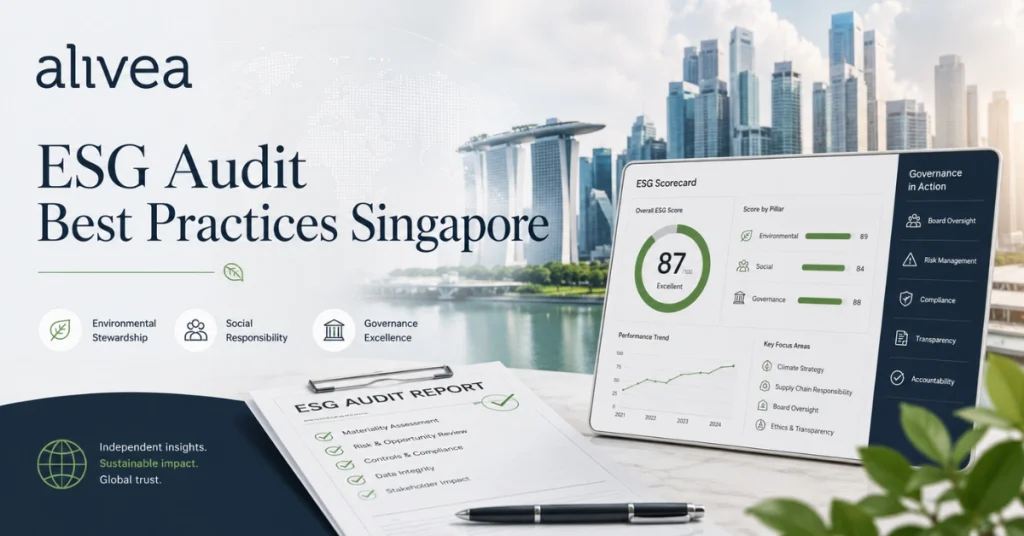
ESG Audit Best Practices Singapore Start With Clear Scope And Materiality
The first esg audit best practices singapore companies should follow is to define the audit scope before reviewing any data. Scope provides the boundary for what will be checked, which entities will be included, which locations are covered, which reporting period applies, and which ESG topics matter most. Without scope, an audit can become inefficient because teams may collect irrelevant information while missing important evidence.
A strong esg audit singapore process should begin with materiality. Material ESG topics are the issues most relevant to the business, its stakeholders, and its long-term value. A manufacturing company may prioritise energy, waste, water, safety, supplier conduct, and emissions. A professional services company may focus on employee development, business ethics, data protection, travel emissions, governance, and client responsibility. A real estate company may need deeper review of building efficiency, climate resilience, tenant engagement, and asset-level environmental data.
Once material topics are identified, the company should map each topic to a data owner. This is one of the most important sustainability audit best practices sg because ESG information rarely belongs to one department. Operations may own energy and safety records. HR may own workforce and training data. Procurement may own supplier screening. Finance may support invoice validation. Legal or compliance may own governance documents. Clear ownership prevents confusion near reporting deadlines.
The next best practice is to document reporting boundaries. Companies should explain which subsidiaries, facilities, leased spaces, outsourced activities, or business units are included. If boundaries change from one year to the next, the change should be explained clearly. This protects comparability and reduces reporting risk.
For esg compliance audit singapore, clear scope and materiality also support stronger board oversight. Leaders can review ESG information more confidently when they understand what is included, why it matters, and how it connects to corporate strategy. This creates a stronger foundation for corporate esg audit singapore and better sustainability reporting outcomes.
ESG Audit Singapore Improves Data Accuracy Through Evidence Controls
ESG audit singapore best practice requires every important metric to be supported by reliable evidence. ESG reporting often includes environmental, social, and governance information from many different systems. If the evidence is incomplete, inconsistent, or poorly stored, the company may struggle to defend its disclosures. A good audit process therefore checks the source, method, owner, and approval trail behind each figure.
Environmental data may include electricity bills, fuel receipts, water records, waste contractor reports, business travel data, logistics information, refrigerant records, and greenhouse gas calculations. Social data may include employee headcount, diversity indicators, training hours, safety incidents, grievance records, wellbeing activities, and workforce turnover. Governance data may include board papers, risk registers, policies, codes of conduct, anti-bribery controls, whistleblowing procedures, and supplier documentation.
One of the strongest esg audit best practices singapore businesses can adopt is an evidence register. This register should list each metric, data owner, source file, calculation method, reporting period, reviewer, approval status, and storage location. It helps teams avoid last-minute searches and makes future audits more efficient.
Another best practice is calculation review. Many ESG errors happen not because source data is missing, but because spreadsheets, unit conversions, emission factors, or formulas are incorrect. For example, emissions reporting may require careful treatment of activity data, conversion factors, and organisational boundaries. A second-level review can detect mistakes before they appear in the final report.
For sustainability audit best practices sg, companies should also keep an explanation of assumptions. If estimates are used, the method should be documented. If data is unavailable, the limitation should be explained. If figures change from the previous year, the reason should be recorded.
These controls help esg compliance audit singapore become more than a checklist. They build a repeatable system that improves accuracy, supports assurance readiness, and gives corporate esg audit singapore stakeholders greater confidence in the final disclosure.
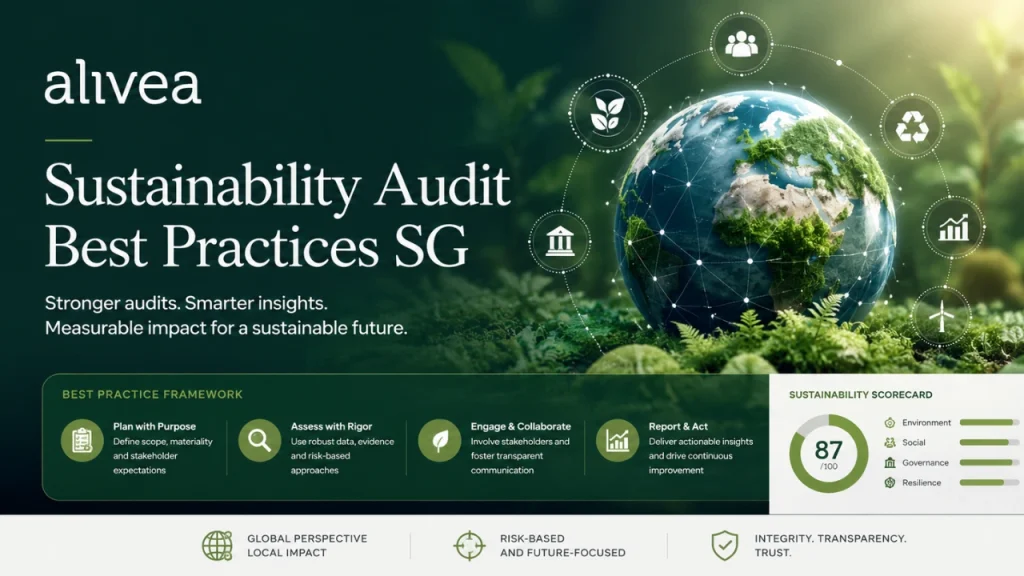
Sustainability Audit Best Practices SG Strengthen Internal Review Workflows
Sustainability audit best practices sg should include a structured internal review workflow that moves ESG information from data collection to final approval. Many reporting issues happen because companies collect data but do not review it properly before publication. A strong workflow ensures that sustainability information is checked at several levels before it becomes part of a report, annual statement, investor deck, or corporate website.
A practical workflow starts with data owners. Each owner should submit data using a standard template, attach supporting evidence, explain assumptions, and confirm the reporting period. The second stage is reviewer validation. Reviewers should check whether the data is complete, whether formulas are correct, whether source evidence matches the figure, and whether the metric follows the agreed definition.
The third stage is management review. Management should assess whether the results make sense in business context. If energy use changes sharply, the reason should be explained. If safety incidents rise, the company should understand whether this reflects a real operational issue or improved reporting discipline. If employee metrics change, HR should provide context around hiring, restructuring, turnover, or reporting boundaries.
The fourth stage is disclosure review. This is where esg audit singapore becomes closely connected to communication quality. Written claims should match evidence. A company should avoid saying it has achieved major sustainability progress if the available data only shows early-stage improvement. It should also avoid vague claims that cannot be supported.
For esg audit best practices singapore, companies should keep review logs. A review log records who checked the information, what changes were made, why changes were made, and when approval was given. This creates accountability and helps future teams understand the reporting history.
A strong internal review workflow supports esg compliance audit singapore because it reduces error risk before publication. It also supports corporate esg audit singapore because boards and senior leaders can approve sustainability information with better confidence and clearer accountability.
ESG Compliance Audit Singapore Aligns Reporting With Required Disclosures
ESG compliance audit singapore best practice requires companies to align their disclosures with applicable reporting expectations and recognised sustainability frameworks. Compliance should not be checked only at the final proofreading stage. It should guide the entire reporting process, from scope setting to data collection, evidence review, board approval, and final communication.
For Singapore-listed companies, climate reporting has become a major area of attention. ACRA’s sustainability reporting timeline states that all listed companies must report Scope 1 and Scope 2 greenhouse gas emissions for financial years starting on or after 1 January 2025. It also states that Straits Times Index constituents must report other ISSB-based climate-related disclosures from FY2025 and Scope 3 emissions from FY2026. In August 2025, ACRA and SGX RegCo announced that external limited assurance for Scope 1 and Scope 2 greenhouse gas emissions is deferred to FY2029 for all listed companies, while Scope 1 and Scope 2 reporting remains mandatory from FY2025.
These requirements show why esg audit best practices singapore should include early emissions data planning. Companies need to define organisational boundaries, collect activity data, document calculation methods, review emission factors, retain evidence, and explain changes clearly. Waiting until the final report stage can create avoidable pressure.
A strong esg audit singapore process should also check whether the company’s selected framework is applied consistently. IFRS S1 and IFRS S2 are designed to be applied together, and IFRS describes their core content areas as governance, strategy, risk management, and metrics and targets.
For sustainability audit best practices sg, framework alignment improves disclosure quality because it prevents random reporting. It helps companies organise ESG information around recognised expectations. For corporate esg audit singapore, it gives boards, investors, clients, and stakeholders a clearer basis for understanding how sustainability risks and opportunities are managed.
Corporate ESG Audit Singapore Turns Findings Into Compliance Improvements
Corporate esg audit singapore should not end with a list of findings. The best practice is to convert audit results into practical compliance improvements that strengthen the next reporting cycle. A company may discover missing evidence, inconsistent definitions, weak approval steps, unsupported claims, incomplete emissions data, outdated policies, or unclear governance responsibilities. These findings should become action plans.
Each finding should have an owner, priority level, target date, and follow-up method. If emissions data is incomplete, operations or facilities teams may need a new monthly data template. If supplier records are weak, procurement may need a stronger vendor screening process. If governance evidence is unclear, legal or compliance teams may need better board reporting documentation. If social data is inconsistent, HR may need standard employee definitions and reporting cut-off rules.
This is one of the most important esg audit best practices singapore because it turns audit work into business improvement. Audit findings should not be viewed as criticism. They should be treated as a roadmap for stronger ESG management, more reliable reporting, and better stakeholder communication.
A strong esg audit singapore process should also identify quick wins and long-term projects. Quick wins may include correcting formulas, updating evidence folders, clarifying definitions, or improving disclosure wording. Long-term projects may include building ESG dashboards, training data owners, improving supplier due diligence, integrating ESG into enterprise risk management, or preparing for future assurance.
For sustainability audit best practices sg, management should review progress after the audit. This follow-up confirms whether actions are completed and whether improvements are effective. Without follow-up, the same issues may return in the next report.
For esg compliance audit singapore, turning findings into improvements supports regulatory readiness. For corporate esg audit singapore, it also helps leadership show that ESG is governed seriously. With support from alivea, improved ESG information can then become stronger sustainability narratives, clearer report design, and more credible corporate communication. Discover the next article professional esg audit singapore for compliance and transparency.
What Are ESG Audit Best Practices Singapore For Better Report Quality?
ESG audit best practices singapore are structured methods that help companies review sustainability information before it is published. They include clear scope setting, material topic review, data owner mapping, evidence collection, calculation validation, internal approval, disclosure review, and improvement planning.
A strong esg audit singapore process checks whether ESG data is complete, traceable, and supported by reliable records. It also reviews whether written claims match actual evidence. This helps reduce reporting errors, unsupported statements, and greenwashing risk.
For sustainability audit best practices sg, companies should use standard templates, evidence registers, review logs, and clear sign-off procedures. For esg compliance audit singapore, these practices improve readiness for regulatory reporting and future assurance. For corporate esg audit singapore, they help boards and management approve sustainability disclosures with stronger confidence.
Who Should Apply ESG Audit Singapore Practices Across The Company?
ESG audit singapore practices should be applied by all teams involved in sustainability performance and reporting. This usually includes operations, HR, procurement, finance, legal, compliance, risk management, investor relations, corporate communications, and senior leadership.
Operations may manage energy, emissions, waste, water, and safety data. HR may manage employee indicators, training, wellbeing, and diversity. Procurement may manage supplier responsibility and vendor screening. Finance may validate invoices and calculations. Legal and compliance may manage governance policies, risk registers, board papers, and regulatory alignment.
For esg audit best practices singapore, each team should understand its role, evidence requirements, timeline, and approval responsibility. For sustainability audit best practices sg, cross-functional ownership prevents ESG from becoming one person’s reporting burden. For esg compliance audit singapore and corporate esg audit singapore, this shared accountability creates stronger reporting discipline and better corporate governance.
Where Do Sustainability Audit Best Practices SG Add The Most Value?
Sustainability audit best practices sg add the most value in areas where ESG data is complex, manual, or spread across different teams. Common examples include emissions calculations, utility records, waste data, workforce metrics, supplier screening, safety records, governance policies, and board oversight evidence.
These practices also add value in multi-location businesses. Different offices, facilities, or departments may use different formats, reporting periods, or definitions. A structured esg audit singapore process helps standardise these differences before the final report is prepared.
For esg audit best practices singapore, the value is not limited to compliance. Better audit discipline can improve cost visibility, operational performance, risk management, stakeholder communication, and assurance readiness. For esg compliance audit singapore, it helps align evidence with reporting expectations. For corporate esg audit singapore, it creates clearer information for boards, investors, clients, and employees.
When Should ESG Compliance Audit Singapore Preparation Begin Early?
ESG compliance audit singapore preparation should begin early in the reporting cycle, not when the report is almost complete. Early preparation gives companies enough time to confirm scope, assign data owners, collect evidence, review calculations, correct gaps, and improve weak controls.
The best timing is during the reporting period or soon after year-end. This allows teams to access records while information is still current. It also gives management time to review unusual changes and prepare explanations before board approval.
For esg audit best practices singapore, companies should also begin early after major business changes, such as acquisitions, new facilities, supplier expansion, framework updates, new climate targets, or increased investor scrutiny. For sustainability audit best practices sg, early planning reduces pressure. For corporate esg audit singapore, it supports smoother review and more reliable disclosures.
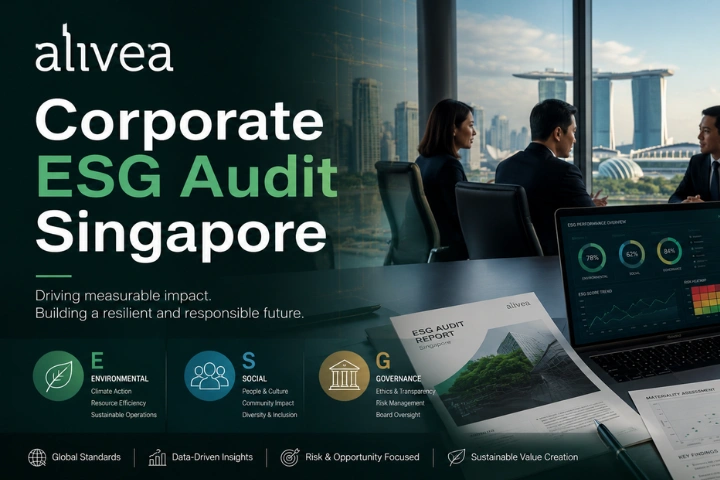
Why Is Corporate ESG Audit Singapore Important For Compliance Success?
Corporate esg audit singapore is important because compliance success depends on evidence, governance, and accountability. Stakeholders do not only want to read sustainability commitments. They want to know whether those commitments are supported by real data, policies, controls, and management action.
A structured esg audit singapore process helps protect credibility by identifying missing records, inconsistent definitions, unclear boundaries, weak approval steps, and unsupported claims before publication. This reduces reporting risk and strengthens stakeholder trust.
For esg audit best practices singapore, audit discipline also helps companies communicate progress honestly. ESG reporting does not require perfection. It requires transparency, measurable improvement, and responsible governance. For sustainability audit best practices sg and esg compliance audit singapore, this approach supports stronger corporate compliance success because it connects sustainability disclosure with real business management.
How Can Companies Follow ESG Audit Best Practices Singapore Effectively?
Companies can follow esg audit best practices singapore effectively by building a repeatable process. They should define scope, confirm material topics, assign data owners, prepare evidence checklists, use standard templates, document calculation methods, and establish review deadlines.
A good esg audit singapore process should also include disclosure review. Report language should be compared with evidence before publication. If claims are too broad, they should be refined. If data limitations exist, they should be explained responsibly.
For sustainability audit best practices sg, companies should convert findings into action plans. Each gap should have an owner, timeline, and follow-up review. For esg compliance audit singapore, this improves readiness for current and future reporting expectations. For corporate esg audit singapore, it creates stronger governance, better board confidence, and more credible stakeholder communication.
Final Thoughts On ESG Audit Best Practices Singapore For Corporate Success
ESG audit best practices singapore give companies a practical pathway to stronger compliance, better reporting accuracy, and more transparent sustainability disclosures. As ESG expectations continue to mature, businesses need more than attractive report design or positive corporate language. They need clear scope, reliable data, documented evidence, strong internal controls, board oversight, and honest communication.
A strong esg audit singapore process begins with materiality and boundaries. Companies must know which ESG topics matter, which entities are included, which activities are covered, and which teams own each metric. This foundation prevents confusion and supports more consistent year-on-year reporting.
The next priority is evidence quality. Each figure should be traceable to source records, calculations should be reviewed, assumptions should be documented, and approvals should be recorded. This makes the sustainability report more defensible and prepares the company for deeper stakeholder questions.
Strong sustainability audit best practices sg also include workflow discipline. Data owners, reviewers, management, and boards should understand their roles. Disclosure language should be checked against evidence so the report remains balanced and credible. ESG communication should be positive, but it should not exaggerate beyond what the company can prove.
For esg compliance audit singapore, best practices support regulatory alignment and future assurance readiness. They help companies prepare for evolving climate disclosures, emissions reporting, framework expectations, and stakeholder scrutiny. For corporate esg audit singapore, they also support better governance because leaders can make decisions based on reviewed information.
Companies working with alivea can use audit-ready ESG data to create clearer sustainability reports, stronger ESG narratives, sharper visual communication, and more responsible corporate messaging. The result is not only a better report. It is a stronger ESG management system that supports transparency, compliance success, stakeholder trust, and long-term corporate value.
