
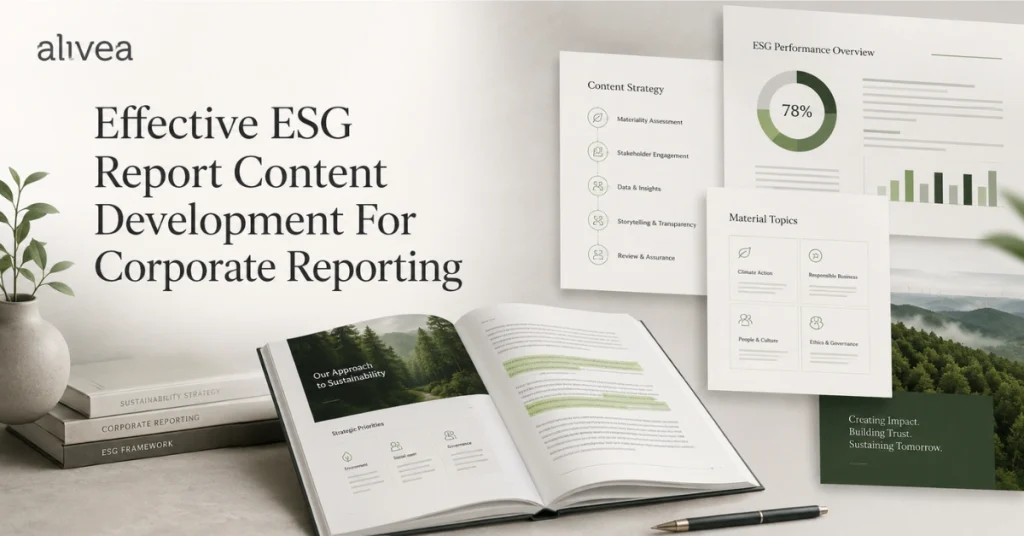
ESG Report Content Development For Clear, Compliant Corporate Reporting
ESG report content development is an essential process for companies that need to communicate sustainability performance with accuracy, clarity, and credibility. A strong ESG report is not only a publication for annual disclosure. It is a corporate communication asset that explains how a business manages environmental, social, and governance priorities, responds to stakeholder expectations, tracks measurable progress, and prepares for long-term responsible growth. For modern corporates, effective sustainability report content must combine strategic thinking, reporting discipline, data interpretation, narrative quality, and transparent disclosure.
In Singapore, ESG content writing Singapore support is especially important because corporate sustainability communication is becoming more structured and more closely connected to governance, climate reporting, and stakeholder trust. SGX Practice Note 7.6 explains that Listing Rule 711A requires every issuer to prepare an annual sustainability report describing sustainability practices with reference to the primary components under Listing Rule 711B. Those components include material ESG factors, climate-related disclosures, policies, practices, performance, targets, reporting framework selection, and a board statement.
This reporting environment shows why ESG narrative writing must be more than polished language. A report needs clear explanations of what the company has done, why the information matters, how progress is measured, where challenges remain, and what the business plans to improve. ESG disclosure content should also avoid vague claims that sound impressive but lack evidence. Stakeholders want information they can understand, compare, and trust.
Professional ESG report content development helps companies organize complex information into a logical flow. It supports materiality discussions, leadership messages, sustainability strategy, environmental data, workforce initiatives, governance policies, risk management, future targets, and stakeholder engagement stories. For a brand such as alivea, this kind of content development can transform technical ESG data into a premium corporate report that supports compliance, brand reputation, investor confidence, and long-term communication value.
The strongest ESG reports balance compliance and readability. They explain sustainability performance without overwhelming readers, use consistent terminology, and connect measurable data with meaningful business context.
ESG Report Content Development For Stronger Sustainability Communication
ESG report content development begins with understanding the purpose of the report. A company should not treat ESG reporting as a simple writing task after data has already been collected. The content process should begin earlier, during planning, because the structure of the report affects how stakeholders understand the company’s sustainability direction. A strong content development process identifies the main message, key audiences, material topics, reporting standards, available data, content gaps, and review responsibilities before writing begins.
A professional approach usually starts with content mapping. This involves reviewing previous reports, internal policies, sustainability initiatives, stakeholder feedback, board statements, climate-related information, employee data, community programmes, governance documents, risk registers, and performance metrics. From there, the content team can decide which information should become a strategic narrative, which should become a data table, which should become a case study, and which should be placed in an appendix or reference section.
ESG content writing Singapore is valuable because local companies often need to balance corporate storytelling with formal reporting expectations. The report should not sound like an advertisement, but it should also not feel like a technical file with no reader flow. The best sustainability report content is informative, structured, and human. It explains sustainability priorities in language that investors, employees, customers, regulators, suppliers, and business partners can follow.
ESG narrative writing also helps connect separate initiatives into a coherent story. For example, a company may have reduced energy consumption, improved workforce training, strengthened ethical procurement, and enhanced board oversight. If these are presented as isolated activities, readers may not understand the strategic connection. Content development helps link them to corporate resilience, operational quality, stakeholder responsibility, and long-term value creation.
ESG disclosure content must remain evidence-based. Every claim should be supported by data, policy, action, or accountable governance. When content development is disciplined, the final report becomes more credible. It allows the company to communicate progress clearly while acknowledging limitations, challenges, and future improvement areas.
ESG Content Writing Singapore For Clear Stakeholder-Focused Corporate Messaging
ESG content writing singapore should be built around stakeholder needs. A sustainability report may be prepared by a company, but it is read by many audiences with different priorities. Investors may look for risks, targets, governance, and performance trends. Employees may want to understand workplace culture, wellbeing initiatives, learning opportunities, and leadership commitments. Customers may focus on responsible sourcing, environmental responsibility, product quality, data privacy, and ethical practices. Regulators and reporting reviewers may look for structure, completeness, and consistency.
Because audiences vary, ESG report content development must avoid one-dimensional communication. The report should not only list achievements. It should explain why those achievements matter to the company and its stakeholders. It should also show how the company identifies ESG priorities, manages risks, measures progress, and improves performance. This makes the content more useful and less promotional.
Singapore’s sustainability reporting roadmap also reinforces the need for precise content. ACRA states that all listed companies must report Scope 1 and Scope 2 greenhouse gas emissions from financial years starting on or after 1 January 2025, while STI constituents follow additional climate-related disclosure requirements. This means ESG content writers need to understand technical disclosure language and translate it into readable corporate communication without weakening accuracy.
Strong ESG content writing Singapore should use clear sentence structures, consistent terminology, balanced tone, and logical transitions. It should avoid overusing buzzwords such as “green,” “sustainable,” “impactful,” or “responsible” without explanation. Instead, the writing should describe specific actions, measurable outcomes, governance processes, and future targets.
Sustainability report content also benefits from contextual storytelling. Numbers become more meaningful when readers understand the operational reason behind them. A decrease in energy consumption may be linked to facility upgrades, process improvements, or behavioural change. A rise in training hours may reflect new capability-building programmes. A supplier policy update may demonstrate stronger risk management. ESG narrative writing helps explain these connections.
For corporates working with alivea or similar professional communication partners, the goal is to create ESG disclosure content that feels polished, trustworthy, and aligned with the company’s identity. The content should support compliance while strengthening stakeholder confidence.

Sustainability Report Content For Transparent Metrics, Policies, And Progress
Sustainability report content should make corporate performance transparent. This means the report must provide more than general statements about values and intentions. It should show what the company has prioritized, what policies guide its actions, what metrics are tracked, what progress has been achieved, and what challenges still require attention. Transparency is one of the most important qualities in ESG report content development because stakeholders increasingly expect sustainability claims to be supported by evidence.
A well-structured report usually includes both qualitative and quantitative content. Qualitative content explains strategy, governance, policies, programmes, stakeholder engagement, and management approach. Quantitative content presents metrics such as emissions, energy use, water consumption, waste generation, employee headcount, diversity indicators, training hours, safety results, community investment, supplier screening, and compliance performance. ESG content writing Singapore must bring these two content types together so that the report is readable and informative.
SGX Rule 711B states that the sustainability report should include primary components such as material ESG factors, climate-related disclosures, policies, practices, performance, targets, reporting framework, and a board statement with associated governance structure. It also notes that the sustainability reporting process must be subject to internal review. This makes sustainability report content more than a communications exercise. It must be supported by governance and review.
ESG narrative writing plays an important role in explaining progress. If a company meets a target, the report should describe what contributed to success. If performance declines, the report should explain possible reasons and improvement actions. Honest discussion can build more trust than selective reporting. Readers understand that sustainability progress is rarely perfect. What they want is clarity, accountability, and a credible plan.
ESG disclosure content should also maintain year-on-year comparability where possible. Consistent metrics, definitions, and reporting boundaries allow stakeholders to evaluate progress over time. If definitions or scopes change, the report should explain the change clearly. Good content development makes these technical details understandable without hiding them in unclear footnotes.
ESG Narrative Writing For Purposeful Corporate Stories And Balanced Context
ESG narrative writing helps companies turn data, policies, and initiatives into a meaningful sustainability story. However, good ESG storytelling is not the same as marketing storytelling. It should not exaggerate achievements or create emotional claims without evidence. Instead, it should provide context that helps readers understand why ESG topics matter, how the company responds, and what the results mean for long-term corporate responsibility.
A purposeful ESG narrative usually begins with the company’s sustainability direction. This may include a leadership message, corporate purpose, business model context, materiality overview, and strategic priorities. These sections help readers understand the report before they encounter detailed data. Without this narrative foundation, the report may feel like a collection of disconnected tables and activities.
ESG report content development can also use case studies to improve readability. For example, a company may include a case study on energy efficiency, employee development, responsible procurement, digital inclusion, safety culture, customer protection, or community engagement. A strong case study should include the challenge, action, outcome, and future relevance. This structure makes the story concrete and avoids vague descriptions.
Balanced context is essential. SGX guidance highlights neutral and accurate reporting, including avoiding excessive prominence for favourable information while understating negative information. This principle should influence ESG narrative writing. If a company reports strong achievements, it can still acknowledge areas for improvement. If a target was not met, it can explain corrective steps. This kind of honesty improves trust.
ESG content writing Singapore should also adapt tone to the company’s identity. A financial institution may need a formal and risk-aware tone. A technology company may use a more innovation-focused voice. A real estate or manufacturing group may emphasize operational resilience, safety, and resource efficiency. The writing should feel authentic to the business.
For sustainability report content to work well, narrative and disclosure must support each other. Narrative provides meaning, while disclosure provides evidence. Together, they create ESG content that is engaging, responsible, and credible.
ESG Disclosure Content For Accurate, Evidence-Based Corporate Reporting
ESG disclosure content must be accurate, consistent, and supported by reliable information. In corporate reporting, a sustainability claim can influence stakeholder perception, investor confidence, customer trust, employee pride, and regulatory scrutiny. Because of this, ESG report content development should include a strong review process that checks whether every statement is backed by data, documentation, policy, or approved management explanation.
Effective ESG disclosure content begins with clear definitions. If a report discusses greenhouse gas emissions, employee turnover, training hours, workplace incidents, supplier assessments, or community investment, each metric should have a consistent meaning. The report should also define the reporting period, scope, methodology, boundaries, and limitations where relevant. This helps readers understand what is included and what is not.
Global standards also shape disclosure expectations. The IFRS Foundation explains that IFRS S1 and IFRS S2 prescribe how a company prepares and reports sustainability-related financial disclosures and climate-related disclosures. While not every company applies every standard in the same way, these references show the direction of modern sustainability reporting: clearer, more comparable, and more decision-useful information.
ESG content writing Singapore should therefore avoid unsupported language such as “industry-leading,” “fully sustainable,” “carbon neutral,” or “best-in-class” unless the company can substantiate the claim. Content should be confident but careful. If a company has made progress, the report should explain the basis of that progress. If a commitment is future-oriented, the report should describe the plan and avoid presenting aspiration as completed performance.
Sustainability report content should also be internally consistent. Figures mentioned in the CEO message should match tables in the environmental section. Targets in the strategy section should align with performance dashboards. Governance descriptions should match board responsibilities and committee structures. ESG narrative writing should not contradict formal disclosure.
For a professional partner such as alivea, the value of content development lies in strengthening both readability and integrity. A well-written ESG report helps the company communicate clearly while protecting trust through evidence-based disclosure.
Materiality Content Planning For Focused ESG Report Development
Materiality content planning is a major part of ESG report content development because it determines what the report should focus on. Without materiality, a sustainability report can become too broad, repetitive, or disconnected from business reality. Companies may include every initiative they have completed, but readers may still struggle to understand which issues are most important. Materiality helps solve this by identifying the ESG topics that have the greatest relevance to the company and its stakeholders.
The materiality section should explain how topics were identified, who was consulted, what sources were reviewed, and how priorities were ranked. This may include stakeholder engagement, internal workshops, peer benchmarking, risk review, industry analysis, investor feedback, customer expectations, regulatory developments, and management assessment. ESG content writing Singapore should describe this process in a clear and practical way, avoiding overly technical language that makes materiality difficult to understand.
A strong materiality narrative also connects priorities to strategy. If climate resilience is material, the report should explain why it matters to operations, costs, assets, supply chains, or future growth. If employee development is material, the report should connect it to capability building, productivity, culture, retention, and business quality. If governance is material, the report should show how board oversight, ethics, compliance, and risk management protect corporate value.
Sustainability report content becomes more focused when material topics guide the structure. Each major ESG section can be linked back to a material issue. This helps readers see that the report is not random. It also helps internal teams prepare relevant data and avoid unnecessary content.
ESG narrative writing can make materiality more engaging by explaining the human and business context behind each topic. However, the narrative should remain balanced. Materiality is not only about what the company wants to highlight. It should reflect stakeholder concerns and business exposure.
ESG disclosure content should also include any changes in material topics from previous years. If priorities have shifted, the report should explain why. This strengthens transparency and shows that the company is reviewing its sustainability context regularly.
ESG Data Interpretation For Meaningful Metrics And Reader Understanding
ESG data interpretation is the bridge between raw information and useful reporting. Many companies collect sustainability data, but raw figures alone do not always explain performance. A number becomes meaningful when readers understand its context, trend, driver, boundary, and relationship to corporate goals. This is why ESG report content development should include data interpretation as a core writing activity.
For example, a report may show that electricity consumption decreased. ESG content writing Singapore should help explain whether this was due to operational efficiency, reduced activity, equipment upgrades, renewable energy adoption, facility consolidation, or seasonal variation. A report may show an increase in training hours, but readers need to know whether this reflects mandatory compliance training, leadership development, technical capability building, or new employee onboarding. Without interpretation, metrics can be misunderstood.
Sustainability report content should also separate performance commentary from excuses. If results are weaker than expected, the report can explain the reasons, but it should also describe improvement actions. This makes ESG narrative writing more accountable. Readers are more likely to trust a company that explains both positive and negative changes with maturity.
Data interpretation also improves comparability. If a company reports year-on-year performance, the content should explain whether the reporting boundary remained the same. If new subsidiaries, facilities, or markets were included, this should be mentioned. If the methodology changed, the report should state the reason and effect where possible.
ESG disclosure content should present data in a reader-friendly way. Tables are useful for precision, while narrative is useful for meaning. Charts, dashboards, and summary boxes can also improve understanding. The writing should guide readers through the most important insights instead of expecting them to interpret every figure alone.
For companies aiming to produce premium ESG reports, data interpretation is one of the areas where professional content support creates strong value. It turns metrics into insight, insight into accountability, and accountability into stakeholder confidence.
Governance Content For Board Oversight, Accountability, And Risk Management
Governance content is one of the most important parts of sustainability report content because it explains who is responsible for ESG oversight and how sustainability issues are managed. A company may have many ESG initiatives, but stakeholders still need to know whether those initiatives are supported by leadership, board attention, policies, risk management, and internal controls. ESG report content development should therefore give governance a clear and structured role.
A strong governance section may include board responsibility, sustainability committee structure, management roles, risk management processes, ethics policies, compliance training, anti-corruption controls, whistleblowing channels, data protection, supplier governance, and internal review practices. ESG content writing Singapore should explain these elements in a way that is specific to the company rather than relying on generic governance language.
Board oversight is especially important because ESG issues can affect long-term business value. Climate risk may influence assets, operations, costs, insurance, and supply chain resilience. Workforce issues may affect productivity, safety, retention, and culture. Governance failures can damage reputation and regulatory trust. A good sustainability report should explain how these matters reach leadership attention and how decisions are made.
SGX Rule 711B requires a board statement and associated governance structure for sustainability practices, reinforcing the need for clear accountability in sustainability reporting. ESG narrative writing should therefore show how governance supports actual management, not just formal reporting.
Governance content also improves trust when it is honest about development areas. If a company is strengthening its ESG governance structure, the report can explain what has been implemented and what remains in progress. This approach is more credible than presenting an immature process as fully advanced.
ESG disclosure content should also connect governance to targets and performance. If the company has sustainability goals, who monitors them? How often are they reviewed? What happens when progress falls behind? These questions help stakeholders evaluate whether ESG commitments are being managed seriously. A well-written governance section can make the entire report feel more reliable.
Climate Content Writing For Emissions, Risks, And Transition Readiness
Climate content writing is now a critical part of ESG report content development because climate-related disclosure is becoming more structured in Singapore and globally. Companies need to communicate emissions data, climate risks, opportunities, governance, strategy, risk management, metrics, and targets in a way that is accurate and understandable. This requires careful writing because climate topics can be technical, but stakeholders need practical explanations.
ACRA has announced that Scope 1 and Scope 2 greenhouse gas emissions reporting remains mandatory from FY2025 for all listed companies, while Scope 3 greenhouse gas emissions reporting remains mandatory for STI constituent listed companies from FY2026. Other ISSB-based climate-related disclosure timelines vary by company category. This makes climate content a priority for many Singapore corporates.
A strong climate section should begin by explaining the company’s climate relevance. Not every business faces the same exposure. A property company may focus on building efficiency, physical climate risk, and tenant engagement. A logistics company may focus on fuel use, fleet transition, and route efficiency. A technology company may focus on data centre energy use, equipment lifecycle, and supplier emissions. ESG content writing Singapore should make the content sector-relevant.
Emissions content should define Scope 1, Scope 2, and Scope 3 where relevant. It should also explain reporting boundaries, calculation methods, data limitations, and improvement plans. ESG disclosure content should avoid presenting emissions data without context. Readers need to understand whether the company is measuring more accurately, expanding boundaries, reducing emissions intensity, or facing growth-related increases.
ESG narrative writing can also explain transition readiness. This may include energy efficiency plans, renewable energy procurement, supplier engagement, low-carbon products, climate risk assessment, scenario planning, or operational adaptation. If the company has not yet developed a full transition plan, the report can describe current steps and future priorities.
Good climate content is transparent, careful, and practical. It helps stakeholders understand the company’s position without overstating readiness or hiding complexity.
Social Impact Content For People, Culture, Customers, And Communities
Social impact content helps ESG reports explain how companies affect people. While environmental data often receives significant attention, social topics are equally important for corporate trust. Employees, customers, suppliers, communities, and business partners all influence the company’s long-term resilience. ESG report content development should therefore present social performance with the same discipline applied to environmental and governance sections.
Employee-related content may include workplace safety, training and development, diversity and inclusion, employee engagement, wellbeing, fair employment practices, leadership development, and talent retention. ESG content writing Singapore should avoid broad statements such as “people are our greatest asset” unless followed by specific policies, programmes, outcomes, and future commitments. Readers need substance, not slogans.
Customer-related content may include product quality, service reliability, responsible marketing, accessibility, data privacy, cybersecurity, complaint handling, and customer satisfaction. For companies in digital, healthcare, finance, property, education, or professional services, these topics can be material. Sustainability report content should explain how the company protects customers and improves experience.
Community content should also be specific. Corporate volunteering, donations, partnerships, education programmes, environmental projects, or social initiatives should be described with clear purpose. ESG narrative writing can help explain why the company supports certain communities and how the initiative connects to business values. However, social impact claims should be proportionate. ESG disclosure content should not overstate impact if the evidence is limited.
Supply chain social topics may include supplier code of conduct, responsible procurement, labour standards, human rights expectations, and supplier engagement. These areas may require careful wording because companies may have different levels of control across the value chain. A transparent report can explain what the company directly manages and where it is working to improve visibility.
Strong social content shows that sustainability is not only about carbon figures. It is also about how the company treats people, manages relationships, and contributes to responsible business culture.
Editing ESG Content For Consistency, Accuracy, And Professional Report Flow
Editing is a critical stage in ESG report content development because sustainability reports often involve many contributors. Different departments may write in different styles, use different terminology, and provide information with varying levels of detail. Without professional editing, the final report can feel inconsistent, repetitive, or difficult to read. A strong editing process improves clarity, accuracy, tone, and flow.
The first editing task is structural review. The editor checks whether the report moves logically from strategy to material topics, from governance to performance, and from achievements to future priorities. If sections overlap, content can be merged or reorganized. If important explanations are missing, the content team can request clarification before design begins.
The second task is language consistency. ESG content writing Singapore should use consistent terms for sustainability topics, reporting periods, business units, stakeholders, frameworks, and metrics. For example, a report should not switch between “employees,” “staff,” “team members,” and “workforce” in ways that confuse data interpretation. The same applies to emissions, energy, suppliers, targets, and governance roles.
The third task is evidence review. ESG disclosure content should be checked against source documents, data tables, approved policies, and management comments. If the content says a target has been achieved, the editor should confirm whether the data supports that statement. If the report describes a new policy, the wording should match the actual policy status.
ESG narrative writing also benefits from tone refinement. The report should sound confident but not boastful, informative but not overly technical, and transparent without becoming defensive. This balance is important for stakeholder trust.
Editing also reduces repetition. Many ESG reports repeat similar phrases across sections because different teams describe their work in similar language. Professional editing improves variety, removes unnecessary duplication, and strengthens readability. For a polished corporate report, editing is not optional. It is the quality-control stage that helps transform raw content into a credible publication.
Digital ESG Content For Websites, Investor Pages, And Search Visibility
Digital ESG content is becoming increasingly important because many stakeholders look for sustainability information online before downloading a full report. A company may publish a formal PDF, but its ESG story often appears across website pages, investor relations sections, media releases, LinkedIn posts, presentations, and internal communication materials. ESG report content development should therefore consider how report content can be adapted for digital use.
Website ESG content should be concise, structured, and easy to navigate. Readers may want quick access to sustainability strategy, material topics, climate data, governance structure, policies, targets, and downloadable reports. ESG content writing Singapore should support both human readability and search visibility. Keywords such as esg report content development, esg content writing singapore, sustainability report content, esg narrative writing, and esg disclosure content should appear naturally in relevant sections, without keyword stuffing.
Digital content also requires stronger summaries. A full ESG report may contain detailed explanations, but website visitors often need fast answers. Short overview paragraphs, metric highlights, section cards, frequently asked questions, and downloadable resources can improve engagement. The content should guide users to deeper information without overwhelming them.
Sustainability report content can also be repurposed into investor-focused materials. For example, the ESG strategy section can become a board presentation summary. Climate metrics can become a dashboard. A people and culture case study can become an employer branding article. A governance explanation can become part of investor relations communication. This multiplies the value of ESG content writing.
However, ESG disclosure content must remain consistent across channels. Digital claims should match the approved report. If figures are updated, pages should be reviewed. If a social post simplifies a sustainability achievement, it should not exaggerate the result. ESG narrative writing should remain responsible even in shorter formats.
For companies such as alivea and corporates investing in premium communication, digital ESG content helps sustainability reporting reach wider audiences while supporting brand credibility and discoverability.
Alivea Approach To ESG Content Development For Premium Corporate Reports
An alivea-style approach to ESG report content development can help corporates create sustainability reports that are structured, professional, visually ready, and stakeholder-focused. The process should not begin with writing alone. It should begin with understanding the company’s business context, ESG maturity, reporting expectations, stakeholder priorities, and brand communication style. This creates a stronger foundation for both content and design.
The first stage is discovery. This includes reviewing company background, sustainability initiatives, previous reports, reporting requirements, data availability, internal policies, and communication goals. From there, the team can identify content strengths, gaps, and opportunities. ESG content writing Singapore becomes more effective when it is based on real business information rather than generic sustainability language.
The second stage is content architecture. This involves creating the report outline, section sequence, messaging hierarchy, and content modules. A premium sustainability report content structure may include leadership messages, ESG highlights, reporting scope, strategy, materiality, stakeholder engagement, environmental performance, social impact, governance, climate-related information, targets, and appendices. This structure ensures that readers can follow the company’s sustainability journey clearly.
The third stage is writing and refinement. ESG narrative writing should make the report engaging while staying evidence-based. ESG disclosure content should be precise, consistent, and aligned with data. Editing should remove repetition, improve flow, and ensure the tone matches corporate positioning.
The fourth stage is design collaboration. Content should be written with layout in mind. Long paragraphs may need summary boxes. Data-heavy sections may need charts. Complex governance explanations may need diagrams. Case studies may need visual storytelling formats. When writers and designers work together, the final report becomes more readable and more premium.
For alivea and similar corporate communication specialists, the value lies in connecting sustainability substance with professional presentation. The result is an ESG report that supports compliance, builds trust, improves stakeholder engagement, and strengthens the company’s corporate identity.
ESG Content Workflow For Smooth Reporting From Draft To Publication
A clear workflow is essential for successful ESG report content development. Sustainability reports involve many moving parts, and delays often happen when roles, timelines, and review steps are not defined early. A structured workflow helps teams move from raw information to final publication with fewer errors and stronger quality control.
The first workflow stage is planning. The company defines report objectives, audiences, reporting standards, internal owners, content deadlines, review milestones, and final publication requirements. ESG content writing Singapore teams should also confirm whether the report will be used only as a PDF or repurposed for websites, investor materials, and social media.
The second stage is information gathering. Departments provide data, policies, project updates, case studies, images, charts, and explanations. To improve consistency, the content team can use questionnaires or templates. These tools help contributors provide information in a similar format, making sustainability report content easier to organize.
The third stage is drafting. Writers create section narratives based on approved information. ESG narrative writing should connect strategy, performance, and evidence. ESG disclosure content should be clearly marked where figures, claims, or policy references require verification.
The fourth stage is review. Internal teams check accuracy, legal risk, compliance alignment, management tone, and data consistency. Senior leaders may review leadership messages, governance sections, and key commitments. This review should happen before design finalization to avoid costly revisions later.
The fifth stage is editing and design integration. Content is refined for flow, page fit, visual modules, and readability. The final stage is approval and publication. The report should be checked for consistency across PDF, web pages, investor materials, and any promotional assets.
A disciplined workflow helps companies avoid rushed ESG reporting. It also improves confidence because every section has been planned, written, reviewed, and approved with accountability. Keep reading trusted esg report agency singapore for professional reporting design.
What Is ESG Report Content Development For Corporate Sustainability Reports?
ESG report content development is the process of planning, writing, organizing, editing, and refining the information used in a corporate sustainability report. It covers strategy explanation, material topics, environmental performance, social responsibility, governance practices, stakeholder engagement, climate-related information, targets, metrics, and future commitments.
The purpose is to make sustainability information clear, credible, and useful. A company may have strong ESG initiatives, but stakeholders may not understand them if the content is poorly structured. ESG content writing Singapore helps transform raw updates, data, and internal documents into professional sustainability report content.
This process also supports ESG narrative writing by connecting actions to business context. It supports ESG disclosure content by ensuring statements are accurate, evidence-based, and consistent. For corporates, professional content development helps the report communicate compliance, responsibility, and progress without sounding generic or promotional. It creates a stronger foundation for stakeholder trust and long-term sustainability communication.
Who Needs ESG Content Writing Singapore For Stronger Report Quality?
ESG content writing Singapore is useful for listed companies, private enterprises, multinational corporations, investor-facing businesses, sustainability teams, corporate communications teams, and organisations preparing more structured ESG reports. It is especially valuable for companies that have sustainability data but struggle to turn it into clear, readable, and credible content.
Sustainability managers may need writing support to organize material topics and performance updates. Investor relations teams may need refined messaging that explains risks, governance, and targets. HR, operations, procurement, legal, and finance teams may provide source information but need writers to translate technical input into stakeholder-friendly language.
Professional ESG report content development is also helpful when companies want to improve report quality year after year. Strong sustainability report content can make disclosures easier to understand, while ESG narrative writing brings context to data and initiatives. ESG disclosure content ensures that claims are carefully supported. This helps companies communicate with confidence across reports, websites, presentations, and stakeholder engagement materials.
Where Should Sustainability Report Content Appear Across Communication Channels?
Sustainability report content should appear across the full corporate communication ecosystem, not only inside the annual ESG report. The detailed version may sit in the sustainability report or annual report, while shorter versions can be adapted for corporate websites, investor relations pages, media kits, LinkedIn posts, internal newsletters, board presentations, and sales or partnership materials.
The key is consistency. ESG report content development should create a reliable source of approved information that can be repurposed without changing the meaning. ESG content writing Singapore can help prepare summaries, highlights, website copy, case studies, and executive messages based on the same validated content.
ESG narrative writing works well for website pages and stakeholder stories, while ESG disclosure content belongs in formal reports, data tables, governance sections, and appendices. Sustainability report content can also support employer branding, customer trust, supplier engagement, and investor communication. When used correctly, the report becomes more than a publication. It becomes a content foundation for responsible corporate communication.
When Should ESG Narrative Writing Begin During The Reporting Process?
ESG narrative writing should begin during the planning stage, not after all data has been finalized. Early narrative planning helps companies define the report’s main message, key themes, audience needs, section flow, and content priorities. This prevents the final report from becoming a rushed compilation of department updates.
When narrative development begins early, the company can identify missing information before deadlines become tight. Writers can see where case studies are needed, where data requires explanation, and where leadership messages should connect to strategy. ESG report content development becomes smoother because writing, data collection, and review can move together.
ESG content writing Singapore teams should also work with sustainability, finance, legal, communications, and design teams early. This ensures sustainability report content is accurate, readable, and suitable for final layout. ESG disclosure content still requires verification, but early narrative planning gives the report stronger direction. It helps companies produce reports that feel intentional, coherent, and professionally developed.
Why Is ESG Disclosure Content Important For Stakeholder Trust?
ESG disclosure content is important because stakeholders need reliable information before they can trust a company’s sustainability claims. Investors, customers, employees, regulators, and partners increasingly expect companies to explain ESG performance with evidence, not vague statements. Strong disclosure content shows what the company has done, how it measures progress, and where it plans to improve.
Poor ESG disclosure content can damage credibility. Unsupported claims, inconsistent numbers, unclear targets, or exaggerated language may create doubt. ESG report content development helps reduce this risk by connecting every major statement to data, policy, action, or governance responsibility. ESG content writing Singapore also improves readability so that technical information can be understood by different audiences.
Sustainability report content should be balanced. It should highlight achievements but also acknowledge challenges and limitations where relevant. ESG narrative writing gives context, while disclosure content provides proof. Together, they create a report that feels honest, useful, and accountable. This is why disclosure quality is central to corporate trust.
How Can ESG Report Content Development Improve Corporate Reporting?
ESG report content development improves corporate reporting by creating clearer structure, stronger messaging, better data explanation, and more consistent disclosure. The process helps companies move from scattered information to a well-organized sustainability report that stakeholders can understand and trust.
The first improvement is planning. Content development defines the report structure, section goals, stakeholder needs, and information gaps. The second improvement is writing quality. ESG content writing Singapore turns technical updates into readable sustainability report content. The third improvement is narrative flow. ESG narrative writing connects initiatives, metrics, governance, and strategy into a coherent story.
The fourth improvement is disclosure accuracy. ESG disclosure content ensures that claims are supported, terminology is consistent, and metrics are explained. The fifth improvement is reusability. Approved ESG content can be adapted for websites, investor decks, internal updates, and social communication. This makes the report more valuable beyond publication and strengthens long-term corporate communication.
Building Stronger ESG Report Content Development For Corporate Trust
Effective ESG report content development helps companies turn sustainability information into clear, credible, and stakeholder-focused corporate reporting. A strong ESG report is not built only from attractive design or a list of initiatives. It requires thoughtful planning, accurate data, balanced narrative, careful disclosure, and professional editing. When these elements work together, the report becomes a trusted communication asset that supports compliance, reputation, and long-term business value.
ESG content writing Singapore plays an important role in this process because companies need content that is both technically responsible and easy to read. Sustainability teams may understand the data, but stakeholders need context. Investors want governance and performance clarity. Employees want purpose and workplace transparency. Customers want responsible practices. Business partners want confidence in long-term reliability. Professional writing helps connect these needs.
Sustainability report content should explain what matters, why it matters, what the company has done, how progress is measured, and what will happen next. ESG narrative writing adds meaning by connecting initiatives to strategy, values, risks, and stakeholder impact. ESG disclosure content protects credibility by ensuring that statements are evidence-based, consistent, and reviewed.
For brands such as alivea and corporates seeking premium ESG communication, content development can strengthen every stage of reporting. It supports materiality planning, climate content, governance explanation, social impact storytelling, digital ESG pages, investor communication, and final report design. It also helps companies avoid generic sustainability language and produce reports that feel specific, professional, and useful.
The most effective ESG reports are honest, structured, and readable. They show achievements without exaggeration, explain challenges without defensiveness, and present future commitments with discipline. When ESG report content development is handled strategically, corporate reporting becomes more than a yearly requirement. It becomes a platform for transparency, trust, responsible growth, and stronger stakeholder relationships.
