
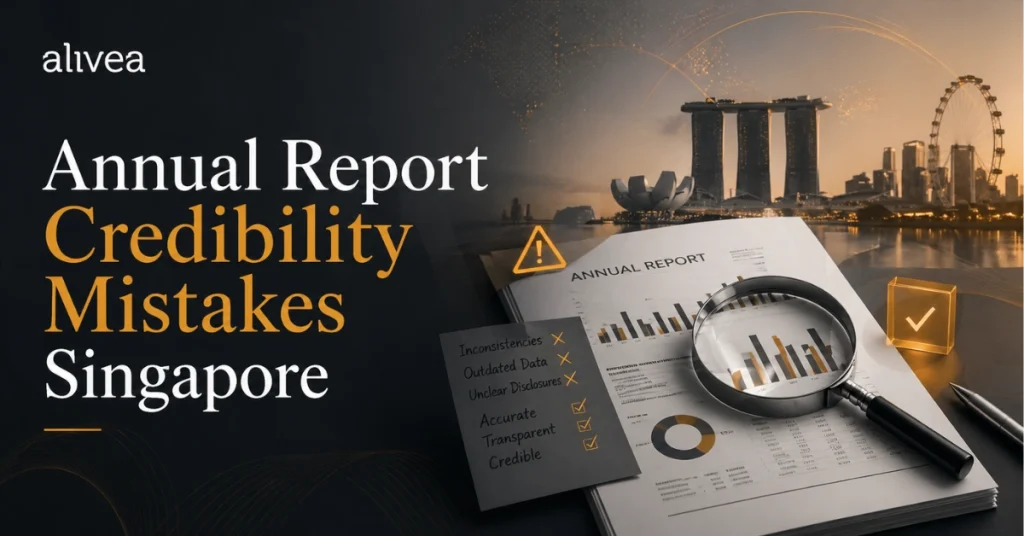
Annual Report Credibility Mistakes That Weaken Investor Confidence in Singapore
Annual report credibility can be damaged by small mistakes that appear harmless at first but create doubt when investors read the full report. In Singapore’s competitive business environment, annual reports are not only compliance documents. They are communication tools that help shareholders, analysts, lenders, business partners, and potential investors understand the company’s performance, governance, risk position, and long-term direction. When the report is unclear, inconsistent, or poorly explained, it can weaken confidence even when the company has solid business results.
One common problem is treating the annual report as a collection of required sections instead of a complete investor communication experience. A company may include financial statements, chairman messages, governance disclosures, and sustainability updates, but if these sections do not connect logically, the report can feel fragmented. Investors may struggle to understand how performance relates to strategy or how management decisions support future value.
Annual report design investor trust depends on clarity, consistency, and evidence. If figures are difficult to compare, charts are poorly labeled, or explanations are too vague, readers may question whether the company is communicating transparently. Investor communication design should help stakeholders move through the report with confidence, not force them to interpret scattered information on their own.
Financial storytelling design is also often misunderstood. Some companies use storytelling as a promotional technique rather than a disciplined explanation of business performance. A credible story should connect data, decisions, risks, and outcomes. It should not exaggerate success or ignore difficult issues. A strong investor relations report builds trust by explaining both progress and pressure with maturity.
For brands such as alivea and professional reporting teams, avoiding these mistakes is essential. Annual reports should be designed to inform, guide, and reassure stakeholders through accurate data and clear communication. When companies understand what reduces annual report credibility, they can create reports that feel more transparent, more professional, and more useful for investor decision-making.
Annual Report Credibility Errors That Make Business Information Less Trustworthy
Annual report credibility often declines when companies fail to present information in a way that feels accurate, complete, and easy to verify. Investors are trained to notice inconsistencies. They compare financial highlights with detailed statements, review current performance against past years, and examine whether management commentary matches the numbers. If the report contains unclear data or unsupported claims, trust can weaken quickly.
One major mistake is inconsistent financial presentation. For example, a company may use one figure in the executive summary, another figure in a chart, and a slightly different number in the financial review. Even when the difference results from rounding or classification, the report should explain it clearly. Without explanation, investors may suspect poor internal review. Annual report credibility depends on data discipline, especially when readers use the report to evaluate business quality.
Another mistake is using vague language instead of specific explanation. Words such as “strong,” “robust,” “improved,” or “resilient” can be useful only when supported by evidence. If a company says it delivered resilient performance, investors need to understand what made the performance resilient. Was it stable revenue, diversified income, cost control, cash flow strength, or customer retention? Without proof, the statement feels promotional.
Annual report design investor trust is also reduced when difficult information is hidden or minimized. Investors understand that companies face market pressure, cost increases, regulatory changes, operational disruptions, and strategic uncertainty. A report becomes more credible when it explains these issues responsibly. Avoiding them may create the impression that management is not being fully transparent.
Investor communication design should help readers identify key facts, not bury them in dense sections. Clear headings, readable tables, fair charts, explanatory notes, and logical page flow can improve trust. Financial storytelling design should connect the evidence into a balanced narrative, showing what happened and why it matters.
A strong investor relations report must be built on reliable information and responsible presentation. The goal is not to make every result look positive. The goal is to make every important message understandable, supportable, and credible.
Annual Report Design Investor Trust Reduced by Weak Visual and Data Choices
Annual report design investor trust can be reduced when visual design choices create confusion or appear to overstate performance. Design should make information clearer, not more difficult to evaluate. Investors may not consciously analyze every design decision, but they often notice when a report feels crowded, inconsistent, or visually misleading.
One common mistake is using charts that lack proper labels, units, time periods, or explanations. A chart may look professional, but if readers cannot quickly understand what it represents, it fails as investor communication. Charts should show what is being measured, which period is being compared, and why the information matters. Annual report credibility weakens when visuals appear decorative rather than informative.
Another mistake is using unfair visual emphasis. If a graph scale exaggerates minor growth or makes a decline appear less serious, investors may question the company’s honesty. Design should never manipulate perception. Annual report design investor trust grows when data visualization is balanced, transparent, and easy to verify.
Crowded layouts are also harmful. Some reports try to include too much information on one page. Long paragraphs, multiple charts, small tables, icons, quotes, and decorative graphics can compete for attention. Instead of improving communication, the page becomes difficult to read. Investor communication design should create hierarchy so readers know what to focus on first, what supports the message, and where to find deeper details.
Poor typography can also reduce credibility. Text that is too small, line spacing that is too tight, inconsistent fonts, and weak contrast can make the investor relations report tiring to read. Digital versions must also remain readable on screen. If investors need to zoom repeatedly or struggle with table formatting, the report does not respect the reader’s time.
Financial storytelling design depends on clear visual support. Performance dashboards, timelines, strategy maps, and business model diagrams can strengthen the report only when they explain meaningful information. Visual elements should connect numbers with context, not simply make the report look modern.
For Singapore companies, design quality is part of market communication. A visually confused report can suggest weak communication discipline. A clear and purposeful report helps investors evaluate information with greater confidence.

Investor Communication Design Mistakes That Create Confusion for Stakeholders
Investor communication design mistakes often occur when companies forget that different stakeholders read annual reports for different reasons. Shareholders may focus on returns and governance. Analysts may study segment performance, margins, cash flow, and risk. Lenders may review debt, liquidity, and capital structure. Employees may look for business direction. A report that does not support these different reading needs can create confusion.
One common mistake is poor information architecture. Annual reports should guide readers through a logical journey. A company overview, leadership message, strategy section, performance review, governance explanation, risk discussion, sustainability update, and financial statements should connect naturally. When sections appear in an unclear order, the report feels harder to use. Annual report credibility improves when readers can understand the structure immediately.
Another mistake is overloading the report with internal language. Companies sometimes use terminology that makes sense to internal teams but does not help outside readers. Acronyms, technical labels, department-specific phrases, and unexplained metrics can make the investor relations report less accessible. Investor communication design should translate internal complexity into clear external communication.
Weak section headings also reduce clarity. Generic titles such as “Our Progress” or “Performance Update” may not tell investors enough. More specific headings can help readers understand the value of each section. Good headings are not only decorative; they are navigation tools. They help investors find information faster and improve the reading experience.
Annual report design investor trust is also affected by inconsistent messaging. If the chairman’s statement emphasizes transformation but the financial review focuses only on short-term performance, the report may feel disconnected. If the sustainability section presents priorities that do not appear anywhere else in the strategy discussion, readers may wonder whether those priorities are truly integrated.
Financial storytelling design can solve this problem by creating a consistent narrative across the report. The company should identify the year’s main business story and support it through data, commentary, visuals, and future outlook. This does not mean repeating the same sentence in every section. It means aligning the report around a clear strategic message.
A strong investor communication design approach reduces effort for the reader. It makes the report easier to scan, easier to understand, and easier to trust. When stakeholders can find answers without frustration, annual report credibility becomes stronger.

Financial Storytelling Design Errors That Turn Reporting Into Promotion
Financial storytelling design becomes a problem when companies use it as promotion instead of explanation. Storytelling should help investors understand financial results, business decisions, market conditions, and future priorities. It should not turn the annual report into a marketing brochure that avoids difficult facts or exaggerates achievements.
One common mistake is creating a story that is not supported by evidence. A company may describe a year of transformation, innovation, or resilience, but if the report does not provide measurable indicators, operational examples, or clear financial context, investors may doubt the message. Annual report credibility depends on proof. A story without evidence can weaken trust.
Another mistake is presenting only positive developments. Investors know that businesses face challenges. A report that highlights growth, awards, expansion, and achievements while ignoring cost pressure, market uncertainty, operational risk, or strategic trade-offs can feel incomplete. Annual report design investor trust grows when the report discusses both success and difficulty with balance.
Financial storytelling design should also avoid unclear cause-and-effect claims. If the report says a strategy improved performance, it should explain how. Did the company reduce costs, enter new markets, improve productivity, strengthen customer retention, or invest in technology? Investors need to understand the connection between management action and business outcome.
Investor communication design can help by structuring the story carefully. The annual report can move from market context to strategic priorities, then to financial results, operational response, risk management, and future outlook. This sequence gives the investor relations report a clear narrative arc without making it feel artificial.
Another mistake is using emotional language where factual explanation is needed. Words such as “remarkable,” “exceptional,” or “unmatched” can sound excessive if they are not backed by data. A more credible tone is specific, measured, and evidence-based. Investors often trust reports that sound disciplined more than reports that sound enthusiastic.
Good financial storytelling design should make the company understandable. It should explain what happened, why it happened, what management learned, and what comes next. When storytelling serves clarity rather than promotion, the report becomes more credible, more useful, and more valuable for investor confidence.
Investor Relations Report Weaknesses That Harm Long-Term Market Confidence
An investor relations report can harm long-term market confidence when it fails to serve as a reliable source of corporate information. Annual reports are often archived, compared, quoted, and reviewed long after publication. Investors may study several years of reports to evaluate whether management communicates consistently. Weaknesses in one report can therefore affect perception beyond a single reporting cycle.
One mistake is treating the investor relations report as a one-time design project instead of part of a continuing communication system. Each report should connect with previous years while explaining current developments. If metrics change without explanation or reporting frameworks shift too often, investors may struggle to compare progress over time. Annual report credibility depends on continuity as well as current-year presentation.
Another weakness is poor digital access. Many stakeholders now access annual reports through websites, PDF files, investor portals, and mobile devices. If report links are difficult to find, files are poorly named, archives are incomplete, or digital pages are not searchable, investors may experience unnecessary friction. Investor communication design should include digital usability, not only printed layout quality.
Annual report design investor trust can also decline when investor relations information is inconsistent across channels. If the annual report, investor presentation, website summary, and shareholder materials use different figures or language, stakeholders may become uncertain. A strong investor relations report should align with broader corporate communication.
Financial storytelling design should also remain consistent over time. A company should not change its story every year without explaining why. If strategic priorities shift, the report should clarify the reason. If performance indicators change, the report should explain the new approach. Investors want to see that management is thoughtful, not reactive.
Another common weakness is failing to anticipate investor questions. A strong report should address likely concerns before stakeholders ask them. If debt increased, explain the purpose. If margins declined, explain the drivers. If risks changed, explain the response. If growth slowed, explain the market context. This level of transparency improves annual report credibility.
A strong investor relations report builds market confidence by being dependable, accessible, and strategically aligned. It shows that the company understands stakeholder expectations and values long-term trust. Here’s what to read next annual report design that builds trust with investors.

What Common Mistakes Damage Annual Report Credibility in Singapore?
Common mistakes that damage annual report credibility include inconsistent financial figures, unclear charts, vague management commentary, weak disclosure, poor structure, and overly promotional storytelling. These issues make it harder for investors to understand the company’s real performance and future direction.
A report may contain accurate information, but if that information is difficult to locate or poorly explained, trust can still decline. Annual report design investor trust depends on clear evidence, fair data visualization, and honest context. Investors want to understand not only what happened, but why it happened.
Investor communication design helps prevent these mistakes by organizing the report around stakeholder needs. Financial storytelling design adds meaning by connecting results with business decisions. A strong investor relations report should be transparent, balanced, and easy to navigate. When companies avoid confusion and unsupported claims, they create a stronger foundation for investor confidence.
Who Should Review Annual Reports Before Investors Find Credibility Gaps?
Annual reports should be reviewed by a cross-functional team before publication. Finance teams should verify data accuracy. Investor relations teams should assess stakeholder relevance. Leadership should confirm strategic messaging. Governance teams should review board and compliance information. Designers should check readability, structure, and visual clarity.
This collaborative review helps protect annual report credibility. If only one department reviews the report, important issues may be missed. Financial data may be correct but difficult to understand. Design may look attractive but fail to support investor communication. Strategy may sound strong but lack supporting evidence.
Annual report design investor trust improves when every part of the investor relations report is checked from the reader’s perspective. Investor communication design and financial storytelling design should be reviewed together, not separately. The final report should feel accurate, coherent, transparent, and useful for stakeholders who need to evaluate the company seriously.

Where Do Credibility Problems Usually Appear Inside Investor Reports?
Credibility problems often appear in financial highlights, performance reviews, charts, governance sections, risk disclosures, sustainability updates, and future outlook pages. These areas carry high investor importance, so mistakes can quickly reduce annual report credibility.
Financial highlights may create doubt if figures do not match detailed statements. Charts may weaken trust if they lack labels or use misleading scales. Governance sections may feel weak if they are difficult to review. Risk disclosures may appear incomplete if they list risks without explaining management response.
Investor communication design should make these sections clear, readable, and connected. Annual report design investor trust grows when important information is not hidden or poorly structured. Financial storytelling design should connect each section to the wider business narrative.
A strong investor relations report allows stakeholders to move from summary information to detailed evidence without confusion. When credibility problems are corrected in these key areas, the report becomes more dependable.
When Do Annual Report Mistakes Become Serious Investor Concerns?
Annual report mistakes become serious investor concerns when they affect trust, interpretation, or decision-making. Small formatting issues may not harm credibility deeply, but inconsistent figures, vague disclosures, misleading visuals, missing context, or unsupported claims can create real concern.
Investors become especially alert when performance changes significantly. If revenue falls, margins decline, debt rises, risks increase, or strategy shifts, the report must explain these changes clearly. Annual report credibility depends on how responsibly the company handles sensitive information.
Annual report design investor trust can decline when investors feel the company is avoiding difficult topics. Investor communication design should make important explanations easy to find. Financial storytelling design should provide context without exaggeration.
Mistakes are also more serious when they repeat across multiple years. A weak investor relations report may be forgiven once, but repeated confusion can damage market confidence. Companies should treat annual reporting as an ongoing trust-building responsibility.
Why Poor Investor Communication Design Reduces Market Confidence?
Poor investor communication design reduces market confidence because it makes company information harder to understand and evaluate. Investors may question the quality of management communication when the report is confusing, inconsistent, or poorly organized.
A weak report creates friction. Readers may struggle to find financial results, compare performance, understand strategy, or assess governance. This weakens annual report credibility because investors depend on clear information to make decisions. If the report does not explain the business well, stakeholders may wonder what else is unclear.
Annual report design investor trust is built through structure, readability, and transparent evidence. Financial storytelling design also matters because investors need context behind the numbers. Without a clear story, the investor relations report may feel like a set of disconnected sections.
Market confidence improves when companies communicate with discipline. Clear investor communication design shows that the company respects stakeholders and understands the importance of transparency.
How Can Companies Prevent Financial Storytelling Design Mistakes?
Companies can prevent financial storytelling design mistakes by grounding every narrative in evidence. The annual report should not claim growth, resilience, innovation, or transformation unless it provides clear support. Data, examples, management explanation, and performance indicators should all connect to the story.
The first step is to define the real business theme of the year. The company should identify what truly shaped performance, such as market demand, cost pressure, investment, expansion, risk management, or operational improvement. The investor relations report should then explain this theme with balance.
Annual report credibility improves when the story includes both achievements and challenges. Annual report design investor trust grows when investors see honest context. Investor communication design can support the process through logical section flow, useful charts, readable summaries, and clear navigation.
Companies should also review tone carefully. Financial storytelling design should sound professional and measured, not exaggerated. When storytelling explains rather than promotes, investors gain a clearer and more reliable view of the business.
Avoiding Credibility Mistakes Builds Stronger Annual Report Confidence
Avoiding common reporting mistakes is essential for any Singapore company that wants to build annual report credibility and strengthen investor confidence. Annual reports are not judged only by their design quality or word count. They are judged by how clearly, accurately, and responsibly they communicate business performance, governance, risk, and future direction.
The most damaging mistakes often involve inconsistency, vague explanations, misleading visuals, weak structure, poor digital access, and unsupported storytelling. These issues can make investors question whether the company manages information carefully. Even when financial results are strong, poor communication can weaken market perception.
Annual report design investor trust grows when the report is built around transparency and evidence. Investors should be able to understand what happened during the year, why it happened, how management responded, and what the company plans next. The report should make key information easy to find and easy to verify.
Investor communication design plays a major role in preventing credibility problems. Strong structure, clear headings, readable charts, consistent terminology, and logical navigation help stakeholders move through the report with confidence. A well-designed report reduces confusion and shows respect for the reader’s time.
Financial storytelling design should also be handled carefully. A credible story connects data with context. It explains results without exaggeration and discusses challenges without avoidance. It helps investors understand the company’s business logic and leadership thinking.
A dependable investor relations report should work across print, PDF, website, presentation, and digital channels. Consistency across these touchpoints reinforces trust. When investors see the same clear message supported by the same reliable data, confidence becomes stronger.
Brands such as alivea and professional annual report design partners can help companies avoid common mistakes by aligning strategy, content, design, and disclosure. The goal is not only to create a beautiful report. The deeper goal is to create a credible communication asset.
In conclusion, companies can protect annual report credibility by improving accuracy, structure, transparency, investor communication design, and financial storytelling design. When these elements work together, the annual report becomes more than a yearly requirement. It becomes a powerful tool for building trust, reducing uncertainty, and supporting long-term investor confidence.
