
Annual Report Layout Guide for Clearer Corporate Communication in Singapore
A strong annual report is not simply a formal document filled with financial statements, chairman messages, and governance disclosures. It is a structured corporate communication tool that shapes how shareholders, directors, investors, regulators, and business partners understand the company. That is why an annual report layout guide matters so much. In Singapore, the annual report must do more than look polished. For listed issuers, SGX requires the annual report to be issued at least 14 days before the AGM, while the AGM itself must be held within four months of the financial year end. SGX also requires a chairman’s statement containing a balanced and readable summary of performance and prospects, which shows that clarity and readability are not optional extras but central expectations of the document.
When businesses think about annual report structure Singapore, they often focus first on the cover, the financial section, or the visual design. Those elements matter, but structure begins much earlier. It starts with deciding how the report should guide the reader from identity and performance into governance, risk, financial detail, and future outlook. A good corporate annual report format does not present sections as isolated blocks. It creates logic between them. The reader should feel that each part builds naturally on the previous one, so the company story becomes easier to follow. This is especially important in Singapore, where annual reports often sit alongside annual return filing obligations with ACRA, and where financial statements may also be required as part of the company’s broader statutory responsibilities.
A well-planned annual report content structure also helps reduce confusion inside the business. Management teams, finance teams, company secretarial functions, designers, and writers often contribute to the same document. Without a clear framework, the report quickly becomes repetitive, overly dense, or visually inconsistent. With a strong structure, the report becomes easier to produce and more persuasive to read. This is where an annual report design framework becomes commercially valuable. It gives the company a disciplined system for page hierarchy, section sequencing, data presentation, and message emphasis. Instead of treating the report as a last-minute compliance file, the business begins to treat it as a flagship expression of its credibility. That shift in mindset often leads to stronger stakeholder trust and a more professional market impression. This strategic conclusion is an editorial inference based on SGX’s emphasis on readable reporting and timely disclosure.
For companies that want their reports to feel premium as well as compliant, layout and structure should never be treated as secondary decisions. They influence how the business is perceived before a single number is closely examined. A cluttered report can make a capable company feel disorganised. A well-structured report can make a complex business feel disciplined, transparent, and ready for growth. That is why brands such as Alivea can play an important role in translating corporate material into a cleaner, more strategic, and more persuasive reporting experience. While the regulatory framework sets the minimum standard, the quality of the layout and structure determines how powerfully the report communicates beyond compliance.
Annual Report Layout Guide That Builds Logic, Readability, and Visual Confidence
The purpose of an annual report layout guide is not to impose a rigid template on every company. Instead, it helps businesses organise essential reporting elements into a sequence that supports understanding. In Singapore, the annual report typically sits within a broader disclosure and filing environment shaped by SGX for listed issuers and ACRA for company filing obligations. That environment makes it important for companies to distinguish between statutory necessity and communication quality. The report may contain similar categories each year, but the way those categories are arranged will determine whether the document feels readable, professional, and strategically useful.
A practical layout usually starts with the front matter. This includes the cover, contents page, corporate profile, key highlights, and leadership messages. These sections set the tone. They are where the company establishes identity, scale, momentum, and relevance. If the opening is too abstract, too dense, or visually weak, the rest of the report has to work harder to recover attention. A stronger corporate annual report format opens with clarity. It helps readers understand who the company is, what happened during the year, and why the report deserves careful reading. That approach is consistent with SGX’s emphasis on readable summaries and meaningful annual-report disclosure rather than bare compilation.
The middle of the report normally carries the business review, operating and financial review, strategy discussion, governance content, and risk-related commentary. This is where an annual report content structure becomes critical. Each section should answer a distinct question. Performance sections explain what happened. Strategy sections explain direction. Governance sections explain oversight. Risk sections explain discipline. When these components are mixed without order, the report becomes tiring. When they are layered properly, they create a sense of momentum and control. A good annual report design framework therefore depends on hierarchy, not just aesthetics. Page sequence, headline weight, chart placement, white space, and section breaks all contribute to whether readers can process the company story without friction. This is an editorial best-practice inference grounded in SGX’s readability expectations and the OFR guidance context.
At the back, the annual report usually closes with the directors’ statement, independent auditor’s report, financial statements, shareholder information, and notices or appendices where relevant. These sections may feel mandatory and technical, but layout still matters. Even highly formal content benefits from clean typography, clear tabular treatment, and disciplined navigation. Readers should never feel that the report becomes harder to use once it reaches its most detailed sections. The strongest annual report structure Singapore balances front-end storytelling with back-end precision, creating a document that is equally credible in narrative form and technical form. That balance is often what separates a merely complete report from one that feels genuinely premium and investor-ready.
Annual Report Structure Singapore for Compliance, Flow, and Stakeholder Trust
A smart annual report structure singapore should reflect both regulatory expectations and the reading habits of serious stakeholders. In formal terms, SGX rules set timing and disclosure expectations for listed issuers, while ACRA sets annual return and financial statement requirements for Singapore-incorporated companies. But structure is not created by regulation alone. Regulations define what must be disclosed or filed. Structure determines how clearly the information is delivered. This is why companies should build their annual reports around communication logic rather than treating the document as a stack of disconnected compliance sections.
A widely effective reporting structure in Singapore begins with brand identity and annual highlights, then moves into leadership commentary, business review, performance discussion, governance matters, sustainability or ESG alignment where relevant, and finally audited financial material. This order works because it moves from high-level orientation into deeper evidence. Readers first understand the company and its year, then the management view, then the operating reality, then the accountability framework, and only after that the detailed financial record. While not every company will use identical sequencing, this general approach supports readability and mirrors the logic that many institutional readers expect from a serious annual report layout guide. This recommendation is an informed reporting best practice, supported by SGX’s focus on readable summaries and the OFR guide context rather than a mandatory prescribed table of contents.
For listed issuers, sustainability reporting may also influence structure. SGX states that a sustainability report must be issued at the same time as the annual report, or later in certain externally assured cases, and allows sustainability disclosure to be included within the annual report or published separately. This has direct implications for annual report content structure. Companies need to decide whether ESG and sustainability content should sit as an integrated section within the annual report, be signposted with clear cross-references, or live in a standalone companion report. That structural choice affects pagination, narrative flow, and stakeholder navigation.
The best annual report structure Singapore is therefore one that respects compliance but is designed for people, not merely process. It should anticipate how an investor scans for performance, how a board member checks governance language, how a partner looks for business direction, and how a regulator or auditor reviews formal disclosures. When the report is structured with those reading behaviours in mind, it becomes more than a year-end obligation. It becomes a tool for trust-building. That is one reason many brands now choose design partners like Alivea that can help organise information strategically while maintaining a polished corporate voice and a premium page experience. This last point is a market-oriented editorial inference rather than a regulatory requirement.
Corporate Annual Report Format That Supports Stronger Storytelling and Data Clarity
A strong corporate annual report format is built on balance. It must feel formal enough to support corporate credibility, yet flexible enough to present strategy, performance, and numbers in a way that stakeholders can absorb. Too much rigidity creates a report that feels mechanical. Too much visual experimentation makes the report feel unserious. The right format blends order and expression, allowing the company to present key facts while still shaping a compelling narrative around them. This is especially relevant in Singapore, where the annual report often functions as both an investor document and a broader reputational asset.
Format decisions usually begin with page architecture. The report needs a grid system, typographic system, heading hierarchy, chart style, image approach, and spacing discipline that can be sustained across dozens or even hundreds of pages. This is where many annual reports weaken. They may start with a strong opening and then lose visual consistency once the financial sections begin. A more effective annual report design framework treats the entire document as one system. The front matter, management sections, governance pages, and financial statements should feel connected even when the content type changes. That consistency helps readers stay oriented and improves confidence in the document as a whole. This is a best-practice design inference supported by SGX’s emphasis on readability and orderly disclosure.
Another essential aspect of annual report layout guide thinking is how to present data. Tables, performance charts, key metrics, and milestones need different design treatment from narrative pages. Data pages should not be overloaded or forced into crowded spreads. Instead, the format should separate primary insights from supporting detail. The reader should be able to identify major numbers quickly and then move into context where needed. This is particularly valuable for chairman messages, financial highlights, and operating reviews, where clarity can greatly improve engagement. SGX’s requirement for a readable chairman’s statement reinforces the importance of making important information easier to absorb.
A premium corporate annual report format also considers digital reading behaviour. Even when the report is designed for print or PDF, many stakeholders now read it on screens. That means small type, cramped tables, low-contrast layouts, and overly complex page compositions create usability problems. A smarter format anticipates both print elegance and digital convenience. It makes the report easier to navigate, easier to scan, and more effective across multiple viewing contexts. This is where specialist studios such as Alivea can offer added value by treating format as a strategic bridge between compliance, readability, and brand expression rather than as a purely visual decision. This is an editorial recommendation informed by modern report consumption patterns and the official reporting framework.
Annual Report Content Structure for Better Narrative Control and Page Efficiency
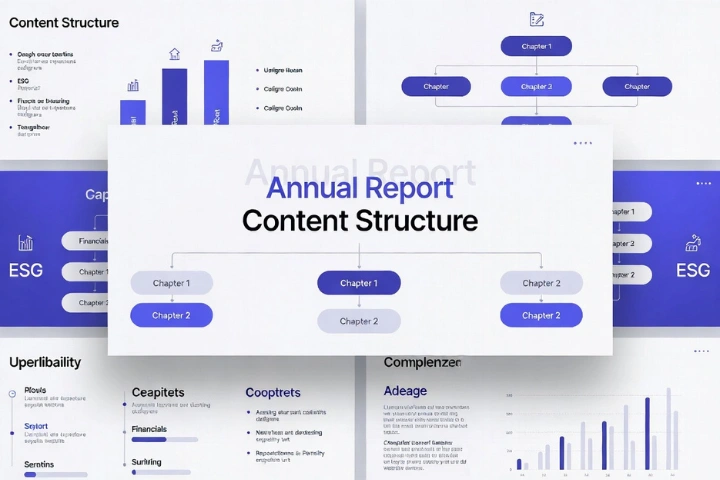
A disciplined annual report content structure helps businesses solve one of the most common reporting problems: too much information presented with too little control. Annual reports often involve contributions from finance, legal, management, investor relations, sustainability teams, and external auditors. Without a strong content structure, the result is often duplication, weak transitions, or sections that feel like separate documents placed under one cover. A stronger structure establishes editorial rules early. It defines what each section is meant to achieve and prevents messages from being repeated in different forms across the report.
A practical structure usually separates content into five broad layers. The first is orientation, which includes the cover, contents, highlights, and corporate profile. The second is leadership narrative, including the chairman’s statement, CEO or management review, and strategic overview. The third is business and operating performance, where segment results, market context, and priorities are explained. The fourth is governance and responsibility, which may include board matters, risk management, remuneration, and sustainability-related disclosures where integrated. The fifth is formal financial reporting, including the directors’ statement, audit opinion, statements, notes, and shareholder information. This layered approach is not mandated word-for-word by SGX, but it aligns well with the exchange’s expectations around annual report readability and the broader OFR guidance.
A strong annual report structure Singapore also uses content structure to manage pacing. Not every section should have the same weight. Some pages need summary-style treatment. Some need analytical depth. Some need visual breathing room so readers can pause and absorb the message. This pacing becomes especially important in long reports, where fatigue can reduce the impact of key content. A clear structure allows the report to feel controlled rather than exhausting. It also supports internal production, because teams know where content belongs and how detailed each part needs to be. This is a professional editorial inference based on reporting best practice and the official emphasis on readable disclosure.
For companies trying to strengthen their market presence, content structure also shapes perception. A report with strong hierarchy feels more intentional. It suggests that management is clear about priorities and confident in how the business should be presented. A weak structure suggests the opposite, even when the underlying performance is sound. That is why an annual report design framework should include editorial logic as well as visual logic. Studios like Alivea can help bridge that gap by translating content complexity into a report that feels ordered, elegant, and commercially credible from the first page to the last. This final point is a market-facing recommendation rather than a rule-based requirement.
Annual Report Design Framework for Consistent Visual Hierarchy and Corporate Presence
An effective annual report design framework gives the report a repeatable system rather than a collection of isolated design decisions. This framework should cover grids, typography, colour usage, iconography, chart logic, image style, section openers, pull quotes, and the treatment of formal financial pages. When these elements are planned in advance, the report feels coherent and easier to navigate. When they are improvised page by page, the result often feels inconsistent. In a Singapore corporate context, consistency matters because annual reports are often read as signals of professionalism, governance discipline, and management maturity. This is an editorial conclusion supported by SGX’s focus on readable and structured corporate communication.
One important part of the framework is hierarchy. Headings should clearly distinguish between report sections, sub-sections, and supporting commentary. Financial highlights should be visually prioritised without overwhelming the rest of the document. Governance tables should be clean and orderly. Charts should look related to one another rather than designed in different visual languages. These may sound like purely design concerns, but they have strategic consequences. A coherent framework improves corporate annual report format because it helps readers understand which information is primary, which is supportive, and how different elements relate to one another. That is what makes the report feel usable instead of merely attractive.
The design framework should also anticipate different content modes. Narrative sections need room for message flow and emphasis. Data sections need clarity and discipline. Legal or financial sections need precision and restraint. A good framework allows all three modes to coexist without making the report feel fragmented. This is one reason why annual report design is more specialised than ordinary brochure design. It needs to accommodate complexity while maintaining elegance. Inferred from the SGX annual-report environment, the strongest framework is the one that supports readable disclosure across the entire document rather than concentrating design effort only in the opening pages.
For brands that want their reporting to feel more refined, the design framework should also reflect brand character without sacrificing corporate seriousness. This is where a partner like Alivea can be especially useful. The goal is not to over-style the report. The goal is to ensure that the final document expresses the company’s quality, confidence, and identity while preserving the clarity expected in a formal reporting context. In other words, the design framework should make the report feel both professional and distinctive. That combination is often what turns a routine annual report into a stronger trust-building asset. This is a commercial design recommendation derived from the formal reporting context rather than from a specific rule. Check the related page best annual report design agency in singapore.
What Is an Ideal Annual Report Layout Guide for Singapore Companies Today
An ideal annual report layout guide for Singapore companies is one that combines mandatory disclosure awareness with reader-first communication. For listed issuers, SGX sets important timing and annual-report expectations, including issuing the annual report at least 14 days before the AGM and providing a readable chairman’s statement. That means the guide should not only organise pages attractively, but also help the company present information clearly and credibly. In practice, the ideal guide covers section order, heading hierarchy, page rhythm, chart placement, front matter, governance pages, and financial-page discipline. It is less about rigid templates and more about creating a dependable system that helps complex corporate information feel orderly and understandable.
Who Should Lead Annual Report Structure Singapore Inside a Business Team
The responsibility for annual report structure Singapore should never sit with only one department. Finance usually owns the numbers, company secretarial or legal teams oversee formal requirements, leadership shapes strategic messaging, and design partners organise the presentation. If sustainability content is integrated, ESG or sustainability teams may also need to contribute. This multi-party process is one reason strong structure matters so much. Without a clear framework, every team tends to write from its own perspective, and the report loses coherence. The most successful annual reports are often led by a core internal coordinator with authority to protect flow, consistency, and deadlines while working with specialist design support where needed. This is a professional process recommendation inferred from the regulatory and reporting environment.
Where Should Corporate Annual Report Format Prioritise the Most Attention
The corporate annual report format should prioritise the sections where perception is formed fastest and where understanding matters most. In most cases, that means the opening pages, leadership messages, key highlights, operating and financial review, governance overview, and any major charts or data spreads. These areas shape whether readers continue with confidence or begin scanning impatiently. Formal financial statements also need careful formatting, but their priority is precision and legibility rather than promotional emphasis. The best reports therefore allocate design effort intelligently, giving high-traffic sections more narrative control while ensuring technical sections remain clean and usable. This advice is an editorial best practice aligned with SGX’s emphasis on readable annual-report communication.
When Should a Company Rebuild Its Annual Report Content Structure Fully
A company should consider rebuilding its annual report content structure when the report starts feeling repetitive, cluttered, outdated, or disconnected from how the business wants to be perceived. Other warning signs include weak section transitions, too many similar pages, leadership messages that add little value, or financial and narrative parts that feel like separate documents. The need becomes even more urgent when the company is growing, changing market position, preparing for more investor scrutiny, or integrating sustainability communication in a more visible way. In such cases, simply refreshing the cover or tweaking visuals is usually not enough. A deeper structural rebuild is often the smarter move. This is a professional recommendation inferred from the annual-report and sustainability-report framework used in Singapore.
Why Does an Annual Report Design Framework Matter Beyond Appearance
An annual report design framework matters beyond appearance because it determines how efficiently the report communicates. Design affects comprehension, pacing, hierarchy, and trust. A strong framework helps readers move smoothly from strategy to performance, from governance to financial detail, and from summary to evidence. In Singapore’s reporting context, where readability is explicitly recognised in SGX annual-report guidance, this is especially important. The framework is what prevents the report from becoming visually inconsistent, editorially repetitive, or difficult to navigate. It gives the document a logic that supports both compliance-minded reading and broader stakeholder engagement. That is why design in annual reports should be treated as a communication system rather than decoration.
How Can Alivea Improve an Annual Report Layout Guide for Premium Results
Alivea can improve an annual report layout guide by translating corporate content into a more strategic, brand-aware, and professionally paced reporting system. That means refining section order, improving narrative emphasis, clarifying page hierarchy, making charts and highlights easier to interpret, and ensuring the report feels consistent from beginning to end. For businesses that want more than a basic compliance document, this kind of support can elevate the report into a stronger reputation asset. In practical terms, the value lies in helping the report communicate with greater clarity, elegance, and confidence while still respecting the formal annual-report environment used in Singapore. This is a commercial positioning statement rather than a regulatory one.
Final Annual Report Layout and Structure Principles for Singapore Companies
The most useful conclusion from this annual report layout guide is that structure and layout should be treated as strategic business tools, not finishing touches. In Singapore, the annual report sits inside a real regulatory and disclosure environment shaped by SGX timing expectations, readability requirements, and broader filing obligations that can include annual returns and financial statements through ACRA. Those formal requirements set the baseline. But the effectiveness of the report depends on how the company organises and presents the content on top of that baseline. A report can be technically compliant and still fail to communicate well. It can also be carefully designed and still feel shallow if the structure is weak. The best outcome requires both discipline and clarity.
Across this guide, five recurring themes stand out. First, the annual report structure Singapore should follow a clear logic from identity and leadership into performance, governance, and formal financial detail. Second, the corporate annual report format must balance professionalism with readability, allowing the document to feel serious without becoming burdensome. Third, the annual report content structure should control duplication and improve pacing so the report reads like one intentional narrative rather than many disconnected contributions. Fourth, the annual report design framework should create consistency across all page types, including highly technical financial sections. Fifth, the entire report should be planned for real readers, not just internal approval chains. These are best-practice conclusions drawn from the current Singapore reporting context and SGX’s emphasis on readable annual-report disclosure.
For companies that want stronger results, the opportunity is substantial. A better report can improve confidence among shareholders, board members, investors, partners, and other stakeholders who rely on the document to understand the business. It can also make annual-report production more efficient by giving internal teams a clearer framework to work within. Most importantly, it can help the company look more organised, credible, and mature in the market. That is why layout and structure decisions deserve serious attention from the earliest stage of the reporting cycle. They are not minor design preferences. They are part of how business quality is communicated.
For brands aiming at a more premium result, an experienced design partner can help turn that structure into a sharper corporate asset. This is where a studio like Alivea can add meaningful value by combining editorial logic, visual consistency, and brand-sensitive design execution. The objective is not to make the report flashy. It is to make the report clearer, stronger, and more persuasive. When that happens, the annual report stops being a routine end-of-year document and becomes a powerful expression of how the company wants to be understood.
