
Annual Report Design Investor Trust for Singapore Businesses With Clearer Value
Annual report design investor trust becomes stronger when a company designs its report around the real questions investors ask before making decisions. Investors want to know whether a business is financially stable, strategically prepared, transparently managed, and capable of creating long-term value. For Singapore businesses, an investor-focused annual report should not only meet reporting expectations. It should help shareholders, analysts, lenders, partners, and potential investors understand the company with confidence.
An investor-focused report begins with clarity. Financial results, governance practices, market conditions, risk exposure, and future priorities should be presented in a way that is easy to follow. Many annual reports contain valuable information, but that value can be lost when content is too dense, visuals are inconsistent, or strategic messages are scattered across separate sections. Strong investor communication design solves this by creating a clear reading path from corporate overview to financial performance, from business strategy to governance, and from current results to future direction.
Annual report credibility also depends on how honestly the company explains its position. Investors do not expect every year to be perfect. They expect management to provide accurate data, balanced commentary, clear disclosure, and responsible explanations. If a company discusses growth, the report should explain what drove it. If performance declined, the report should explain why. If the business faced uncertainty, the report should show how leadership responded.
Financial storytelling design is essential because investors need more than figures. They need context. A strong investor relations report connects numbers with business meaning, explains decisions behind results, and shows how strategy supports future value. This helps stakeholders understand the company’s direction instead of simply reviewing isolated metrics.
For brands such as alivea and other Singapore-focused reporting specialists, the goal is to help companies build annual reports that communicate with purpose. A report designed for investors should be credible, structured, readable, and evidence-based. When financial data, storytelling, disclosure, and design work together, the annual report becomes a strategic trust-building asset.
Annual Report Design Investor Trust That Aligns Data With Investor Needs Clearly
Annual report design investor trust begins with understanding investor needs before designing pages or writing sections. Investors read annual reports to evaluate performance, risk, governance, capital discipline, market position, and future potential. A company that designs its annual report around these needs can make the reporting experience more useful and more credible.
The first investor need is access to clear financial data. Revenue, profit, margin, cash flow, debt, liquidity, segment performance, and capital expenditure should be presented in formats that are easy to review. Tables must be readable. Charts must be properly labeled. Comparisons must use relevant timeframes. When financial information is difficult to interpret, investors may question the quality of reporting even if the numbers are accurate.
The second need is business context. Investors want to understand why results changed. A Singapore company may experience revenue growth because of regional expansion, improved customer demand, pricing strategy, acquisition activity, or new service lines. Profit may decline because of inflation, investment, restructuring, competition, or temporary market disruption. The annual report should explain these factors clearly. This supports annual report credibility because readers can see the causes behind the numbers.
The third need is strategic direction. Investors want to know where the company is heading and whether management has a realistic plan. An investor-focused report should explain priorities, progress, risks, and future opportunities. It should not rely on vague statements such as “we aim for growth” without showing how growth will be pursued.
Investor communication design helps organize these needs into a logical structure. A well-planned investor relations report may include performance dashboards, business model visuals, strategy maps, risk summaries, governance snapshots, and outlook sections. These elements guide readers through the company’s story without overwhelming them.
Financial storytelling design strengthens trust by connecting data with management decisions. Instead of presenting financial statements as separate from strategy, the report shows how leadership actions influenced performance and how current decisions support future value. When data, context, and strategy are aligned, investors can evaluate the company more confidently. That is the foundation of investor-focused annual report design.
Investor Communication Design That Makes Complex Business Results Easier
Investor communication design is the discipline of making complex corporate information easier for stakeholders to understand. Annual reports often include financial statements, operating reviews, governance disclosures, sustainability updates, risk explanations, leadership messages, and market commentary. Without a clear communication system, these sections can feel disconnected. With strong design, they become one coherent investor journey.
The first principle is hierarchy. Investors should quickly understand which information is most important. Key financial results, strategic messages, and major business developments should be easy to identify. Supporting details should be available, but they should not distract from the main story. Good hierarchy uses headings, subheadings, summary panels, charts, spacing, and section flow to guide attention.
The second principle is readability. Singapore businesses may communicate with local shareholders, regional investors, institutional funds, analysts, lenders, and international partners. A report should therefore use clear business language. Technical details should remain accurate, but explanations should not be unnecessarily complicated. Strong investor communication design respects professional readers by making information efficient to absorb.
The third principle is consistency. Annual report credibility improves when a report uses consistent terminology, visual styles, chart formats, color systems, and data labels. Inconsistent design can make a report feel fragmented. Consistent presentation creates a sense of discipline and control, which supports annual report design investor trust.
The fourth principle is navigation. Investors often do not read an annual report from beginning to end. Some go directly to financial highlights. Others review governance, risk, segment performance, or outlook. A strong investor relations report should support both scanning and deep reading. Digital bookmarks, clear contents pages, linked sections, and well-labeled headings improve usability.
Financial storytelling design becomes more effective when communication design is strong. A company can explain its business journey through leadership messages, performance summaries, operational reviews, and future priorities. Each section should add value to the overall narrative. The story should not be hidden in dense paragraphs or repeated without purpose.
Ultimately, investor communication design reduces friction. It helps investors find answers faster, compare information more easily, and understand management’s message with less uncertainty. For Singapore businesses, this clarity can strengthen market perception and make the annual report more useful as an investor communication tool.

Annual Report Credibility Built Through Reliable Context and Clear Proof
Annual report credibility depends on whether investors believe the report is accurate, balanced, and supported by clear proof. A visually attractive report may gain attention, but credibility is built through reliable information. Investors want to know that figures are consistent, claims are backed by evidence, and management commentary reflects business reality.
Reliable context is one of the strongest credibility factors. A company should not present financial results without explaining the business conditions behind them. For example, higher revenue may look positive, but investors need to know whether it is recurring, sustainable, or influenced by one-time factors. Lower earnings may look negative, but they may reflect planned investment, market pressure, or long-term transformation. Context helps investors interpret results fairly.
Clear proof is equally important. If a company says it improved operational efficiency, the investor relations report should show supporting indicators. If it discusses stronger governance, the report should present board structure, committee responsibilities, attendance, independence, and oversight practices clearly. If it highlights market expansion, the report should explain where growth occurred and how it supports strategic objectives.
Annual report design investor trust improves when proof is easy to verify. Performance dashboards, multi-year charts, properly labeled tables, and concise explanations can help investors connect claims with evidence. However, design must remain responsible. Charts should not exaggerate results through misleading scales. Visual emphasis should not hide important limitations. Design should make information clearer, not more persuasive than the data allows.
Investor communication design also supports credibility by organizing disclosures in a way that feels complete. Governance, risk, financial review, sustainability, and strategy sections should not appear as isolated obligations. They should work together to explain how the company creates and protects value.
Financial storytelling design adds meaning by connecting evidence with narrative. A credible annual report tells investors what happened, why it happened, and how management responded. It avoids empty optimism and communicates with maturity. It explains opportunities without ignoring uncertainty.
For Singapore businesses, annual report credibility can influence investor confidence, lending relationships, analyst perception, and stakeholder trust. A credible annual report shows that the company respects transparency and understands the importance of responsible communication.
Financial Storytelling Design That Connects Performance With Future Value
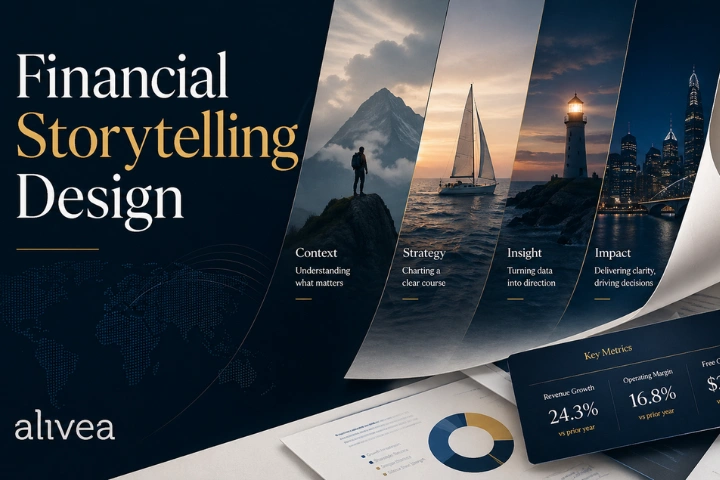
Financial storytelling design helps transform annual reports from static records into meaningful investor communication. Numbers are essential, but investors need to understand what those numbers reveal about the company’s direction. A business may publish revenue, profit, assets, liabilities, cash flow, and segment performance, but without narrative structure, readers may struggle to understand the full business journey.
A strong financial story begins with a clear theme for the reporting year. That theme may involve resilience, transformation, expansion, efficiency, innovation, disciplined growth, or sustainable value creation. The theme should reflect real business activity, not marketing language. Investors can usually detect when a story feels unsupported. Annual report credibility improves when storytelling is grounded in evidence.
The report should then connect the theme across sections. The leadership message can introduce the company’s priorities. The financial review can explain key performance movements. Business segment pages can show operational progress. Risk sections can discuss challenges and mitigation. Governance pages can show oversight. Outlook sections can explain future priorities. This connection helps investors understand how different parts of the business work together.
Annual report design investor trust becomes stronger when financial storytelling design explains cause and effect. If margins changed, what caused the movement? If cash flow improved, what actions contributed? If the company invested in digital systems, how does that support future performance? If sustainability initiatives were expanded, how do they connect to business resilience?
Investor communication design makes this story easier to follow. Timelines, charts, summary boxes, business model diagrams, and strategy maps can help readers see relationships between decisions and outcomes. However, every visual element should serve a communication purpose. Decoration without meaning can weaken the seriousness of the report.
A well-built investor relations report should also connect current results with future value. Investors want to know whether the company’s performance is sustainable and whether management has a credible plan. Financial storytelling design helps answer this by linking past actions, present results, and future priorities into one coherent narrative.
When applied responsibly, financial storytelling design makes annual reports more useful, more memorable, and more trustworthy.
Investor Relations Report Planning That Improves Stakeholder Confidence
An investor relations report should be planned as a strategic communication platform, not only as a year-end publication. Singapore businesses that want to build stakeholder confidence should begin planning by identifying what investors need to understand most. The report should answer practical questions about performance, strategy, risk, governance, capital allocation, and future growth.
Good planning starts with audience mapping. Different stakeholders read the annual report for different reasons. Shareholders may focus on returns, dividends, earnings, and governance. Analysts may examine segment results, margins, cash flow, and business drivers. Lenders may review liquidity, debt, capital structure, and risk exposure. Employees may look for purpose and direction. Potential investors may study the business model and growth potential. A strong investor relations report should serve these audiences without becoming confusing.
The next planning step is message alignment. The annual report should not feel like separate sections written by unrelated teams. Leadership commentary, financial review, operational updates, sustainability discussion, governance disclosure, and future outlook should support the same overall direction. Investor communication design can help create this alignment through consistent structure and visual language.
Annual report design investor trust also depends on early coordination between finance, investor relations, governance, sustainability, leadership, and design teams. If design begins too late, the report may become visually polished but strategically weak. If content is created without considering the reader experience, important messages may become buried. Early collaboration improves annual report credibility because the final report feels intentional and well-managed.
Financial storytelling design should also be planned early. Teams should identify the key reporting narrative before layouts are produced. This allows charts, case examples, financial highlights, and management commentary to support one coherent story.
Digital access should be part of planning as well. Investors increasingly access reports through websites, PDF files, tablets, and mobile screens. A modern investor relations report should be searchable, easy to navigate, and consistent across formats.
When planning is thoughtful, the annual report becomes more than a compliance document. It becomes a stakeholder confidence tool that communicates the company’s quality, discipline, and transparency. You should also read annual report design that builds trust with investors.

What Makes an Investor Focused Annual Report Clear and Credible for Trust
An investor-focused annual report is clear and credible when it answers investor questions with accurate data, transparent explanation, and structured design. Investors want to understand how the company performed, why results changed, what risks matter, how governance works, and where the business is heading next.
Annual report design investor trust is built when the report makes these answers easy to find. The report should not force readers to search through scattered sections to understand the company’s direction. Investor communication design helps by creating logical flow, readable layouts, clear headings, and useful visual summaries.
Annual report credibility depends on evidence. Claims about growth, resilience, efficiency, or transformation should be supported by data, commentary, or examples. Financial storytelling design then connects this proof into a meaningful business narrative.
A strong investor relations report is not simply attractive. It is helpful. It respects stakeholder time, explains important issues clearly, and presents both achievements and challenges responsibly. That combination makes the report more valuable for investor evaluation.
Who Needs Investor Focused Annual Reports for Better Market Decisions Today
Investor-focused annual reports are needed by companies that want to improve market understanding and stakeholder confidence. Public companies, growing private businesses, family enterprises, financial institutions, technology firms, real estate groups, healthcare companies, industrial firms, and service businesses can all benefit from clearer reporting.
Shareholders use the investor relations report to evaluate performance and governance. Institutional investors use it to compare companies and assess long-term value. Analysts use it to understand business drivers and financial movement. Lenders use annual report credibility to judge financial stability and risk.
Internal teams also benefit. Leadership can communicate strategy more clearly. Finance teams can present complex data more effectively. Investor relations teams can use the report as a foundation for meetings, briefings, and stakeholder communication.
Annual report design investor trust is therefore not only useful for external audiences. It also improves internal alignment. Financial storytelling design helps everyone understand how business results connect with strategy. Investor communication design makes the company’s message easier to share across different market touchpoints.
Where Investor Communication Design Matters Across Reporting Channels Most
Investor communication design matters across every reporting channel where stakeholders interact with company information. This includes printed annual reports, downloadable PDFs, investor relations websites, annual general meeting materials, analyst presentations, financial summaries, corporate profiles, and digital annual report platforms.
Annual report credibility can weaken if information is clear in one channel but confusing in another. For example, a well-designed PDF may lose impact if the investor relations page is difficult to navigate. A strong presentation may create uncertainty if it uses different language from the annual report. Consistency across channels supports trust.
Annual report design investor trust improves when stakeholders receive the same clear message wherever they access information. Financial storytelling design should therefore extend beyond the report. The same narrative can guide shareholder presentations, leadership messages, media releases, and website content.
For Singapore businesses with regional or global audiences, digital accessibility is especially important. Investors may access reports from different markets and devices. A well-organized investor relations report should be easy to find, search, download, and review across formats.
When Singapore Companies Should Start Investor Report Design Planning Early
Singapore companies should start investor report design planning early in the annual reporting cycle. Waiting until the final production stage often leads to rushed layouts, incomplete storytelling, inconsistent messaging, and missed opportunities to improve clarity.
Early planning allows teams to define the report’s purpose, audience, structure, key messages, data requirements, and design direction. It also gives finance, investor relations, governance, sustainability, leadership, and design teams enough time to align their contributions. This improves annual report credibility because the final report feels more organized and accurate.
Annual report design investor trust becomes stronger when companies identify investor questions before writing begins. What should stakeholders understand about performance? Which risks need clearer explanation? What strategic progress should be shown? Which financial movements require context?
Investor communication design can then shape the report from the beginning. Financial storytelling design can guide charts, summaries, and commentary. The result is an investor relations report that feels purposeful, consistent, and easier to trust.
Why Annual Report Credibility Influences Investor Confidence Deeply Today
Annual report credibility influences investor confidence because investors use the report to judge both business performance and management quality. A company that communicates clearly appears more disciplined, transparent, and prepared. A company that provides vague explanations or inconsistent data may create uncertainty.
Investors do not rely only on financial statements. They also study how management explains results, discusses risk, presents governance, and communicates future direction. This is why annual report design investor trust depends on both substance and presentation.
Investor communication design helps make credible information easier to understand. Clear structure, readable visuals, and logical section flow reduce confusion. Financial storytelling design adds depth by connecting numbers with strategy and decision-making.
A credible investor relations report gives stakeholders confidence that the company respects informed evaluation. It does not hide difficult information. It explains it responsibly. For Singapore businesses, this can strengthen market reputation, improve stakeholder engagement, and support long-term investor relationships.
How Financial Storytelling Design Builds Stronger Investor Understanding
Financial storytelling design builds stronger investor understanding by explaining the relationship between financial results, business decisions, market conditions, and future priorities. Numbers show what happened, but storytelling explains why it happened and what it may mean.
The process begins with a clear reporting theme. A company may focus on growth, transformation, resilience, operational improvement, innovation, or sustainability. The investor relations report should then support that theme with evidence from financial results, business reviews, governance practices, risk management, and outlook sections.
Annual report credibility improves when storytelling is specific and balanced. The report should explain achievements, but it should also discuss challenges and trade-offs. Annual report design investor trust grows when investors see that management is willing to communicate honestly.
Investor communication design makes the story easier to follow through clear layouts, charts, summaries, and section flow. When financial storytelling design is done well, investors gain a more complete understanding of the company’s performance and future direction.
Designing Investor Focused Annual Reports That Build Lasting Market Trust
Designing investor-focused annual reports is an important strategy for Singapore businesses that want to strengthen transparency, credibility, and stakeholder confidence. A strong annual report does more than present financial statements. It explains performance, connects data with strategy, communicates governance quality, and helps investors understand future value.
Annual report design investor trust begins with the investor’s perspective. Companies should ask what stakeholders need to know before making decisions. They should then build the report around those needs. Financial highlights, strategic updates, business reviews, risk explanations, governance disclosures, and outlook sections should work together as one clear communication journey.
Investor communication design plays a central role in this process. It improves structure, readability, navigation, and visual clarity. It helps readers find information quickly and understand complex issues without confusion. When a report is easy to use, stakeholders are more likely to view the company as organized and transparent.
Annual report credibility depends on accurate data, reliable context, balanced commentary, and responsible presentation. Investors trust reports that provide proof, not just claims. They respect companies that explain challenges as well as achievements. A credible annual report should make information easier to verify and interpret.
Financial storytelling design adds meaning by connecting numbers with decisions. It explains how management responded to market conditions, how strategy influenced results, and how current actions support future value. This makes the investor relations report more than a record of the past. It becomes a guide to understanding the company’s direction.
For Singapore businesses, investor-focused reporting can improve market perception, support investor engagement, and strengthen long-term trust. Brands such as alivea and professional annual report design partners can help companies transform reporting from a routine requirement into a strategic communication asset.
In conclusion, the best investor-focused annual reports combine data, transparency, narrative, and design discipline. They are visually clear, evidence-based, easy to navigate, and aligned with investor needs. When companies design annual reports this way, they create stronger investor understanding, deeper annual report credibility, and more lasting stakeholder confidence.
