
Understanding Corporate vs Annual Report Choices for Clearer Business Communication
In modern business communication, reports are no longer treated as simple collections of text, numbers, and charts. They have become strategic tools that shape perception, communicate authority, and help organisations present their achievements, direction, and credibility to the right audience. This is especially true when discussing corporate vs annual report choices, because many businesses still assume these two formats serve the same purpose. In reality, the distinction matters. The differences affect content planning, design structure, audience targeting, compliance approach, and the overall communication value of the publication.
When exploring report design differences, it becomes clear that each report type is built around a different intention. A corporate report may be created for branding, performance communication, sustainability positioning, strategic updates, internal stakeholder alignment, or market-facing messaging. An annual report, by contrast, usually carries a stronger formal and statutory function. It is often connected to governance, audited financial statements, board communication, shareholder information, and year-end disclosure responsibilities. Because of that, the way each report is planned and designed should never be identical.
For companies working on corporate report singapore projects, flexibility is often one of the biggest strengths. A corporate report can be more thematic, more campaign-oriented, and more tailored to a specific business goal. It may support investor relations, employer branding, business development, sustainability communication, or corporate storytelling. In comparison, annual report singapore work usually requires tighter structure, greater disclosure discipline, and a more regulated content flow. It must balance readability with governance, creativity with precision, and brand value with reporting responsibility.
Among the many business reporting types used today, these two are often discussed together because they both represent the company in a formal document format. Yet they speak to different expectations and produce different strategic outcomes. Understanding where one begins and the other ends helps organisations avoid design mistakes, content misalignment, and weak messaging. A specialist team such as alivea can often help businesses choose the most suitable route by aligning communication goals with document structure and visual strategy.
A well-designed report should never exist only to fill pages. It should support clarity, purpose, and trust. That is why understanding the distinction between corporate and annual reports is an important step for any brand that wants to communicate with more precision and professionalism.
Defining Corporate vs Annual Report Roles in Strategic Business Communication
The comparison between corporate vs annual report starts with a simple but important principle: both are business documents, but they do not always exist for the same reason. A corporate report is generally broader in function. It may be produced to support strategic storytelling, business updates, stakeholder engagement, sustainability communication, or brand-driven corporate messaging. An annual report is usually more fixed in purpose, with a stronger emphasis on year-end disclosure, performance accountability, and structured communication to shareholders, regulators, boards, and financial stakeholders.
This distinction affects the entire document from the first page to the last. In discussions about report design differences, purpose is always the foundation. If the report exists to fulfil formal reporting obligations and present audited performance for a financial year, the structure should reflect precision, governance, and balance. If the report is created to highlight growth, culture, ESG progress, transformation, or market presence, the design can often be more flexible and more expressive. That is why businesses should define intent before choosing layout direction, narrative style, and content hierarchy.
For corporate report singapore projects, companies often have room to shape tone and structure around their messaging goals. A company may publish a sustainability report, integrated communication report, transformation report, business overview document, or corporate profile-based performance report without the same strict framework associated with statutory year-end reporting. This gives the organisation more freedom to align visuals, storytelling, and audience engagement with broader branding objectives. However, freedom does not mean lack of structure. Corporate reports still need editorial discipline, coherent data usage, and a strong information architecture.
On the other side, annual report singapore documents usually require a more disciplined content sequence. Leadership messages, business highlights, governance disclosures, audited statements, risk commentary, and statutory sections must be arranged in a credible and accessible order. Among different business reporting types, annual reports carry higher expectations for consistency, technical accuracy, and accountability. Their role is not only to present the company attractively but also to demonstrate transparency and control.
This is where a specialist like alivea can add real value. By understanding whether a business needs a strategic corporate report or a formal annual report, the design and writing process becomes far more effective. The best results come when the document’s purpose, audience, and presentation style are aligned from the beginning rather than treated as interchangeable formats.
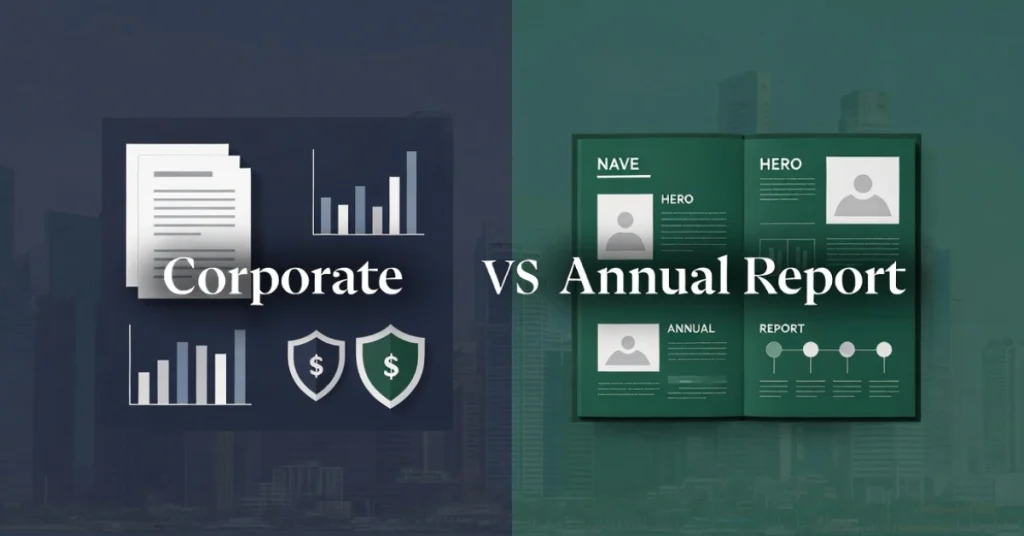
Examining Report Design Differences in Structure, Tone, and Information Priorities
The most visible distinction between these formats appears in the report design differences themselves. Even when two reports look polished on the surface, their internal logic can be completely different. Design is not only about visual beauty. In corporate communications, design is a structural system that shapes how information is prioritised, interpreted, and remembered. This means the purpose of the document must always guide the design method.
In a corporate vs annual report comparison, corporate reports are typically more adaptable in tone, pacing, and visual emphasis. They may include stronger storytelling, larger thematic spreads, more expressive branding, richer use of photography, or a more narrative-driven structure. This is because many corporate reports are designed to explain progress, reinforce values, communicate transformation, or build stronger emotional and strategic alignment with stakeholders. The report can often move with a more editorial rhythm, combining data, insights, quotes, and branded messaging in a more fluid way.
By contrast, annual report singapore design tends to require greater restraint. The report must still be visually strong, but the design system usually needs to support dense information, financial disclosures, governance sections, notes, and cross-referenced material. Typography, table formatting, grid systems, spacing, and hierarchy become especially important because clarity is more valuable than decorative impact. In annual reporting, the reader should never struggle to find essential information. A clean and disciplined layout supports trust far more effectively than excessive visual experimentation.
For corporate report singapore projects, design can also shift depending on the report’s role. A sustainability-focused document may rely heavily on icons, data visualisation, environmental imagery, and thematic section colours. A corporate profile report may use a brand-centric style that strengthens market positioning. Among various business reporting types, this flexibility makes corporate reports highly useful for communication strategy. They can be designed to inform, persuade, inspire, or align, depending on what the company needs to achieve.
Still, the strongest design decisions always come from understanding the reader. This is why agencies such as alivea focus on the relationship between information type and user experience. Good report design is not simply about filling pages attractively. It is about ensuring the right content is seen, understood, and trusted. When businesses understand these report design differences, they are better equipped to commission the right document, communicate with the right tone, and avoid using one reporting format as a substitute for another.
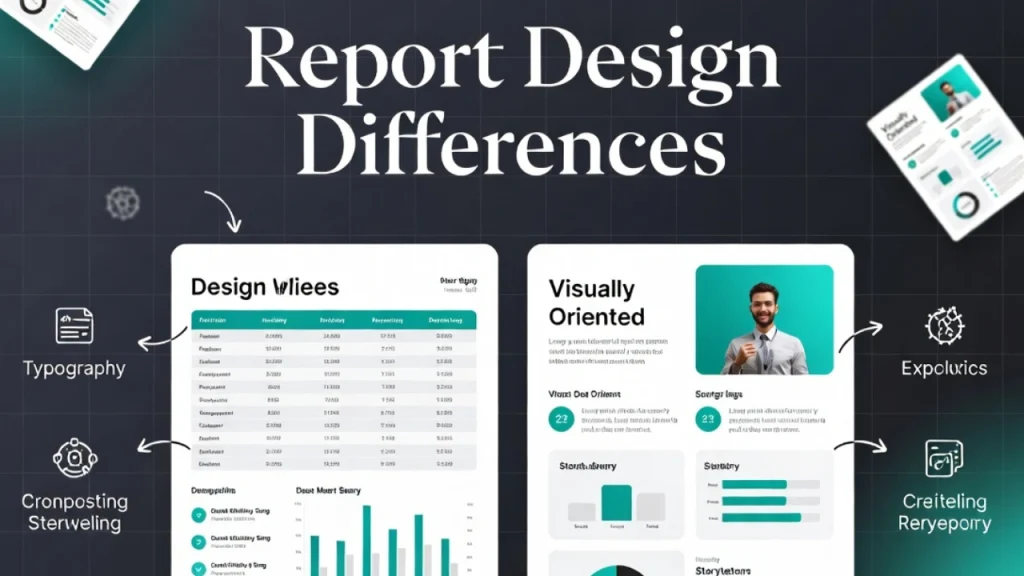
Positioning Corporate Report Singapore Projects for Branding and Stakeholder Messaging
A corporate report singapore project often serves as a communication bridge between formal business information and strategic brand expression. Unlike a standard marketing brochure, a corporate report still carries authority and substance. Yet unlike a strict annual report, it often offers greater room for narrative shaping, audience targeting, and thematic emphasis. This makes it one of the more versatile options among modern business reporting types, especially for organisations that want to communicate depth without being limited by statutory reporting structure.
When businesses compare corporate vs annual report options, the corporate report usually stands out for its flexibility. It can be used to present company milestones, strategic transformation, regional expansion, operational capability, ESG initiatives, leadership vision, corporate achievements, or market positioning. It may support investor-facing communication, partnership development, client trust-building, or broader brand authority. Because of this flexibility, the content structure can be arranged around what matters most to the intended reader rather than around a mandatory year-end disclosure format.
These broader possibilities also influence report design differences. A corporate report may use more varied pacing, more visual storytelling, and more contextual explanations to create a stronger reading experience. Instead of moving section by section through highly formal disclosure requirements, the document may begin with purpose, vision, transformation, capability, customer value, sustainability, or future ambition. This allows the company to design the report around strategic messaging rather than fixed compliance sequencing. For many businesses in Singapore, that flexibility is highly valuable because it helps them communicate not only what they did, but also what they stand for.
Even so, effective corporate report singapore work still requires precision. A flexible document is not the same as an unstructured one. Strong reports maintain clarity in information flow, consistency in data presentation, and discipline in visual hierarchy. Readers should feel guided through the narrative rather than overwhelmed by content. That is why strong corporate reporting still demands experienced planning, writing, and design direction.
A professional team such as alivea can help companies build a report that reflects business goals while staying credible, polished, and strategically useful. Whether the report is used for corporate positioning, stakeholder communication, or market differentiation, its value lies in how well it translates business identity into an organised publication. In a landscape where trust and perception matter, a strong corporate report can become a powerful strategic asset rather than just another business document.

Shaping Annual Report Singapore Publications Around Governance, Accuracy, and Trust
An annual report singapore publication carries a different level of expectation because it is usually tied to year-end accountability and formal disclosure standards. For many organisations, it is one of the most scrutinised documents they produce. Investors, board members, analysts, regulators, and key stakeholders may all rely on it to understand the company’s performance, governance standards, direction, and financial standing. This makes the annual report both a legal communication instrument and a reputation document.
In a corporate vs annual report discussion, annual reports are generally more structured and less open-ended. Their purpose is not simply to describe the company in a positive light, but to provide a balanced and credible account of the reporting year. That includes financial performance, management commentary, governance information, risk awareness, business overview, and other required disclosures. The report must therefore support trust through substance, not only through style. Readers expect depth, consistency, and reliability.
These expectations drive major report design differences. The annual report needs a stronger system for hierarchy, indexing, table presentation, note formatting, page navigation, and content clarity. Sections should be easy to locate, and design should never interfere with interpretation. This does not mean annual reports must look plain. On the contrary, high-quality design can improve readability, reinforce professionalism, and strengthen investor confidence. But the design should always support governance logic rather than compete with it.
Compared with a corporate report singapore project, the annual report is usually less flexible in pacing and structure. Its tone is also more measured. While there is still room for strong storytelling in the chairman’s statement, strategic review, or business highlights, the report as a whole must retain formal credibility. Among the many business reporting types available to companies, annual reports remain one of the most important because they combine accountability with public visibility. A weak annual report can create doubts about discipline, even when business performance is strong.
This is why many companies rely on specialists such as alivea for annual reporting support. The challenge is not merely producing an attractive file. It is about balancing design sophistication with document integrity. A strong annual report should feel professional, transparent, and carefully controlled. When done well, it communicates that the company is serious about governance, confident in its position, and capable of presenting complex information with clarity and maturity.
Exploring Business Reporting Types and Their Different Strategic Communication Uses
Among all business reporting types, corporate reports and annual reports are two of the most commonly discussed, but they are far from the only options available. Businesses today operate in a communication landscape where stakeholders expect more than basic financial disclosure. Companies may produce sustainability reports, integrated reports, impact reports, governance reports, investor presentations, corporate profiles, capability documents, strategy updates, and transformation reports. Each serves a different purpose, and choosing the right format matters because the document should match the communication objective.
When organisations debate corporate vs annual report formats, the real question is often broader: what kind of business narrative needs to be delivered, and to whom? If the goal is to meet year-end accountability requirements and present an official performance record, the annual report is usually the right vehicle. If the goal is to communicate broader organisational progress, reposition the brand, explain long-term strategy, or highlight specialised initiatives, a corporate report may be more effective. Understanding the wider ecosystem of business reporting types helps companies avoid forcing the wrong message into the wrong document.
This also reveals deeper report design differences. A sustainability report may need strong infographic systems and thematic storytelling. A capability report may rely on case studies, service architecture, and proof-based messaging. A corporate report may blend performance, vision, and branding. An annual report singapore publication may need stronger formal structure, denser reference systems, and greater content discipline. Each document should feel aligned to its purpose. Design, language, imagery, and information hierarchy should change accordingly.
For businesses developing a corporate report singapore strategy, this understanding is especially useful. It allows them to think beyond compliance and see reporting as part of long-term communication architecture. One report may support investor confidence, another may strengthen market authority, and another may communicate sustainability progress. The strongest companies use reporting formats intentionally rather than treating all reports as interchangeable templates.
A partner such as alivea can help organisations map these choices more strategically. The value lies in understanding that reports are not just documents. They are communication platforms with different audiences, risks, and opportunities. By selecting the right report type and designing it with the right structure, businesses can strengthen clarity, improve stakeholder engagement, and present themselves with more authority. That is why knowing the range of business reporting types is essential for any company serious about modern corporate communication. Discover more resources annual report design service for singapore companies.
What Is the Main Difference Between Corporate vs Annual Report Purposes?
The main difference in corporate vs annual report purpose lies in function and expectation. A corporate report is often created to support broader business communication goals such as strategic storytelling, stakeholder engagement, sustainability messaging, transformation updates, or brand positioning. An annual report, by contrast, is typically more formal and tied to year-end accountability, governance presentation, and financial disclosure. This makes it one of the most structured business reporting types used by companies.
These distinct purposes also shape report design differences. A corporate report singapore project may be more flexible in tone, visual direction, and content sequencing because it can prioritise messaging impact. An annual report singapore document usually needs greater control in hierarchy, disclosure logic, and page navigation because accuracy and trust are central to its role.
A specialist team such as alivea often helps businesses identify this difference before the design stage begins. When purpose is clearly defined, the final report becomes more effective because its structure, language, and visual system are aligned with what the company actually needs to communicate.
Who Should Read a Corporate Report Singapore or Annual Report Singapore Document?
The audience for a corporate report singapore document often depends on the business objective behind it. It may be intended for investors, partners, clients, regulators, internal leadership teams, employees, or the wider market. Because the report can be designed around a specific communication need, its audience can be narrower or broader than that of an annual report. This flexibility is one reason many businesses include corporate reports among their most adaptable business reporting types.
An annual report singapore publication, however, usually speaks to a more formal audience. Shareholders, board members, analysts, auditors, regulators, and governance-conscious stakeholders often rely on it to assess the company’s performance and transparency. In a corporate vs annual report comparison, the annual report generally has a stronger accountability dimension.
These audience differences naturally create report design differences. Corporate reports may use a more narrative tone and more branded storytelling, while annual reports usually require clearer indexing, denser factual presentation, and stricter structural order. With support from alivea, businesses can tailor the report experience so the intended reader receives information in the clearest and most strategic way.
Where Should Businesses Use Different Business Reporting Types Most Effectively?
Different business reporting types should be used where their communication strengths matter most. A corporate report singapore is highly effective in settings where a company wants to communicate strategic value, organisational progress, ESG direction, or market capability in a more flexible and visually branded way. It is useful for stakeholder engagement, business development, partner confidence, leadership messaging, and corporate positioning across both digital and print channels.
An annual report singapore document is most effective where formal disclosure, accountability, and financial-year communication are essential. It belongs in governance-driven environments where readers expect a comprehensive and reliable summary of the company’s annual performance. In a corporate vs annual report discussion, the annual report is more closely associated with formal reporting cycles, while the corporate report can be deployed more selectively according to communication goals.
These usage contexts explain many report design differences. A document designed for broad strategic communication will not look or read the same as one designed for structured annual disclosure. With guidance from alivea, businesses can place the right report in the right setting and strengthen both clarity and strategic impact.
When Should a Company Choose Annual Report Singapore Instead of Corporate Reporting?
A company should choose annual report singapore over broader corporate reporting when the communication need is tied to year-end accountability, formal financial disclosure, governance presentation, or shareholder communication. If the report must present audited outcomes, official statements, and a complete picture of the reporting year in a structured format, the annual report is usually the correct choice. In the corporate vs annual report comparison, this is where the annual format becomes essential rather than optional.
By contrast, a corporate report singapore project is more suitable when the business wants to highlight selected achievements, communicate specific strategic themes, or present a branded narrative that does not need the full formal structure of an annual report. These different triggers sit at the heart of many report design differences, because the moment a report becomes disclosure-driven, its format must become more disciplined.
Agencies such as alivea can help businesses assess timing and purpose so that the right report type is commissioned at the right stage of the company’s communication cycle. Choosing correctly saves time, improves relevance, and prevents strategic confusion.
Why Do Report Design Differences Matter in Corporate Communication Outcomes?
Report design differences matter because design influences how readers interpret information, judge professionalism, and decide whether the content is credible. In a corporate vs annual report comparison, design is not just decoration. It determines whether a report feels trustworthy, accessible, and aligned with its purpose. A corporate report may need stronger storytelling flow and branded visual identity, while an annual report may need clearer hierarchy, disciplined tables, and formal navigation.
For a corporate report singapore project, effective design can strengthen strategic messaging and make complex information easier to absorb. For an annual report singapore document, effective design helps stakeholders move confidently through governance, performance, and financial material. Across all business reporting types, good design helps companies communicate with less friction and more authority.
This is why experienced teams like alivea approach design as a business communication framework rather than a visual afterthought. When design aligns with document purpose, the report does more than look professional. It performs better as a strategic communication tool.
How Can Companies Decide Between Corporate Report Singapore and Annual Report Singapore?
Companies can decide between corporate report singapore and annual report singapore by starting with three practical questions: what is the report for, who needs to read it, and what level of formality does the content require? If the goal involves year-end accountability, financial disclosure, and governance communication, an annual report is usually the stronger fit. If the goal is to present strategic messaging, thematic business progress, or stakeholder-focused storytelling, a corporate report may be more appropriate.
This decision becomes clearer when businesses understand corporate vs annual report distinctions and the wider range of business reporting types available. They should also consider how these goals affect report design differences. A document intended for formal disclosure needs a more structured design system, while a strategic communication piece may benefit from a more flexible narrative layout.
Working with a reporting specialist such as alivea can simplify the process. A good partner helps map objective, audience, content type, and design expectations before production begins. That early alignment often leads to a stronger, more useful report and a better return on the company’s communication investment.
Concluding Corporate vs Annual Report Planning With Better Strategic Reporting Decisions
Understanding the distinction between corporate vs annual report formats is essential for businesses that want to communicate with precision, relevance, and professionalism. Although these documents may appear similar at first glance, their purpose, structure, and communication responsibilities are often very different. A corporate report typically offers greater flexibility for thematic storytelling, strategic positioning, and stakeholder engagement, while an annual report usually carries a more formal role centred on accountability, governance, and year-end performance disclosure.
These distinctions are reflected clearly in the report design differences between the two. Corporate reports often benefit from a more expressive visual system, broader narrative pacing, and stronger brand-led communication. Annual reports demand more control, more disciplined hierarchy, and a layout approach that supports dense information and reader trust. Neither is better in every context. Their value depends on whether the chosen format truly matches the company’s communication goal.
For organisations developing a corporate report singapore project, the opportunity lies in using reporting as a strategic asset rather than a routine publication. A well-executed corporate report can strengthen market perception, clarify transformation stories, support partnership confidence, and communicate depth beyond promotional messaging. For businesses preparing an annual report singapore document, success depends on presenting information with balance, accuracy, and professional clarity so that shareholders and stakeholders can rely on the report with confidence.
Across all business reporting types, the strongest outcomes come from alignment. The report type should fit the audience, the content should fit the objective, and the design should fit the information. When companies treat reports as communication systems rather than page-based deliverables, they gain more value from every publication they produce.
That is why many businesses work with experienced specialists such as alivea, who understand how to connect design thinking, editorial structure, and strategic business communication into one coherent reporting solution. In the end, choosing between a corporate report and an annual report is not simply a design decision. It is a strategic decision about how the company wants to be understood, trusted, and remembered.
