
Integrated Annual Report Design Singapore for Clearer Value Creation Storytelling
For modern businesses, an annual report is no longer just a document that records performance after the year has ended. It has become a strategic communication asset that shapes how investors, board members, regulators, lenders, partners, and internal leadership understand the company’s direction. This is why integrated annual report design singapore is becoming more relevant for businesses that want to communicate with more depth and coherence. Rather than treating financial reporting, sustainability reporting, governance disclosure, and strategic narrative as separate streams, integrated reporting brings them together into a more connected explanation of how the business creates value over time. The International Integrated Reporting Framework, maintained under the IFRS Foundation, is designed to improve information quality, promote a more cohesive approach to corporate reporting, and support decision-making that focuses on value creation over the short, medium, and long term.
This matters strongly in Singapore because the reporting environment increasingly supports connected disclosure. SGX rules require issuers to issue a sustainability report at the same time as the annual report, unless external assurance allows a later deadline of no more than five months after financial year-end. SGX also requires the sustainability report to describe key primary components, including material ESG factors, climate-related disclosures, policies, practices and performance, targets, reporting framework, and a board statement with governance structure. These rules do not force every company into a single document, but they do make a connected reporting mindset far more practical and relevant. In other words, the market is moving toward greater alignment between financial, sustainability, and strategic communication.
That is where integrated report design Singapore becomes commercially valuable. A disconnected report may satisfy minimum requirements, but it often weakens the overall message. The financial sections may look formal but isolated. The sustainability sections may look thoughtful but detached from business performance. The governance content may appear complete but not meaningfully linked to strategy. A more integrated approach solves this by helping readers see how governance influences priorities, how sustainability affects resilience, how risks connect to capital allocation, and how business strategy drives long-term value. This is not merely a design preference. It is a better communication model for complex companies that want to look disciplined, future-ready, and trustworthy. This paragraph is an editorial interpretation grounded in the integrated reporting and SGX reporting frameworks.
For Singapore companies, the value of integration is not only regulatory or technical. It is also reputational. When an annual report feels unified, stakeholders tend to perceive the company as more organised, transparent, and strategically mature. When the report feels fragmented, the opposite impression can emerge even if the underlying performance is solid. A more thoughtful annual integrated report Singapore therefore combines structure, narrative, data clarity, and corporate identity into one reporting experience. That is why a partner such as Alivea can add real value by turning connected reporting principles into a polished, premium, and persuasive publication that communicates beyond compliance and supports stronger corporate positioning. This final commercial point is an editorial recommendation rather than a regulatory requirement.
Integrated Annual Report Design Singapore for Better Business Alignment and Readability
A successful integrated annual report design Singapore begins with a simple shift in thinking. Instead of asking how to assemble required content into a year-end publication, the company asks how to explain its full value-creation story in a way that serious stakeholders can understand. The IFRS Foundation says the Integrated Reporting Framework aims to promote a cohesive and efficient approach to corporate reporting that communicates the full range of factors reasonably likely to affect value creation over time. That makes integrated reporting highly relevant for companies that want to connect strategy, governance, performance, and prospects rather than present them in isolation.
From a practical standpoint, this affects both structure and page flow. In a traditional reporting model, the annual report may begin with highlights, move into leadership statements, then separate financial review, governance content, and perhaps a different sustainability report published alongside it. In an integrated model, these sections are still present, but the logic linking them becomes much stronger. Leadership commentary should connect clearly to strategic priorities. Strategic priorities should connect to the resources, relationships, and risks that shape value creation. ESG and climate discussion should not feel like a detached appendix. It should explain how the company is protecting and strengthening its longer-term prospects. This kind of design thinking is not mandated line-by-line by the IFRS Framework, but it is consistent with its purpose and with SGX’s emphasis on connected financial and sustainability reporting.
A connected report is also easier to read when designed well. Integrated reporting is not about stuffing everything into one oversized publication. It is about prioritising the links between content. The reader should quickly understand the business model, the capitals or resources the organisation depends on, the risks and opportunities it faces, the governance structures that guide decisions, and the outcomes that emerged during the year. The IFRS Foundation’s overview emphasises value creation, preservation, or erosion over the short, medium, and long term. That time-horizon perspective gives integrated reports a stronger sense of continuity than many conventional annual reports.
This is why strategic report design Singapore matters so much in the integrated context. The report should feel intentionally sequenced, not mechanically assembled. Readers should not have to guess how the climate section relates to operations, how the strategy section relates to financial performance, or how governance supports the company’s stated ambitions. The layout, hierarchy, section introductions, and data presentation should make these links visible. For Singapore brands seeking a more premium and commercially aware result, Alivea can help translate this connected reporting logic into a report that feels elegant, credible, and easier for stakeholders to trust. That last point is an editorial and commercial positioning inference based on the integrated reporting objectives and SGX disclosure environment.
Integrated Report Design Singapore for Financial and Sustainability Connectivity
The core strength of integrated report design singapore lies in connectivity. The IFRS Foundation explicitly states that the Integrated Reporting Framework can be used to connect financial statements and sustainability-related financial disclosures. That statement is especially important today because many businesses are trying to avoid duplicated narratives across annual reports, sustainability reports, investor decks, and governance disclosures. A well-integrated report reduces that fragmentation by providing one clearer reporting architecture. Instead of repeating the same themes in disconnected sections, it creates a single narrative system where performance, risk, governance, sustainability, and outlook reinforce one another.
Singapore’s regulatory context makes this especially timely. SGX requires issuers to issue a sustainability report at the same time as the annual report, except in certain externally assured cases, and states that sustainability reporting should include climate-related disclosures and board-linked governance information. SGX’s Sustainability Reporting Guide also notes that adding sustainability reporting to financial reporting provides a more comprehensive picture of the issuer, because financial statements show the present and the past year while sustainability reports show risks and opportunities within sight that are managed for future returns. It further says that combined financial and sustainability reports enable a better assessment of financial prospects, future sustainability of the business, and management quality. That is very close to the logic of integrated reporting.
For companies, this means integration is not simply a global reporting idea imported from elsewhere. It has direct relevance to the way Singapore issuers are increasingly expected to communicate. The move toward climate-related disclosure, board responsibility for sustainability reporting, and simultaneous reporting timelines all point toward a reporting model where disconnected storytelling becomes harder to justify. A company may still publish separate documents, but the strategic design challenge remains the same: the different reports should feel coherent, aligned, and mutually reinforcing. This is an editorial interpretation based on SGX’s formal requirements and guidance.
The strongest annual integrated report Singapore approach therefore depends on choosing what must be connected on the page and what can be connected by structure, cross-referencing, and narrative tone. Not every report needs to be physically merged into one book. But every serious report should act as though the business is one business, not a collection of separate disclosure silos. That is where design becomes strategic. Good design helps readers understand how financial performance depends on leadership choices, how sustainability risks affect resilience, and how the company intends to create value across different time horizons. This is the kind of integrated communication that can make a Singapore business appear more mature, more transparent, and more investment-ready. That conclusion is reasoned from the official frameworks rather than stated verbatim in them.
Corporate Integrated Reporting for Stronger Governance and Long-Term Narrative
Corporate integrated reporting is often misunderstood as a format change, when in reality it is a decision-making and communication discipline. The IFRS Foundation says integrated reporting supports integrated thinking, decision-making, and actions focused on the creation of value over the short, medium, and long term. That means the report should reflect how the organisation actually thinks across functions, not just how it packages information at the end of the year. When governance, strategy, operations, sustainability, finance, and risk management are genuinely connected internally, the report becomes easier to structure externally.
This is especially relevant for boards. SGX’s Sustainability Reporting Guide states that the board has ultimate responsibility for the issuer’s sustainability reporting and should determine the ESG factors that are material to the business, ensuring they are monitored and managed. That board-level responsibility makes integrated reporting more than a design trend. It becomes a governance signal. A fragmented report can suggest that the board sees sustainability, strategy, and performance as separate conversations. A more integrated report suggests that management and the board understand how these topics interact in the real business.
The reporting benefits are significant. An integrated approach helps avoid repetitive chairman messages, isolated ESG narratives, and strategy sections that read like aspiration without evidence. Instead, each section can reinforce the others. Governance can be shown as the enabler of disciplined strategy. Strategy can be linked to the capitals and capabilities the business depends on. Sustainability can be shown as part of resilience, risk, and future competitiveness. Financial performance can be positioned as one outcome within a broader value-creation story rather than the only story being told. This paragraph is an editorial synthesis based on the principles in the IFRS Framework and SGX guidance.
For corporate brands in Singapore, this also has a powerful reputational effect. Integrated reports tend to feel more serious because they avoid the sense that the company is speaking in different voices to different audiences. A reader should not feel they are moving from a finance document into a sustainability brochure and then into a compliance appendix. The tone, logic, and visual treatment should suggest one company with one accountable leadership structure and one coherent business direction. This is where strategic report design Singapore becomes a competitive advantage, especially for businesses that want their annual reporting to support credibility, stakeholder trust, and premium brand perception at the same time. The last sentence is an editorial recommendation.
Annual Integrated Report Singapore for a More Cohesive Stakeholder Experience
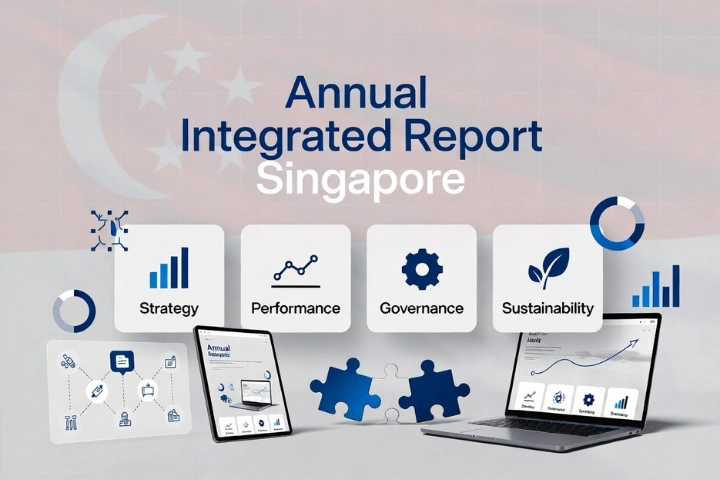
An effective annual integrated report Singapore should feel like a connected journey rather than a collection of statutory chapters. That does not mean every page must look identical or that all content types should be blended together. It means the report should help the reader understand the company’s business model, priorities, performance, sustainability-related exposures, and outlook as parts of one story. The IFRS Foundation’s examples database describes integrated reporting as concise information about how strategy, governance, performance, and prospects, in the context of the external environment, lead to the creation, preservation, or erosion of value over time. That definition is highly useful for Singapore companies deciding how to design their report architecture.
In practical terms, this often begins with the opening sections. Instead of front-loading only visual highlights, the report can introduce the value-creation logic of the company early on. Leadership messages can explain how strategy responded to the year’s opportunities and pressures. Business-review sections can then show how these priorities translated into execution. Sustainability and climate-related sections can explain the resilience, dependencies, and risks associated with that strategy. Governance content can show who is accountable for oversight. Financial sections then reinforce the consequences and outcomes of these decisions. This kind of sequencing helps stakeholders interpret the report more efficiently. It is a best-practice application of integrated reporting principles rather than a prescribed mandatory template.
For Singapore issuers, the timing rules also support a more unified stakeholder experience. Since SGX requires sustainability reporting to be issued at the same time as the annual report in normal cases, companies have a strong reason to ensure both disclosures feel aligned in structure and message. If the reports are separate, they should still be planned as companion publications rather than independent content streams. If they are integrated into one annual report, the hierarchy must be especially clear so the reader can move easily between operating review, ESG materiality, governance, and financial disclosures without confusion.
This is why premium execution matters. A connected report can easily become cluttered if structure is weak. Too much information on each page makes the integrated concept feel heavier rather than smarter. The best integrated reports use disciplined hierarchy, selective emphasis, concise summaries, and elegant transitions to make a complex company easier to understand. For businesses that want this done with both strategic and visual sophistication, Alivea can support the creation of a report that feels unified, refined, and commercially strong. That closing point is a market-facing editorial suggestion.
Strategic Report Design Singapore for Integrated Thinking on the Page
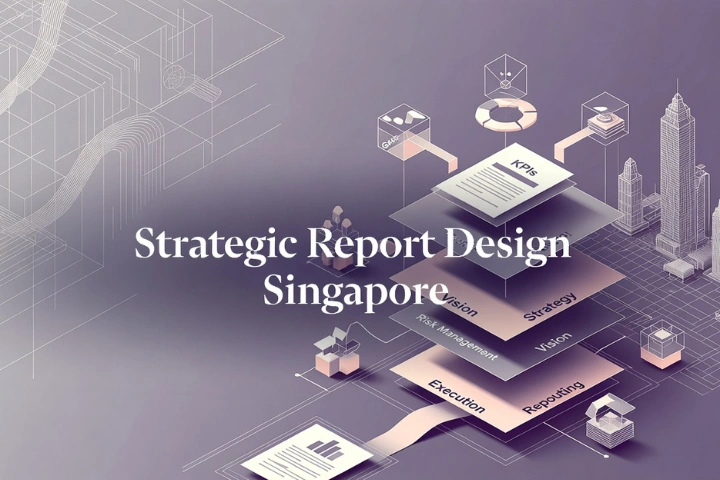
The phrase strategic report design Singapore is especially important in integrated reporting because strategy is what connects the report’s parts. Without strategy, integration becomes superficial. A report may combine financial and sustainability pages, but the result will still feel fragmented if the reader cannot see how the company’s decisions drive outcomes across different forms of value. The Integrated Reporting Framework is built around this idea of value creation over time, supported by integrated thinking and attention to multiple capitals, not only financial capital. That broad lens is what makes integrated reporting more demanding, but also more useful.
Strategic design therefore begins with editorial decisions, not artwork. The company must decide what its central value-creation story really is. Which resources and relationships matter most? Which risks and opportunities most affect future performance? How does governance support the chosen direction? Where do sustainability and climate issues influence resilience, access to markets, or operating efficiency? Once those questions are answered, the report can be designed around them. This creates a structure where visuals, charts, and page flow reinforce meaning rather than competing with it. This paragraph is an editorial application of the IFRS integrated reporting concepts and SGX sustainability governance guidance.
In Singapore, this strategic lens is particularly useful for companies facing more sophisticated stakeholder expectations. Investors, boards, and partners increasingly want connected information. They do not want to guess whether the sustainability section is relevant to future earnings, or whether governance language has real implications for decision-making. They want a report that explains how the business thinks and why it believes its model remains sustainable over time. SGX’s guidance that combined financial and sustainability reports allow better assessment of prospects and management quality supports this need for clearer connectivity.
A strong integrated annual report design Singapore should therefore feel strategic at every level. The page order should reflect business logic. The visual hierarchy should reflect priority. The section introductions should interpret, not merely label. The data should support conclusions rather than sit passively on the page. And the overall tone should make the organisation feel accountable, thoughtful, and forward-looking. That is how integrated thinking becomes visible in the report itself. For companies that want this level of precision and polish, a design partner like Alivea can help shape a report that is both structurally intelligent and visually premium. The final sentence is an editorial commercial recommendation. Continue to the article best annual report design agency in singapore.
What Is Integrated Annual Report Design Singapore in Practical Terms
In practical terms, integrated annual report design Singapore means designing a report so that financial performance, sustainability-related information, governance, strategy, and prospects are connected in a coherent way. The IFRS Foundation describes the Integrated Reporting Framework as a tool to improve information quality and promote a cohesive approach to corporate reporting, while SGX’s guide explains that combined financial and sustainability reports give a more comprehensive view of the issuer and help stakeholders assess prospects and management quality. So, an integrated report is not simply a longer annual report. It is a clearer explanation of how the company creates value and manages the factors that affect that value over time.
Who Should Use Integrated Report Design Singapore Most Often
Integrated report design Singapore is especially useful for listed issuers, investor-facing companies, multi-stakeholder organisations, and businesses with growing sustainability, governance, or long-term strategy expectations. It is also helpful for companies whose annual and sustainability messages currently feel disconnected. Since SGX requires sustainability reporting with defined primary components and board responsibility, issuers already need a more coordinated communication model. Companies that want stronger investor understanding, clearer board accountability, and better alignment between performance and resilience are often the ones that gain the most from integrated design. This recommendation is an editorial inference based on the formal reporting environment.
Where Should Corporate Integrated Reporting Show the Strongest Connections
Corporate integrated reporting should show its strongest connections in the sections where stakeholders most often look for meaning: leadership commentary, strategy, business review, ESG and climate discussion, governance, and outlook. These are the places where the company explains not only what happened, but why it happened and what it means for future value creation. The IFRS Foundation’s overview of integrated reporting and SGX’s discussion of combined financial and sustainability reporting both support this emphasis on connected understanding rather than isolated disclosure. Strong linkage in these sections makes the entire report easier to trust and easier to interpret.
When Should a Business Create an Annual Integrated Report Singapore
A business should seriously consider an annual integrated report Singapore when its current reporting feels fragmented, when sustainability issues are becoming more material, when the board wants stronger cross-functional reporting discipline, or when investor and stakeholder expectations have become more demanding. The case is also stronger when the company already publishes both an annual report and a sustainability report and wants them to feel more aligned. SGX’s simultaneous reporting timeline for sustainability and annual reports makes this an especially practical moment for issuers to rethink structure and connectivity rather than continue with disconnected reporting habits.
Why Does Strategic Report Design Singapore Matter in Integrated Reporting
Strategic report design Singapore matters because integration fails when design is treated only as a visual layer. Strategy is what tells the reader how the company creates value, how it uses and affects different resources, how governance supports decisions, and how future prospects are shaped. The Integrated Reporting Framework is explicitly oriented around value creation over time and integrated thinking. That means the report design must make those relationships visible. When done well, the report feels more coherent, more credible, and more useful to decision-makers. This is a reasoned conclusion based on the formal aims of the IFRS Framework.
How Can Alivea Support Integrated Report Design Singapore Effectively
Alivea can support integrated report design Singapore by helping companies translate complex, multi-stream disclosure into one more coherent reporting experience. That includes clarifying structure, aligning leadership and strategy messaging, improving hierarchy, presenting financial and sustainability content more cohesively, and ensuring the final report feels premium rather than pieced together. For brands that want their annual report to communicate with both authority and elegance, this kind of support can turn integrated reporting principles into a clearer and more persuasive publication. This is a commercial positioning statement rather than a regulatory or standards-based claim.
Integrated Reporting Gives Singapore Companies a More Cohesive Corporate Voice
The strongest conclusion from this discussion is that integrated annual report design Singapore is not just a reporting style. It is a more advanced way of communicating corporate quality. The IFRS Foundation’s integrated reporting materials focus on value creation over the short, medium, and long term, and on promoting a cohesive approach to corporate reporting. SGX’s sustainability reporting framework reinforces this relevance by requiring annual sustainability reports with defined primary components, board accountability, and timing aligned with the annual report in normal cases. Together, these frameworks show that the direction of travel is toward connected, decision-useful communication rather than isolated disclosure silos.
For Singapore companies, this creates a real opportunity. Instead of producing one document for finance, another for sustainability, and separate messages for governance and strategy, the company can build a reporting system that makes the relationships between these elements visible. That creates benefits for readers and for the business itself. Readers gain a fuller understanding of how the company performs, what risks and opportunities matter, and how leadership intends to create durable value. Internally, integrated reporting can encourage stronger alignment between departments and more disciplined thinking about how the business explains itself. This is an editorial inference supported by the objectives of the Integrated Reporting Framework and SGX’s board-responsibility guidance.
The design implications are equally important. Integration only works when structure, hierarchy, and narrative control are strong. Otherwise, the report becomes heavier rather than clearer. The best integrated reports feel more intelligent because they reduce repetition, clarify linkages, and show how governance, sustainability, and financial performance interact. They do not ask the reader to do the connecting work alone. They guide the reader through it. That is why integrated reporting should be approached as both a strategic and a design challenge.
For brands that want to communicate with greater clarity, confidence, and market maturity, this is where a specialist partner becomes valuable. Alivea can help turn integrated reporting principles into a premium annual report experience that feels connected, readable, and commercially strong. When done well, the report does more than document the year. It shows how the company thinks, how it governs, and how it plans to create value in the years ahead. That is what makes integrated reporting especially powerful for modern Singapore businesses. This final paragraph’s commercial recommendation is editorial.
