
Annual Report vs Sustainability Report for Stronger Corporate Communication
For many companies in Singapore, reporting is no longer just about compliance. It is also about positioning, trust, investor confidence, and the ability to communicate business value with clarity. This is why the discussion around annual report vs sustainability report has become more important than ever. Businesses are no longer judged only by revenue, profitability, and balance sheet strength. They are also evaluated by how they govern risks, communicate long-term strategy, address stakeholder expectations, and demonstrate responsibility across environmental, social, and governance priorities.
An annual report and a sustainability report may appear similar at first glance because both are formal corporate publications, both reflect company performance, and both influence external perception. However, the difference between annual and sustainability report is significant when examined closely. An annual report focuses on financial outcomes, governance structures, operational performance, and the broader business review for a given period. A sustainability report, on the other hand, highlights ESG priorities, climate-related considerations, social impact, ethical governance, and the company’s long-term approach to responsible growth.
This distinction matters because different stakeholders read these reports for different reasons. Investors may open the annual report to assess financial credibility, profitability, risk exposure, and management discipline. Procurement teams, institutional partners, and socially conscious stakeholders may turn to the sustainability report to understand how the company operates beyond the numbers. In a modern corporate reporting comparison, one report explains present performance, while the other helps stakeholders understand future resilience and strategic maturity.
For brands operating in a competitive market like Singapore, the way these reports are structured and presented can influence more than compliance outcomes. They can shape brand authority, strengthen corporate reputation, and create a more persuasive business narrative. That is where thoughtful report design and professional storytelling make a measurable difference. For companies that want to communicate with clarity and confidence, Alivea helps transform complex corporate content into polished reporting assets that look credible, feel premium, and support both investor trust and brand perception. In that sense, sustainability reporting singapore and annual reporting should not be treated as isolated obligations, but as strategic communication tools that move the business forward.
Annual Report vs Sustainability Report in a More Strategic Business Context
When discussing annual report vs sustainability report, many companies still approach the topic from a purely technical angle. They ask which report is mandatory, which report should be prioritised, or which format is more suitable for compliance. These are valid questions, but they only address part of the picture. In reality, the more important question is how each report supports the company’s broader communication strategy and how both can work together to reinforce trust, transparency, and long-term value.
An annual report is generally more grounded in financial storytelling. It presents the company’s results, operating review, leadership insights, governance structure, and performance highlights for the reporting year. It is often the document that shareholders, investors, financial analysts, and board members review most closely. The language is typically more formal, data-led, and structured around accountability. In contrast, a sustainability report extends the narrative into areas that traditional financial reporting cannot fully capture. It shows how the company manages ESG priorities, responds to stakeholder concerns, addresses environmental responsibilities, and prepares for future expectations beyond immediate financial returns.
This is the real difference between annual and sustainability report in commercial terms. One demonstrates business strength through financial and operational performance, while the other demonstrates strategic maturity through responsible leadership and long-term thinking. A company may have strong financial results, but if it cannot articulate its sustainability priorities, governance discipline, or stakeholder awareness, the overall message can feel incomplete. Likewise, a sustainability report without a strong annual report may look aspirational but disconnected from business fundamentals.
A strong corporate reporting comparison therefore reveals that both reports serve different but complementary functions. The annual report anchors credibility. The sustainability report adds depth, relevance, and future-facing context. Together, they help stakeholders understand not only how the company performed, but also why that performance is sustainable, defensible, and aligned with evolving market expectations.
For this reason, more companies in Singapore are treating annual reporting and sustainability disclosure as brand-sensitive deliverables rather than document-heavy exercises. A well-designed report does more than present information. It organises complexity, strengthens narrative flow, and shapes how stakeholders interpret the company. Alivea supports this process by helping businesses build professionally crafted reports that blend strategic messaging, clean design, and premium presentation. That is especially valuable for companies that want their reports to look as strong as the business behind them.
Difference Between Annual and Sustainability Report in Purpose and Value
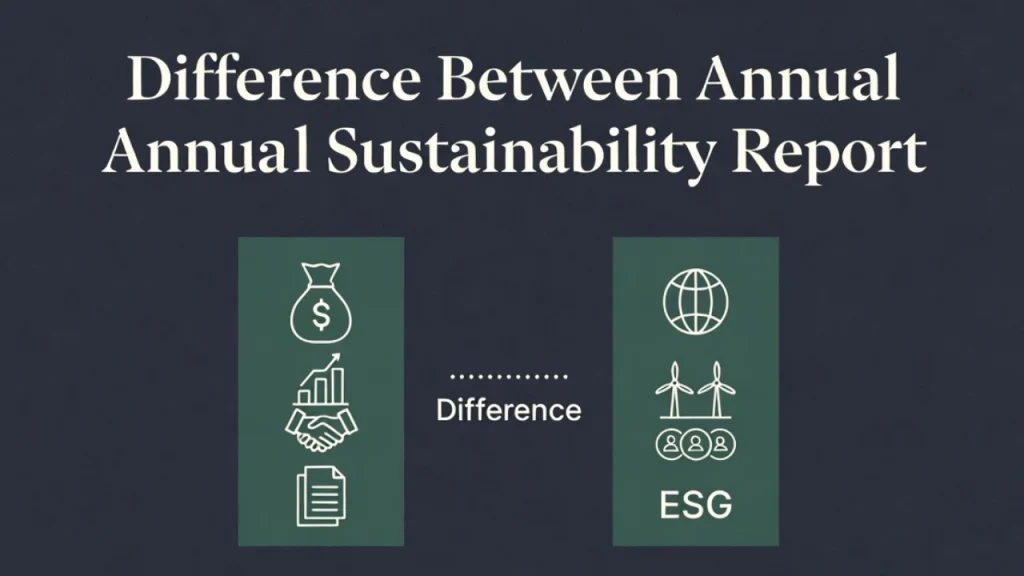
The clearest difference between annual and sustainability report lies in purpose. An annual report exists primarily to communicate financial performance, management direction, corporate governance, and key operational developments during a defined reporting period. It is often seen as the official record of the business year. The sustainability report serves a different purpose. It communicates how the company addresses ESG issues, sustainability priorities, responsible operations, long-term impact, and the broader expectations of investors, regulators, employees, and the market.
This difference in purpose naturally creates a difference in tone. Annual reports usually emphasise financial clarity, strategic review, and formal governance language. Sustainability reports are often more thematic, principle-led, and forward-looking. They may include discussions around energy use, emissions, social policies, employee wellbeing, governance controls, supply chain responsibility, stakeholder engagement, and future improvement targets. Both documents can discuss risk, strategy, and performance, but they approach those themes from different angles.
In a strong corporate reporting comparison, the annual report answers the question, “How did the business perform?” The sustainability report answers, “How is the business building responsible and resilient value over time?” These are not competing questions. They are connected questions. One supports financial trust, and the other supports long-term institutional confidence.
This is especially relevant in sustainability reporting singapore, where stakeholders increasingly expect businesses to communicate beyond short-term profit. Investors want more transparency. Corporate partners want more accountability. Employees and clients are more likely to assess a brand through both performance and principles. As a result, the sustainability report is becoming an important business communication tool rather than a secondary document tucked behind the annual report.
For commercial websites like Alivea, this distinction offers a strong positioning opportunity. Many companies understand the compliance side of reporting, but fewer understand how report strategy, content hierarchy, and visual execution can improve stakeholder trust. Alivea’s role is not simply to make reports look attractive. It is to help businesses present complex information in a way that feels clear, premium, persuasive, and aligned with corporate identity. That means bringing together narrative structure, visual consistency, information design, and brand credibility across both annual and sustainability reporting formats.
Corporate Reporting Comparison for Investor Trust and Brand Positioning
A useful corporate reporting comparison goes beyond content categories and looks at business impact. The annual report influences how a company is seen from a financial and governance perspective. It can shape investor confidence, support board-level accountability, and reinforce market positioning. The sustainability report influences how a company is seen from a responsibility and resilience perspective. It can strengthen trust among strategic partners, stakeholders, institutional evaluators, and procurement decision-makers who increasingly value ESG transparency.
What makes this comparison commercially important is that both reports contribute to the same corporate reputation, but from different entry points. When a business publishes a strong annual report but neglects the quality of its sustainability communication, it may look financially capable but strategically outdated. When a business invests heavily in sustainability messaging but produces an uninspiring annual report, it may appear values-driven but commercially underdeveloped. This imbalance weakens the overall corporate message.
That is why businesses should not view annual report vs sustainability report as a choice between two documents. The better approach is to see them as two coordinated parts of one corporate communication system. One gives structure to financial truth. The other gives meaning to long-term responsibility. Both shape how the company is interpreted by the market.
This alignment is where design and storytelling become commercially powerful. A high-quality report helps stakeholders move through information with confidence. It reduces friction, clarifies priorities, strengthens perception, and shows that the company is serious about communication. Premium report design also signals internal maturity. When stakeholders see a report that is clear, cohesive, and well-organised, they often assume the business behind it is equally disciplined.
Alivea helps companies bring that level of professionalism into corporate reporting. Whether the goal is to improve annual report presentation, elevate sustainability disclosure, or create stronger consistency across both, the focus remains the same: transform technical content into polished brand communication. For companies that want to stand out in Singapore’s competitive market, this is no longer a cosmetic upgrade. It is a strategic advantage.
Sustainability Reporting Singapore Expectations and Commercial Relevance Today
In the context of sustainability reporting singapore, companies are operating in an environment where expectations are steadily rising. Sustainability is no longer viewed as a peripheral issue managed only for image purposes. It is increasingly tied to governance quality, risk awareness, stakeholder trust, and market relevance. Businesses are expected to show how they manage material ESG issues, not merely state that they care about them. This shift means the sustainability report has become a key corporate touchpoint rather than an optional communication piece.
Commercially, this matters because the sustainability report often influences audiences beyond shareholders. It can affect how potential clients assess your business, how procurement teams evaluate vendor alignment, how talent perceives company culture, and how institutional stakeholders judge long-term preparedness. A weak or generic sustainability report may suggest the business is reactive, vague, or underprepared. A well-structured and professionally designed report can signal leadership, discipline, and strategic awareness.
That is why the difference between annual and sustainability report should not be understood only through compliance language. It should also be understood through business outcomes. The sustainability report helps frame the company’s non-financial credibility. It allows the brand to demonstrate responsibility with structure, rather than rely on scattered messaging across websites, presentations, or isolated ESG statements.
From a design and branding perspective, sustainability reporting also creates an opportunity to humanise corporate communication without reducing professionalism. Unlike more rigid financial reporting formats, sustainability reports often allow for stronger narrative flexibility, clearer thematic sections, data visualisation, case examples, stakeholder highlights, and more expressive visual storytelling. This makes the report a valuable extension of corporate identity.
Alivea supports companies in turning sustainability reporting into something more than a procedural document. The goal is to create reports that feel intentional, premium, easy to navigate, and aligned with the company’s brand position. In a market where business trust is shaped by both information quality and presentation quality, the way the report looks and reads can become part of the message itself.
Annual Reporting Guide Singapore for Better Structure and Stronger Credibility
A practical annual reporting guide singapore should always begin with one key principle: clarity builds confidence. The annual report is one of the most visible corporate documents a company will publish, and it often carries a heavier reputational burden than businesses realise. Stakeholders do not only review it for numbers. They also assess how the company explains its direction, priorities, governance, performance challenges, and future outlook. A report that is dense, disjointed, or visually weak can reduce the impact of otherwise strong business results.
This is where the commercial side of annual reporting becomes relevant. The annual report is not just a formal publication. It is also a brand-level corporate communication asset. It should reflect the professionalism of the company and communicate business maturity with precision. Strong annual reports usually have clear content hierarchy, well-structured leadership messaging, disciplined page flow, thoughtful data presentation, and a visual system that supports credibility rather than distracting from it.
When comparing annual report vs sustainability report, the annual report still holds a unique role because it consolidates the company’s most essential business information into one flagship document. For many stakeholders, it is the first or most trusted source of truth. That means its structure matters. Its readability matters. Its tone matters. And its design standards matter more than many companies assume.
For commercial websites like Alivea, this opens an important conversion path. Many businesses know they need an annual report, but they underestimate how much better communication can improve the outcome. A well-executed report can make strategy feel clearer, leadership more credible, and the company more investor-ready. That does not come from decoration alone. It comes from strategic design thinking, editorial refinement, and a strong understanding of corporate communication.
Alivea helps brands produce annual reports that balance compliance-minded clarity with premium visual storytelling. The result is a report that not only informs, but also elevates perception. For businesses that want to communicate performance with more authority, that kind of reporting support can make a real difference. Browse related articles best annual report design agency in singapore.
What Is the Core Purpose Behind Annual Report vs Sustainability Report
The core purpose behind annual report vs sustainability report is to communicate two different dimensions of business value. The annual report presents financial and operational performance in a structured way that supports accountability, investor understanding, and governance transparency. The sustainability report presents how the company manages long-term responsibility, ESG priorities, and strategic resilience. Together, they give stakeholders a fuller picture of the business. In a commercial sense, this means one report helps prove performance, while the other helps explain whether that performance is built on a durable and responsible foundation. Companies that understand this distinction are usually better positioned to communicate with confidence and credibility across different stakeholder groups.
Who Benefits Most From Strong Corporate Reporting in Singapore Today
The short answer is that many groups benefit, but for different reasons. Investors benefit from financial clarity and stronger confidence in management communication. Boards benefit from better alignment between strategy, governance, and public disclosure. Clients and procurement teams benefit from clearer insight into company maturity and responsibility. Employees benefit from understanding the company’s long-term direction and values. In sustainability reporting singapore, strong reporting also helps businesses present themselves more professionally in front of institutional or cross-border stakeholders. For brands, the benefit is not only compliance comfort. It is stronger market perception. That is why professional report strategy increasingly matters to companies that want to look credible, scalable, and ready for larger opportunities.
Where Should Companies Use Reporting to Strengthen Their Brand Image
Companies should not think of reports as documents that live in isolation. They should be used wherever corporate trust matters. This includes investor communication, board engagement, business development conversations, procurement submissions, website credibility, stakeholder outreach, and strategic presentations. A premium report can function as a brand asset as much as a disclosure asset. In a strong corporate reporting comparison, both annual and sustainability reports become part of the company’s broader reputation architecture. This is especially important for businesses in Singapore that compete on professionalism, clarity, and institutional trust. A thoughtfully designed report creates an impression of maturity that extends well beyond the publication itself.
When Should a Business Upgrade Its Report Strategy and Design Quality
A business should upgrade its reporting strategy when its current reports feel generic, difficult to navigate, visually outdated, or disconnected from the brand’s actual market position. It is also time to improve when leadership wants stronger investor confidence, clearer communication, or better consistency between financial and ESG messaging. Many companies wait until reporting becomes a problem, but the smarter move is to improve before credibility starts to erode. In the annual reporting guide singapore context, this means planning early, refining the message structure, and ensuring both the annual report and sustainability report are developed with a clear strategic purpose. Better reporting is rarely just about appearance. It is about business communication quality.
Why Does the Difference Between Annual and Sustainability Report Matter
The difference between annual and sustainability report matters because stakeholders no longer judge companies through a single lens. Financial strength remains important, but it is no longer sufficient on its own. The market increasingly wants to know how the company is governed, how it thinks long term, how it manages material non-financial issues, and whether its operations are aligned with responsible growth. Without this distinction, businesses risk publishing reports that are repetitive, vague, or strategically weak. With a clear distinction, each report can do its job more effectively. The annual report can anchor financial trust, while the sustainability report can build future-facing credibility. That combination gives companies a stronger voice in a more demanding market.
How Can Alivea Help Improve Annual and Sustainability Reporting Results
Alivea helps companies improve reporting results by combining strategic content structure, premium design execution, and stronger corporate storytelling. Instead of treating reports as layout exercises, the focus is placed on clarity, hierarchy, positioning, and communication impact. For annual reports, that may mean refining flow, elevating presentation, and making performance narratives more persuasive. For sustainability reports, it may mean organising ESG themes more clearly, improving readability, and aligning the report with the company’s broader brand identity. In the broader annual report vs sustainability report conversation, Alivea helps businesses present both documents as high-quality corporate assets. The outcome is not only a better-looking report, but a more credible and commercially effective one.
Why Annual and Sustainability Reports Should Work Together for Better Growth
The best commercial takeaway from this discussion is that businesses should stop viewing reporting as a routine annual task and start seeing it as a strategic communication opportunity. The annual report vs sustainability report discussion is not about choosing which one matters more. It is about understanding how each report contributes to a stronger and more complete corporate message. The annual report delivers financial confidence, governance clarity, and structured business review. The sustainability report adds long-term relevance, ESG depth, stakeholder perspective, and future-facing credibility.
When these two reports are developed separately without a common narrative approach, the company often ends up with fragmented communication. The annual report may look formal but uninspiring. The sustainability report may sound aspirational but disconnected. When they are aligned properly, however, they create a far more powerful impression. Stakeholders can see not only what the company achieved, but also how it thinks, how it operates, and how it is preparing for the future. That kind of communication builds deeper trust.
For companies in Singapore, this matters more than ever. Market expectations are higher, stakeholder scrutiny is broader, and corporate communication standards continue to evolve. In this environment, report quality is not a minor detail. It can influence credibility, positioning, and even commercial opportunity. A polished report tells the market that the business is organised, thoughtful, and serious about how it presents itself.
That is why Alivea approaches reporting as both a strategic and creative discipline. Whether a company needs a stronger annual report, a clearer sustainability report, or a more cohesive reporting identity across both, the goal remains the same: transform complex content into professional communication that supports trust, authority, and brand value. When done well, reporting becomes more than an obligation. It becomes a business advantage.
