
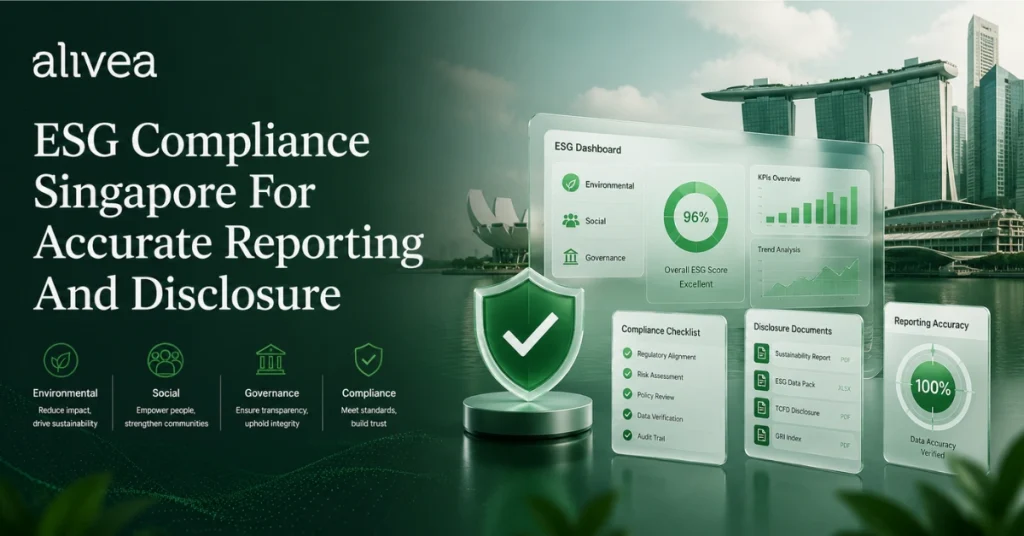
ESG Compliance Singapore For Accurate Disclosure And Corporate Accountability
ESG compliance singapore is becoming a strategic priority for companies that need accurate reporting, stronger disclosure discipline, and better alignment with sustainability expectations. Corporate ESG reporting is no longer only a voluntary communication exercise or a branding statement. It is increasingly connected to governance, risk management, investor confidence, climate-related disclosure, stakeholder trust, and long-term business resilience. Companies that want to communicate sustainability performance clearly need structured systems that support both regulatory alignment and meaningful corporate accountability.
For Singapore corporates, ESG disclosure Singapore requirements must be understood as part of a wider reporting environment. SGX explains that sustainability reports should include primary components such as material ESG factors, climate-related disclosures, policies, practices, performance, targets, reporting framework, and board statement. This means sustainability compliance SG is not only about publishing a document. It is about showing how the company identifies material issues, measures performance, explains risks, manages responsibilities, and communicates progress in a way stakeholders can evaluate.
ESG reporting compliance also depends on data quality. Companies may collect information from finance, operations, procurement, human resources, legal, risk, facilities, and sustainability teams. If this information is inconsistent or poorly reviewed, the final report may contain unclear claims, mismatched figures, incomplete explanations, or unsupported statements. Corporate ESG compliance therefore requires defined ownership, documentation, review workflows, internal controls, and approval processes.
Singapore’s climate disclosure environment is also developing. ACRA states that Scope 1 and Scope 2 greenhouse gas emissions reporting remains mandatory from FY2025 for all listed companies, while other ISSB-based climate-related disclosure requirements follow phased timelines depending on company category. This makes early preparation important. Companies should not wait until deadlines become urgent before building compliance systems.
For brands such as alivea and corporates seeking professional sustainability communication, ESG compliance should be treated as a foundation for trust. A strong report must be accurate, readable, transparent, and evidence-based. When compliance, content, design, and governance work together, ESG reporting becomes more than obligation. It becomes a credible communication platform that supports stakeholder confidence and responsible business growth.
ESG Compliance Singapore For Structured Sustainability Reporting Processes
ESG compliance Singapore begins with a structured reporting process. Many companies have sustainability initiatives, but not all have a reliable system for collecting, validating, organizing, and disclosing ESG information. A company may have energy-saving programmes, employee training, supplier policies, community initiatives, risk controls, and governance committees. However, if these efforts are not documented and reported properly, stakeholders may not see a clear picture of performance or accountability.
A structured ESG compliance process should begin with materiality. The company needs to identify which environmental, social, and governance topics are most relevant to its business model, stakeholders, risks, and future strategy. These topics may include climate resilience, emissions, resource efficiency, workplace safety, talent development, diversity, customer responsibility, responsible sourcing, data protection, business ethics, and board oversight. Once material topics are defined, ESG disclosure Singapore becomes more focused and useful.
The next step is ownership. Sustainability compliance SG cannot rely on one person or one department alone. ESG data often comes from many business functions. Environmental information may come from facilities, operations, or procurement. Social metrics may come from human resources, safety teams, or community engagement units. Governance information may come from legal, compliance, risk, internal audit, or board secretariat teams. Each topic needs a clear data owner, reviewer, and approval path.
SGX Practice Note 7.6 explains that Listing Rule 711A requires every issuer to prepare an annual sustainability report describing sustainability practices with reference to the primary components under Listing Rule 711B. This reinforces the need for repeatable reporting processes rather than ad hoc annual preparation.
ESG reporting compliance also requires documentation. Figures should be supported by source records, calculation methods, reporting boundaries, and review notes. Narrative claims should be traceable to policies, actions, decisions, or approved management explanations. Corporate ESG compliance becomes stronger when every major statement in the report can be connected to evidence. This protects credibility and helps companies prepare for future assurance, investor review, and regulatory expectations.

ESG Disclosure Singapore For Clear, Complete, And Evidence-Based Reports
ESG disclosure singapore should be clear, complete, and evidence-based. Stakeholders do not only want to see positive sustainability messages. They want to understand what the company is doing, how performance is measured, what risks are being managed, what governance structures are in place, and what targets guide future improvement. A strong disclosure approach helps companies communicate these areas without vague language or unnecessary complexity.
Clear disclosure begins with plain explanation. ESG reports often contain technical information, especially when they cover emissions, climate risks, safety performance, diversity indicators, risk management, supplier screening, and governance controls. ESG compliance Singapore requires companies to explain these topics in a way that investors, employees, customers, regulators, and business partners can understand. Technical accuracy is important, but readability is equally important for stakeholder trust.
Complete disclosure means the report should address relevant topics with enough context. A company should not simply state that it is committed to sustainability. It should explain material issues, policies, practices, performance, targets, and governance responsibilities. SGX identifies primary sustainability report components including material ESG factors, climate-related disclosures, policies, practices and performance, targets, reporting framework, and board statement. These areas help stakeholders evaluate whether the company’s sustainability approach is structured and accountable.
Evidence-based disclosure protects credibility. If the report says emissions decreased, it should explain the reporting boundary, metric, period, and reason where appropriate. If a workplace initiative improved safety, the report should include relevant actions, data, or outcomes. If governance has strengthened, the report should describe structures, responsibilities, review processes, or policy updates.
Sustainability compliance SG also requires balance. ESG reports should not overemphasize favourable information while hiding challenges. A mature disclosure style explains progress honestly and acknowledges areas for improvement. ESG reporting compliance becomes stronger when companies present achievements, limitations, corrective actions, and future plans with appropriate detail.
Corporate ESG compliance is ultimately about trust. A report that is visually polished but unsupported by evidence may weaken confidence. A report that is structured, transparent, and factual can strengthen relationships with stakeholders and support long-term reputation.
Sustainability Compliance SG For Climate, Governance, And Stakeholder Trust
Sustainability compliance SG involves more than preparing a sustainability report at the end of the year. It requires companies to understand evolving expectations around climate disclosure, governance accountability, data management, internal review, and stakeholder communication. As sustainability issues become more connected to financial risk, operational resilience, and investor decisions, companies need stronger compliance systems that can support accurate and timely disclosure.
Climate compliance is one of the most important areas. ACRA’s sustainability reporting timeline states that listed companies must report Scope 1 and Scope 2 greenhouse gas emissions for financial years starting on or after 1 January 2025, while STI constituents have additional requirements including other ISSB-based climate-related disclosure from FY2025 and Scope 3 greenhouse gas emissions from FY2026. This means companies must build the capability to collect emissions data, define reporting boundaries, apply calculation methodologies, and explain results.
Governance compliance is also essential. ESG compliance Singapore depends on clear accountability from leadership. SGX guidance states that the board has ultimate responsibility for sustainability reporting, while management is responsible for monitoring and managing material ESG factors. This means ESG should not be treated as a communications task only. It must be connected to board oversight, management processes, risk review, and internal controls.
Stakeholder trust depends on how well these areas are communicated. ESG disclosure Singapore should help readers understand not only what the company reports, but also how the information is governed. Who reviews the data? Which teams are responsible? How are material issues selected? How are targets monitored? How does the company respond when progress falls behind?
ESG reporting compliance becomes more credible when companies connect governance, climate, data, and stakeholder communication into one consistent system. Corporate ESG compliance is not only about avoiding errors. It is about building a sustainability reporting culture that values accuracy, transparency, and continuous improvement. This helps companies respond confidently to regulators, investors, customers, employees, and business partners.

ESG Reporting Compliance For Accurate Data, Review, And Assurance Readiness
ESG reporting compliance depends heavily on data accuracy and review discipline. Sustainability reports contain both qualitative and quantitative information. Qualitative information may include policies, governance structures, materiality processes, stakeholder engagement, and management approaches. Quantitative information may include emissions, energy use, water consumption, waste generation, employee demographics, training hours, safety indicators, supplier screening, and compliance outcomes. Both types of information need structured review before publication.
The first part of ESG compliance Singapore is defining data clearly. Each metric should have a consistent meaning, reporting period, unit, boundary, and calculation method. For example, training hours should specify whether they cover all employees or only selected groups. Emissions data should explain whether the figures include all operations or only certain facilities. Safety data should use consistent incident definitions. Without clear definitions, ESG disclosure Singapore may become difficult to compare across years.
The second part is validation. Data owners should confirm figures before they enter the report. Reviewers should check whether numbers align with source records, internal systems, invoices, surveys, or operational logs. Sustainability compliance SG becomes stronger when companies maintain supporting evidence instead of relying only on final spreadsheets.
The third part is internal review. SGX Rule 711B states that the sustainability reporting process must be subject to internal review, and issuers may additionally commission independent external assurance on the sustainability report. Internal review helps companies identify errors, gaps, inconsistencies, and unsupported statements before publication.
Assurance readiness is another important consideration. ACRA’s timeline identifies future external limited assurance requirements for Scope 1 and Scope 2 greenhouse gas emissions for relevant entities, with timelines varying between listed and large non-listed companies. Companies that prepare early can reduce pressure by improving documentation, control ownership, calculation methods, and evidence management.
Corporate ESG compliance is easier when data governance is embedded before the report is written. Accurate reporting is not achieved at the final editing stage. It begins when teams collect data responsibly and maintain records throughout the year.
Corporate ESG Compliance For Board Oversight And Responsible Governance
Corporate ESG compliance requires strong governance because sustainability issues can affect business strategy, risk exposure, reputation, financial planning, and stakeholder confidence. A company cannot produce a credible ESG report if accountability is unclear. Stakeholders need to know who oversees sustainability, how decisions are made, how risks are reviewed, and how progress is monitored.
Board oversight is central to governance. ESG compliance Singapore should include clear explanation of the board’s role in reviewing sustainability matters, climate-related risks, material ESG topics, and reporting outcomes. Management should also have defined responsibilities for implementing policies, tracking data, managing risks, and supporting disclosure quality. When board and management roles are clearly described, ESG disclosure Singapore becomes more credible.
Corporate governance also includes policies and controls. Companies may need to disclose anti-corruption practices, whistleblowing channels, data protection procedures, supplier standards, workplace safety policies, environmental management systems, and employee conduct expectations. Sustainability compliance SG requires these policies to be more than statements on paper. Reports should explain how policies are implemented, reviewed, communicated, and improved.
Risk management is another major part of corporate ESG compliance. Climate risks, labour risks, supply chain risks, ethical risks, cybersecurity risks, and regulatory risks may all affect business continuity and reputation. ESG reporting compliance should show how these risks are identified, assessed, escalated, and monitored. A structured risk explanation can help investors and stakeholders understand the company’s resilience.
IFRS S2 focuses on disclosure of climate-related risks and opportunities that are useful to users of general purpose financial reports when making decisions about providing resources to an entity. This direction reinforces the importance of governance-quality disclosure. ESG information should help stakeholders make informed judgments, not simply admire corporate commitments.
For alivea and corporates seeking professional reporting communication, corporate ESG compliance should be presented with clarity. Governance information can be complex, but good structure, concise writing, and visual explanation can make it easier for stakeholders to understand accountability.

ESG Compliance Framework For Standards, Policies, And Reporting Controls
An ESG compliance framework helps companies turn sustainability obligations into practical reporting workflows. Without a framework, ESG reporting may depend on scattered information, inconsistent templates, and last-minute approvals. A compliance framework creates order by defining standards, policies, roles, evidence requirements, review stages, and publication controls.
The first element is standards alignment. Companies should understand which reporting requirements and frameworks apply to their situation. Listed companies in Singapore need to consider SGX sustainability reporting requirements. Climate-related reporting is increasingly connected to ISSB-based disclosures. IFRS explains that IFRS S1 and IFRS S2 prescribe how a company prepares and reports sustainability-related financial disclosures and climate-related disclosures. Companies may also use other recognised frameworks depending on industry needs, investor expectations, and reporting maturity.
The second element is policy mapping. ESG disclosure Singapore should reflect actual company policies, not generic language. If a company discusses workplace safety, responsible sourcing, ethics, diversity, data protection, or emissions management, the report should connect these topics to internal policy documents, procedures, and accountability structures. Sustainability compliance SG becomes stronger when disclosures can be traced to formal governance.
The third element is control design. ESG reporting compliance requires controls over data collection, content drafting, review, approval, and design integration. These controls can include data templates, evidence folders, reviewer sign-offs, management approvals, version tracking, and final consistency checks. The goal is not to make reporting overly bureaucratic. The goal is to reduce errors and improve confidence.
The fourth element is continuous improvement. Corporate ESG compliance should mature over time. A first report may focus on basic disclosure and data collection. Later reports may include deeper climate analysis, improved metrics, stronger targets, external assurance preparation, and better digital reporting. A practical framework helps the company evolve year by year while maintaining reporting discipline.
ESG Data Governance For Reliable Metrics And Documented Evidence
ESG data governance is one of the most important foundations of ESG compliance Singapore. A sustainability report can only be credible if the data behind it is reliable. Many companies face challenges because ESG data is spread across departments, systems, spreadsheets, invoices, manual records, and third-party sources. Without governance, this information can become inconsistent, incomplete, or difficult to verify.
Data governance begins with metric ownership. Each ESG metric should have a responsible owner who understands the source, calculation method, reporting boundary, and evidence needed. For emissions, this may involve facilities or operations teams. For workforce metrics, human resources may be responsible. For safety data, operational safety teams may own the process. For governance data, legal, compliance, or risk teams may provide inputs.
The next step is documentation. ESG disclosure Singapore should be supported by records that explain where numbers came from and how they were calculated. Supporting documents may include utility bills, HR system extracts, incident logs, training records, supplier questionnaires, policy registers, board papers, risk assessments, or calculation files. Sustainability compliance SG becomes stronger when evidence is organized before review begins.
Data governance should also include reasonableness checks. If electricity consumption changes significantly from one year to another, the company should understand why. If employee headcount changes, the report should reflect the reporting scope accurately. If training hours increase sharply, reviewers should confirm whether new programmes, calculation changes, or reporting coverage explain the result.
ESG reporting compliance benefits from consistency. Metrics should be reported using comparable definitions across years whenever possible. If definitions or boundaries change, the report should explain the change clearly. Corporate ESG compliance does not require perfection from the first year, but it does require transparency about methodology and limitations.
Strong data governance also supports management decision-making. Reliable ESG data helps leaders identify risks, monitor progress, set targets, and allocate resources. It turns sustainability reporting into a useful internal management tool, not only an external publication requirement.
ESG Disclosure Controls For Claims, Language, And Risk Reduction
ESG disclosure controls help companies reduce the risk of unclear, exaggerated, or unsupported sustainability claims. As ESG communication becomes more visible, stakeholders are increasingly alert to greenwashing, vague promises, selective reporting, and inconsistencies between public claims and actual performance. ESG compliance Singapore therefore requires careful control over the language used in sustainability reports, websites, investor materials, and marketing content.
The first control is claim substantiation. If a company says it has reduced emissions, improved supplier responsibility, strengthened diversity, increased training, or enhanced governance, the statement should be supported by evidence. ESG disclosure Singapore should avoid broad claims such as “leading,” “world-class,” “fully sustainable,” or “best practice” unless the company can substantiate them clearly.
The second control is consistency. Sustainability compliance SG requires alignment between the ESG report and other communication channels. A figure in the sustainability report should match the figure used on the website or investor presentation. A target described in one section should not be worded differently elsewhere in a way that changes its meaning. Consistency protects credibility and reduces stakeholder confusion.
The third control is balanced language. ESG reporting compliance should allow companies to communicate achievements with confidence, but not in a way that hides challenges. If a target is still in progress, the report should say so. If data coverage is limited, the limitation should be explained. If methodology changes affect comparability, the report should provide context.
The fourth control is legal and governance review. Corporate ESG compliance may involve sustainability, legal, finance, risk, investor relations, and communications teams. Each group can review different aspects of disclosure. Legal may check risk language, finance may review data alignment, sustainability may verify methodology, and communications may refine readability.
Good disclosure controls do not make reports dull. They make reports trustworthy. Professional ESG communication can still be engaging, but it must be grounded in accurate information and responsible wording.
Climate Compliance Planning For Scope Data And Transition Reporting
Climate compliance planning is a major part of ESG compliance Singapore because greenhouse gas emissions and climate-related risks are now central to sustainability reporting. Companies need to understand what data they must collect, how emissions should be calculated, which boundaries apply, and how climate-related risks and opportunities should be communicated.
Scope 1 emissions generally refer to direct emissions from sources owned or controlled by the company. Scope 2 emissions relate to purchased energy. Scope 3 emissions include wider value chain emissions and are often more complex because they involve suppliers, logistics, product use, business travel, waste, investments, or other indirect activities. ESG disclosure Singapore should explain these categories clearly when they are included in the report.
ACRA states that Scope 1 and Scope 2 greenhouse gas emissions reporting remains mandatory from FY2025 for all listed companies, while Scope 3 greenhouse gas emissions reporting remains mandatory for STI constituent listed companies from FY2026, with other timelines applying to other ISSB-based climate-related disclosures. This means companies should prepare emissions data systems early, even if some requirements apply later depending on company category.
Climate compliance also includes governance and strategy. Companies may need to explain how climate risks are overseen, how management assesses exposure, whether transition or physical risks affect operations, and what actions are being taken. ESG reporting compliance should avoid presenting emissions data alone without explaining how the company manages climate issues.
Corporate ESG compliance can be strengthened through a phased climate roadmap. Early steps may include defining boundaries, collecting Scope 1 and Scope 2 data, documenting calculation methods, training data owners, and creating internal review processes. Later steps may include Scope 3 mapping, scenario analysis, transition planning, target setting, and assurance preparation.
Climate reporting can be technical, but good compliance planning makes it manageable. It turns complex requirements into practical actions that support transparency and future readiness.
Internal Review Process For Stronger ESG Reporting Compliance Quality
An internal review process is essential for ESG reporting compliance because sustainability reports often involve many contributors and many types of information. Without review, errors can appear in data tables, narrative claims, chart labels, board statements, targets, and framework references. A structured review process helps companies improve accuracy before the report reaches stakeholders.
The first review layer is department validation. Each data owner should confirm that information from their area is complete and accurate. Human resources should check workforce data. Operations should review energy, emissions, waste, or safety figures. Procurement should verify supplier information. Legal and compliance should review ethics, policy, and governance content. This step ensures that source-level information is correct.
The second review layer is sustainability or ESG team consolidation. This team checks whether the report is consistent with the materiality assessment, reporting framework, company strategy, and disclosure requirements. ESG compliance Singapore depends on this coordination because individual departments may not see the full reporting picture.
The third review layer involves management and leadership. Senior executives may review strategic messages, targets, challenges, and commitments. The board may review sustainability reporting matters in line with governance responsibilities. ESG disclosure Singapore becomes more credible when leadership has visibility over the final report.
The fourth review layer is technical consistency. This includes checking numbers across tables, charts, summaries, and narrative sections. It also includes verifying units, reporting periods, captions, footnotes, and appendix references. Sustainability compliance SG can be weakened by small inconsistencies, so careful checking is important.
Corporate ESG compliance may also involve external consultants, designers, assurance providers, or legal advisors where appropriate. However, internal accountability remains important. A good review process does not only fix mistakes. It builds better reporting habits and improves organisational confidence in ESG disclosures.
Digital ESG Compliance For Websites, PDFs, And Investor Communications
Digital ESG compliance is increasingly important because sustainability information is not limited to one PDF report. Companies also communicate ESG content through websites, investor relations pages, presentation decks, social media, recruitment materials, and internal communications. ESG compliance Singapore should therefore cover how ESG information is repurposed across digital channels.
A company may publish a detailed sustainability report, but stakeholders often search online for specific information such as emissions, climate strategy, diversity, governance, supplier responsibility, or sustainability targets. ESG disclosure Singapore should be consistent across all digital touchpoints. If the report says one thing and the website says another, stakeholder trust may decline.
Digital compliance begins with content governance. Approved ESG content should become the source for website summaries, charts, infographics, executive messages, and investor updates. Sustainability compliance SG requires teams to avoid rewriting technical claims in ways that change meaning. Shorter digital content can be simpler, but it must still be accurate.
PDF accessibility and usability also matter. A sustainability report should be easy to navigate, searchable, and structured. Clear headings, bookmarked sections, readable tables, and well-labeled graphics improve usability. ESG reporting compliance is not only about what information is disclosed but also about whether stakeholders can find and understand it.
Investor communications require particular care. ESG claims used in investor presentations should match approved disclosures and be supported by evidence. Corporate ESG compliance should include review of ESG slides, website pages, and announcement materials before publication.
Digital ESG communication can improve visibility and engagement when done well. Companies can present ESG information through interactive dashboards, web articles, downloadable reports, and visual summaries. However, all digital materials should remain aligned with the official report. Compliance and communication should work together, not compete with each other.
Alivea Approach To Corporate ESG Compliance Communication
An alivea-style approach to corporate ESG compliance communication can help companies present sustainability information with accuracy, clarity, and premium professionalism. Compliance does not need to make a report feel dry or difficult to read. With the right content strategy, design structure, and disclosure discipline, an ESG report can be both responsible and engaging.
The process begins with understanding the company’s reporting obligations, ESG maturity, stakeholder priorities, and brand positioning. Some companies may need basic reporting support, while others may require deeper climate disclosure, stronger data visualization, assurance preparation, and investor-focused communication. ESG compliance Singapore should be tailored to the company’s context rather than treated as a generic checklist.
Content development is the next step. ESG disclosure Singapore requires clear language that explains material topics, policies, performance, targets, governance, and future actions. The writing should avoid unnecessary jargon while still respecting technical accuracy. Sustainability compliance SG becomes stronger when the report is readable enough for general stakeholders and precise enough for professional review.
Design also supports compliance. Good layout makes disclosures easier to navigate, data easier to understand, and governance structures easier to follow. ESG reporting compliance can be weakened if important information is buried in dense pages. Professional visual hierarchy, charts, tables, callout boxes, and section summaries can make the report more transparent.
Alivea-style communication can also support multi-channel ESG consistency. Report content can be adapted for corporate websites, investor pages, presentations, and internal communication while preserving approved meaning. Corporate ESG compliance becomes more effective when the company has one clear source of truth and a disciplined communication system.
The goal is to make ESG reporting accurate, useful, and trusted. Compliance provides structure, while professional communication turns that structure into stakeholder confidence.
ESG Compliance Roadmap For Continuous Improvement And Reporting Maturity
An ESG compliance roadmap helps companies improve reporting quality over time. Many organisations begin with basic sustainability disclosure and gradually mature into more structured, data-driven, and assurance-ready reporting. A roadmap prevents ESG compliance Singapore from becoming a one-time exercise. It creates a practical pathway for continuous improvement.
The first stage is baseline assessment. Companies should review current ESG data, policies, governance structures, reporting gaps, stakeholder expectations, and regulatory requirements. This assessment helps identify where the company is already strong and where improvement is needed. ESG disclosure Singapore becomes more effective when it is based on an honest understanding of current capability.
The second stage is priority setting. Not every improvement can happen at once. A company may decide to focus first on Scope 1 and Scope 2 emissions data, internal review processes, materiality assessment, governance documentation, or clearer target reporting. Sustainability compliance SG should be realistic and sequenced.
The third stage is system building. This may include data templates, evidence repositories, department training, reporting calendars, disclosure controls, policy mapping, board reporting updates, and review workflows. These systems help ESG reporting compliance become repeatable instead of rushed.
The fourth stage is reporting enhancement. As maturity improves, the company can include better data visualization, clearer climate risk explanations, stronger target tracking, more detailed stakeholder engagement, and improved digital ESG content. Corporate ESG compliance becomes more valuable when reporting quality improves year after year.
The fifth stage is assurance preparation. Even before assurance is required, companies can prepare by strengthening documentation, clarifying methodologies, and improving internal controls. A roadmap helps companies move toward assurance readiness with less pressure.
A compliance roadmap supports long-term trust. It shows that the company is not only trying to publish a report, but also building the internal capability to manage sustainability responsibly. Next article trusted esg report agency singapore for professional reporting design.
What Is ESG Compliance Singapore For Corporate Sustainability Reporting?
ESG compliance Singapore refers to the systems, processes, and reporting practices companies use to meet sustainability disclosure expectations and communicate ESG performance accurately. It includes materiality assessment, data collection, climate disclosure, governance explanation, internal review, reporting framework alignment, and evidence-based communication.
For companies, ESG compliance is not only about publishing a sustainability report. It is about ensuring that the report is structured, accurate, balanced, and supported by reliable information. ESG disclosure Singapore helps stakeholders understand how the business manages environmental, social, and governance matters. Sustainability compliance SG also supports risk management and corporate accountability.
A strong ESG reporting compliance process defines who owns each metric, how data is reviewed, what evidence supports claims, and how final content is approved. Corporate ESG compliance helps companies avoid unsupported statements, inconsistent figures, and unclear communication. This builds stronger trust with investors, employees, customers, regulators, and business partners.
Who Needs ESG Disclosure Singapore Support For Stronger Reporting Quality?
ESG disclosure Singapore support is useful for listed companies, large private enterprises, multinational groups, investor-facing businesses, regulated organisations, and companies preparing for more structured sustainability reporting. It is especially valuable for corporates that collect ESG information from multiple departments and need to present it clearly.
Boards and management teams need ESG compliance Singapore support to understand responsibilities and review sustainability risks. Sustainability managers need support to coordinate reporting workflows and content. Finance, operations, human resources, procurement, legal, and risk teams need clear roles because they often provide data and evidence.
Sustainability compliance SG also helps companies that want to improve stakeholder confidence. Professional ESG reporting compliance support can improve materiality structure, disclosure language, data quality, governance explanation, and digital communication. Corporate ESG compliance is not only for companies facing mandatory requirements. It is also useful for any organisation that wants sustainability communication to be credible, consistent, and future-ready.
Where Should Sustainability Compliance SG Apply Across Business Functions?
Sustainability compliance SG should apply across all business functions that influence ESG performance and disclosure. Environmental data may involve operations, facilities, logistics, procurement, and finance. Social data may involve human resources, safety teams, customer service, community engagement, and supplier management. Governance information may involve legal, compliance, risk, internal audit, board secretariat, and senior management.
ESG compliance Singapore should not sit only within the sustainability department. The final report depends on accurate inputs from across the company. ESG disclosure Singapore becomes stronger when each function understands what information it owns and how it should be documented.
ESG reporting compliance also applies across communication channels. Approved sustainability information may appear in annual reports, standalone ESG reports, websites, investor presentations, board updates, and internal communications. Corporate ESG compliance ensures that these channels remain consistent. When compliance is embedded across functions, sustainability reporting becomes more reliable and easier to manage every year.
When Should ESG Reporting Compliance Be Reviewed Before Publication?
ESG reporting compliance should be reviewed throughout the reporting cycle, not only at the final stage. Early review should happen when material topics, reporting standards, timelines, and data owners are defined. Mid-cycle review should check whether information is complete, data is available, and departments are meeting reporting requirements. Final review should confirm accuracy, consistency, approval, and publication readiness.
ESG compliance Singapore becomes stronger when review is built into the workflow. If companies wait until the report is fully designed, errors may be harder to correct. ESG disclosure Singapore should be checked before writing, during drafting, after data tables are prepared, and before final publication.
Sustainability compliance SG review should involve relevant teams, including sustainability, finance, legal, communications, operations, human resources, risk, and senior leadership. ESG reporting compliance may also involve board review depending on the company’s governance process. Corporate ESG compliance improves when each review stage has clear responsibilities and evidence requirements.
Why Is Corporate ESG Compliance Important For Stakeholder Trust?
Corporate ESG compliance is important because stakeholders need confidence that sustainability information is accurate, balanced, and properly governed. Investors may use ESG data to assess risk and long-term resilience. Customers may use it to evaluate responsible business practices. Employees may use it to understand company values and workplace commitments. Regulators and business partners may review it for transparency and accountability.
Poor ESG compliance Singapore can create credibility risks. Unsupported claims, inconsistent data, unclear targets, or selective reporting may cause stakeholders to question the company’s integrity. Strong ESG disclosure Singapore reduces this risk by connecting statements to evidence, policies, governance, and measurable performance.
Sustainability compliance SG also shows that the company treats ESG as part of business management, not only brand communication. ESG reporting compliance builds trust when it presents achievements honestly, explains challenges responsibly, and shows future improvement plans. Corporate ESG compliance helps companies protect reputation, strengthen relationships, and communicate sustainability progress with confidence.
How Can Companies Improve ESG Compliance Singapore More Effectively?
Companies can improve ESG compliance Singapore by building a structured reporting framework that covers materiality, data ownership, disclosure controls, internal review, governance oversight, and publication consistency. The first step is identifying material ESG topics and relevant reporting requirements. The second step is assigning responsible owners for each metric, policy, and narrative section.
The third step is improving data quality. ESG disclosure Singapore should be supported by source records, clear definitions, calculation methods, and evidence files. The fourth step is creating review workflows so sustainability, finance, legal, operations, human resources, risk, communications, and leadership teams can validate information before publication.
Sustainability compliance SG also improves when companies prepare early for climate-related disclosure and assurance expectations. ESG reporting compliance should include clear documentation, balanced language, and consistent digital communication. Corporate ESG compliance becomes more effective when companies treat ESG reporting as an ongoing management process, not a last-minute annual task.
Building Reliable ESG Compliance Singapore For Accurate Corporate Reporting
Reliable ESG compliance Singapore helps companies communicate sustainability performance with accuracy, confidence, and accountability. As ESG expectations become more structured, corporates need more than attractive reports or general sustainability statements. They need disciplined processes that support data quality, disclosure clarity, governance oversight, climate readiness, internal review, and consistent stakeholder communication.
ESG disclosure Singapore begins with materiality and evidence. Companies should identify the topics that matter most, collect reliable information, and explain performance in a way readers can understand. Sustainability compliance SG then ensures that this information is reviewed, documented, and aligned with reporting requirements. ESG reporting compliance protects the company from unclear claims, inconsistent data, and weak disclosure quality.
Corporate ESG compliance also depends on leadership. Board oversight, management responsibility, internal controls, and cross-functional collaboration all help strengthen the reporting process. ESG information should not be created only by communications teams at the end of the year. It should be built from accurate records, responsible ownership, and ongoing sustainability management.
For Singapore companies, climate-related disclosure is a major area of focus. Scope data, emissions methodology, transition planning, climate risks, and assurance readiness all require early preparation. Companies that build strong systems now will be better positioned for future reporting expectations and stakeholder questions.
For brands such as alivea and corporates seeking professional ESG communication, compliance and presentation should work together. A report can be accurate and still be engaging. It can be detailed and still be readable. It can meet disclosure expectations while strengthening brand trust. The best ESG reports combine regulatory awareness, clear writing, thoughtful design, honest data, and responsible governance.
Ultimately, ESG compliance is not only about meeting requirements. It is about building trust. When companies report with structure, transparency, and evidence, they show stakeholders that sustainability is part of responsible business management. This supports stronger reputation, better decision-making, and long-term corporate resilience.
